
Village life during 1971
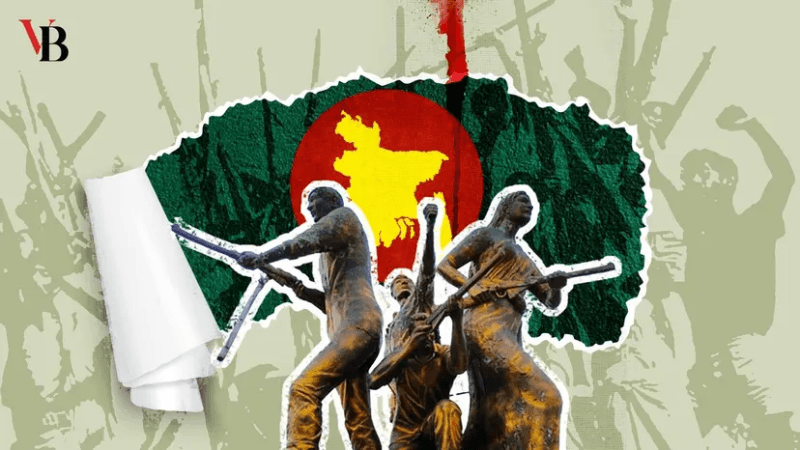
[In 2002, Liberation War researcher Afsan Chowdhury started a history project called ‘Bangladesh 1971’. As part of this work, a four-volume book called ‘Bangladesh 1971’ was published in 2007. In 2013, another project called ‘Gramer Ekattor’ started. Based on the information from that project, he published a book titled ‘Gramer Ekattor’ in 2019. Inspired by the author’s ‘Gramer Ekattor’, Views Bangladesh brings its Victory Day event ‘How was the village life during the 1971 war?’]
Village life
The period of the Liberation War was different for each person. Although the reality of 1971 was different for people of different classes and professions in the villages, most people went through the same crisis, they had to flee to survive. Because of this, the condition of society became so unstable that local influential people took this opportunity to loot and plunder. Especially after the formation of the Razakar bahini, the condition of the people was unimaginably fragile. Some fragments of that situation are presented.
Disrupted lifestyle
The terrible days of the war were spent in terrible financial and food hardship. Due to the war, the normal way of life collapsed, and the economic structure also weakened. In this situation, even going out of the house for employment was very dangerous. There was a risk of being attacked anywhere. The Pakistani invaders and Razakars kept an eye on the movements of the Mukti Bahini or their associates at all times. And the local Razakars regularly looted the goods of travelers whenever they got the opportunity. For these reasons, many people reduced their travel. There was less need for markets or roads. However, even in this time, people went from one place to another, risking their lives, for the need of bread and livelihood.
Condition of village schools
Although village schools were open in 1971, students did not go very much. The collected information shows that although some schools were open, teachers would only go to sign in to save their jobs. In that sense, children had more opportunities to play sports at that time. It was a time of mixed experience for them if their own family, village, and region were not affected. Because anxiety was a constant companion of everyone.
Religious life
The war also had an impact on people's lives and religious practices. In most cases, the imams of the mosques did not deliver sermons in favor of the war or Pakistan during the Friday prayers. However, in some cases, politically active imams did this. In many cases, the imam of the mosque was himself a victim of torture. In many cases, they had to go on with the help of the villagers.
For the Hindu population, practicing religion was a matter of direct danger. They were the identified enemies of the Pakistanis. Therefore, they had no choice but to practice religion secretly in almost all cases.
Resistance and preparation
In 1971, there was both resistance and revenge. That is, just as there was an attempt to stop the Pakistan Army and its allies, those who had suffered at their hands tried to take revenge. It is worth remembering that before 1969, the villages of Bangladesh were not so involved in national politics. The elections of 1970 changed this situation and after March 1971, a kind of political unity was created among the people.
Circumcision and marriage
Haji Abdul Kader of Kushtia said, “Marriage and Aqiqa were held during the war. However, circumcision was not done.” Riaz Uddin of Daulatpur also said the same.
From various accounts, it is understood that marriages were held during the war in 1971. However, the ceremonies were few. Many others said that marriages were not possible. In some places, forced marriages occurred. In most areas, Muslims got married, while Hindus rarely tied the knot.
Childbirth
The midwives worked most of the time in the village to deliver children. Occasionally, a doctor was available somewhere. Haji Md. Abdul Kader of Kushtia said that a Hindu woman died during childbirth in their area.
Fasting in Ramadan
Refugees and freedom fighters from different places used to stay at Joynal Abdin Chowdhury’s house. Food and drink arrangements were made at his house. His wife, Mohitonnesa, said, “We used to fast. There were two or four of us. We used to feed the last night’s food. It was cold. These people fasted in the hope of getting a reward, so we did more. We are in trouble.”
Rajab Ali Molla of Kalabariya village said, “We used to fast. We ate whatever food we could get in the midst of poverty. However, we could not do it the way Ramadan had been.”
Eid
Kushtia’s Haji Md. Abdul Kader said, “Eid prayers were held at the Eidgah, but there was no pomp. Arrangements were also made for Tarawih prayers at the mosque.”
Maulana Md. Fazlul Haque of Chandpur village of Kalia said, “Fasting in extreme poverty and winter was difficult. Even then, I am staying. I could not buy any new clothes for Eid.”
Mohitonnesa said, “Joy on Eid? It was on the day of Eid that there was a war here. The Mukti Bahini who came to India and they (Rajakar and militia) were always there.”
Diseases and treatment
In the village, there were usually fever, cold, cough, dysentery, and cholera. People were injured while fighting, injured while robbing and looting, or injured in various ways by robbers and looters. These diseases were treated by village doctors. The village doctors had medicine. Although it was very insignificant compared to the need. The drug stores in the market were opened taking advantage of the opportunity. At that time, doctors and patients would collect medicine.
Buying and selling and scarcity
Mohammad Ali Mandal of Daulatpur, Kushtia said that he sold the household utensils made of copper for ten taka a maund. Due to the high price, he used to take food without salt. Gram costs 10 taka a maund, cloth costs five to six taka while a lungi costs one taka.
Food and the starvation of people
Freedom fighter Sharif Abdul Mannan wrote that since October 1971, the general public and freedom fighters faced a food crisis. At that time, the markets were almost non-existent. In a few areas, people had to cook porridge with leaves of lotus to survive. Beef was very cheap. The Razakars would capture cows from the villages and slaughter them. After meeting the meat needs of the Razakars and militias, they would sell the rest for one taka or one taka for four annas.
Wages
Mohammad Ali Mandal of Daulatpur, Kushtia, said that wages at that time were a pita and rice. People would be happy with whatever they got for two or four annas. Bimal Das said, “People used to give food to day labourers for their work or they used to get one taka for a day.
Hats and markets
Md. Abdul Quader of Mirpur upazila of Kushtia said that a small market had just opened in Chithiliya. The market was held on Thursdays and Sundays and only vegetables were available.
Hats and markets were held in various other places in the country. However, there was very little buying and selling. Goods were not available at all. One had to walk a few kilometers to go to the market. The market would close by evening. The market was burned down in many places. Looting was also a regular occurrence.
Razakars
Mainly the poor villagers, most of whom had criminal tendencies, joined the Razakars. The motivation behind becoming Razakars was the opportunity to get a regular income and a share of the loot. Very little information is available about the political role of the Razakars. However, many were followers of influential people in the village. The relationship that allowed them to become Razakars.
Danger of youth and Hindus
The danger was greater for the youth. Because they had a high chance of becoming freedom fighters. That is, the future enemies of the Pakistanis. So many fled. They stayed at home only if they felt safe. To escape persecution, they were forced to travel for a long time to India. Many took shelter in their homes along the way, and some died of illness.
Violence against women and confrontation
From the information collected, it is understood that there were various types of violence against women. The type and extent of this violence depended on the fragility and position of the woman. Generally, women were victims of sexual violence and in almost all cases it happened at the hands of various pro-Pakistan people. Although everyone was in danger during the war, women were more in danger.
Suddenly, upon hearing the news of the army coming to the village, both men and women tried to hide wherever they could. They fled to ponds, ponds, forests, and jungles. This insecurity was a daily reality for many people in Bangladesh's villages.
Leave A Comment
You need login first to leave a comment