
What Nigerian experiment could teach Bangladesh about AI
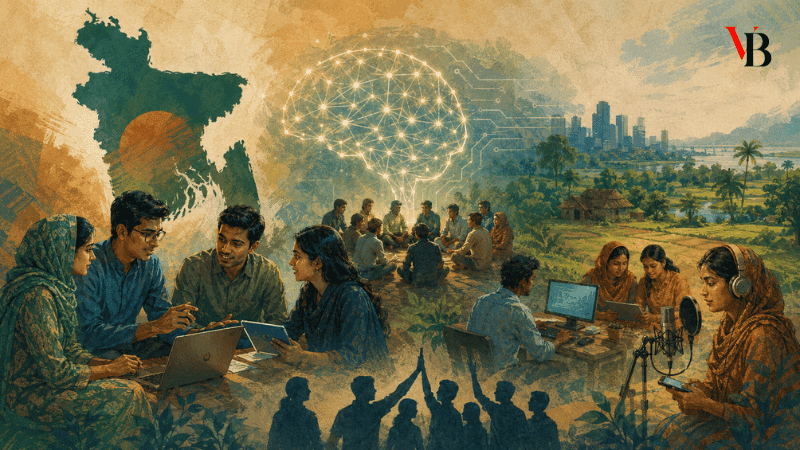

Bangladesh does not need to win the global race for computing power. It needs to rediscover its own strength: organising people so that technology creates shared prosperity.
Bangladesh's development story has never been principally a story about capital. It has been a story about social organisation. Female literacy, immunisation coverage and women's participation in the workforce were built first, and the growth figures followed. The Grameen five-member borrower group and the BRAC samity were not welfare instruments but productive ones, and they succeeded precisely because they were collective.
That pattern deserves to be remembered as Bangladesh formulates its response to artificial intelligence. Growth, in our national experience, has come through social development rather than in spite of it. Yet the instruments we now deploy for young people are almost entirely individual: a training course for one person, a soft loan to one applicant, a youth grant awarded to one recipient at a time. We have quietly set aside the very mechanism that distinguished us.
A state in south-eastern Nigeria has been rebuilding it.
The initiative is called ÓKÓBÌ, the One Kindred One Business Initiative, launched in Imo State. Its premise is straightforward: rather than backing one entrepreneur at a time, back a group. An extended family, a village or a student society comes together, selects a business, registers it and owns it collectively.
To qualify, a venture must be formally registered, group owned rather than individually held, profit oriented, professionally managed, properly governed, and demonstrably job creating.
The Imo State Office of the Chief Economic Adviser reports 461 registered businesses and 19,676 active members across all 27 local government areas as at December 2025. Since these figures are published by the programme that administers them, a degree of caution is warranted. The model itself, however, has been published by the London School of Economics and has secured a partnership with Nigeria's Bank of Industry, which offers registered groups grants of up to five million naira.
One design feature merits particular attention, because it addresses a failure mode familiar to anyone who has observed youth grant schemes in Bangladesh. The programme's own rationale notes that in individual grant schemes, beneficiaries sometimes divert or mismanage start-up funds, and that group ownership corrects this because every member holds a stake in the outcome. Funds entrusted to one person can be quietly lost by one person. Funds entrusted to five are watched by five.
Rwanda has applied the same instinct directly to technology. A firm called Digital Umuganda took Umuganda, the national tradition of communities gathering monthly to build roads and schools, and redirected it towards digital infrastructure, collecting Kinyarwanda voice data for AI systems. Within months, Mozilla reported, Kinyarwanda had become one of the fastest growing languages on its Common Voice platform.
Why the urgency? Because of where we now stand in industrial history.
The first industrial revolution arrived in the late 1700s with mechanisation through water and steam. The second followed from around 1870, bringing electricity, mass production and the assembly line. The third came in the 1960s and 70s with computers, electronics and automation. The fourth, named Industrie 4.0 by a German industrial working group in 2011, describes cyber-physical systems in which the physical and digital worlds merge, and machines, products and entire supply chains coordinate in real time.
Read those dates as a series and the conclusion presents itself. Roughly a century separated the first revolution from the second, and another century the second from the third. Barely forty years separated the third from the fourth. The interval between one general purpose technology and the next is compressing, and within the current revolution the sub-cycles are compressing further still. Generative AI moved from research curiosity to routine business tooling in under three years.
That compression is what should concern us. James Utterback's work on the dynamics of innovation describes how the period of ferment in any new technology ends once a dominant design emerges, after which the terms of competition harden and latecomers find themselves largely excluded. The shorter the cycle, the narrower the window in which a country can position itself before the design settles. Bangladesh had decades to find its place in the third revolution and used them well, building a garments sector and subsequently a freelancing sector on cost advantage. It will not have decades this time.
There is, however, a caution embedded in that same logic. Technology enables novelty; it does not by itself determine value. Procuring GPUs will not resolve this question for us. Value is determined by how a society organises itself around a technology, which returns us to the central argument.
The Bangladesh Bureau of Statistics recorded graduate unemployment at 13.5 per cent in 2025, underscoring the persistent challenge facing the country's labour market.
Against that sits an apparent success. Oxford Internet Institute research cited by The Financial Express ranks Bangladesh as the world’s second largest supplier of online labour with a 16 per cent share, behind only India, and roughly 650,000 IT freelancers.
Closer inspection reveals a less comfortable picture. Payoneer data suggests the average Bangladeshi freelancer earned between $500 and $700 a month in 2025, yet research published in April 2025 found roughly 48 per cent earning under $208, reflecting how many remain in low-skill work such as basic data entry. That is precisely the category of work artificial intelligence is automating fastest.
Meanwhile, the ICT Division set a $5 billion IT export target for 2025 and the sector recorded $724.6 million, with skills mismatch cited among the reasons.
In short, a large number of isolated young people are selling inexpensive hours into a market that is preparing to stop buying them. Isolation is as much the problem as skill.
Call it Ek Somiti, Ek Byabsha: one group, one business. Three layers, adapted from the Nigerian structure.
A facilitator, most naturally the ICT Division through the iDEA project alongside a commercial bank, provides seed grants of three to five lakh taka per registered group rather than per individual. Universities and polytechnics serve as consultants, delivering the curriculum and the mentoring, with BASIS and the freelancer associations providing the market link.
The students themselves own the venture, registered as a cooperative or partnership, with elected officers and a written profit-sharing agreement designed to survive graduation.
Imo State has already built the student version. Its ÓKÓBÌ Students Club runs a three-module curriculum culminating in a practicum in which students form groups, pitch, pilot and launch a functioning business, with ventures continuing after their founders graduate so that each cohort trains the next.
What would such groups sell? The most instructive answer comes from India. Karya, a social enterprise that originated within Microsoft Research, routes global demand for AI training data to rural workers, paying around $5 an hour, roughly twenty times the local minimum wage, together with royalties when the resulting dataset is resold.
Founder Manu Chopra’s framing was to ask, “What if we could bypass skilling?” and instead pay people for a skill they already possess: their language. Karya has reached more than 35,000 people across 24 states and keeps its platform open source precisely so that others can deploy the model elsewhere.
Bangla has some 300 million speakers and a dozen major regional dialects, almost none of them adequately represented in AI training data. A student group in Sylhet recording Sylheti is not undertaking charity work. It is building an export product from something socially held rather than individually owned. Beyond language, the openings are readily identifiable: automation services for local SMEs, Bangla tutoring agents, crop disease diagnosis by photograph, defect detection on garment production lines.
The National AI Policy 2026 to 2030 has recently completed public consultation. That is the moment to insert a delivery mechanism, because a policy without one remains a document.
Honesty about the risk is warranted. As Policy Magazine observed, the national AI strategy drafted in 2019 and 2020 contained detailed roadmaps of which almost none materialised. Infrastructure remains uneven, and the current policy draft itself acknowledges that fewer than 38 per cent of rural residents access the internet. That is an argument for beginning in university towns and district polytechnics rather than villages.
None of this requires Bangladesh to build foundation models or compete on compute. It requires us to do once more what we have historically done better than our neighbours: organise people first and let the growth follow. The difference is that the clock is running faster than it did the last three times.
Akm Boby (FCCA) is a Fellow Chartered Certified Accountant with a Postgraduate Diploma in Strategy and Innovation from the University of Oxford, the Senior Management Programme at Cambridge Judge Business School, and a BSc (Hons) in Applied Accounting from Oxford Brookes University. Finance Director, member of the ACCA Global Forum for SMEs, board member and trustee, and speaker on AI in finance.
Leave A Comment