
When lamp of journalism flickers in Dark

During May 1999, I was enrolled as a student at Jahangirnagar University, and Prothom Alo, a newspaper that had graced the newsstands merely twelve months prior, had already established itself as an integral component of our daily morning routine. At that time, I served as the university correspondent for the daily publication Sangbad. Nevertheless, each morning I would proceed to the common room of my residential hall, frequently waiting for my opportunity to peruse Prothom Alo.
One column from those days has stayed with me. On 9 May 1999, its editor, Matiur Rahman, wrote under a blunt headline: “Prime Minister, Rein in Chhatra League.”
It was difficult not to notice the courage in it.
The Bangladesh Chhatra League, the student wing of the ruling Awami League, was facing allegations of violence and other abuses. At Jahangirnagar University, the organisation was split between two rival factions, crudely nicknamed at the time the “killer group” and the “rapist group”. At Dhaka University, too, internal conflict was making student life increasingly precarious.
Matiur Rahman’s column gave words to what many of us were thinking.
Nearly a decade later, on 19 January 2009, he returned to almost exactly the same subject, again writing under the headline “Prime Minister, Rein in Chhatra League.” The Awami League was back in government.
There were other moments when his journalism cut against the grain of power. On 2 September 2005, while the BNP-led four-party alliance was in office, he published another column that became the subject of intense discussion: “Is Bangladesh Heading Towards Becoming a Failed State?”
By then I was working full-time as a journalist at Janakantha. I remember the column being discussed throughout our newsroom.
The context mattered. Foreign Policy magazine and the Washington-based Fund for Peace had begun publishing their Failed States Index, and Bangladesh had been ranked 17th. Matiur Rahman used the moment to examine the country’s political condition, sharply criticising the 21 August 2004 grenade attack on an Awami League rally and what he regarded as the farcical “Joj Mia” investigation that followed.
Then, on 11 June 2007, he published another provocative column: “The Two Leaders Must Step Aside.”
This time, both the Awami League and the BNP objected.
Bangladesh was then under the military-backed caretaker administration led by Fakhruddin Ahmed. Yet Matiur Rahman continued to write as he saw fit, apparently unwilling to let the political sensitivities of the moment determine the limits of his argument.
I recall these columns for a simple reason. They offer, to my mind, a useful measure of what independent journalism in Bangladesh once looked like.
Across different governments and different political climates, Matiur Rahman was willing to address those in power directly. Under the Awami League, he could tell the prime minister to rein in the ruling party’s student wing. Under the BNP, he could ask whether Bangladesh was becoming a failed state. Under the caretaker government, he could tell the country’s two most powerful political leaders that they should step aside.
That history makes the silence of more recent years difficult for me to ignore.
During the interim government led by Muhammad Yunus, as mob violence and political disorder spread and the boundaries of public safety seemed increasingly uncertain, I found myself expecting a column from Matiur Rahman with a headline along the lines of: “Chief Adviser, Rein in the Uninformed.”
I did not find one. Some Prothom Alo columnists did write about mob violence, although often cautiously and indirectly. But the tone was different. It lacked, to my mind, the directness with which Matiur Rahman had once confronted governments.
Then came the grotesque spectacle outside the Prothom Alo office, where a group of people slaughtered a cow as part of what they described as a “jiyafat” celebration. It was an unsettling sight. I thought it might prompt Matiur Rahman to take up his pen. It did not.
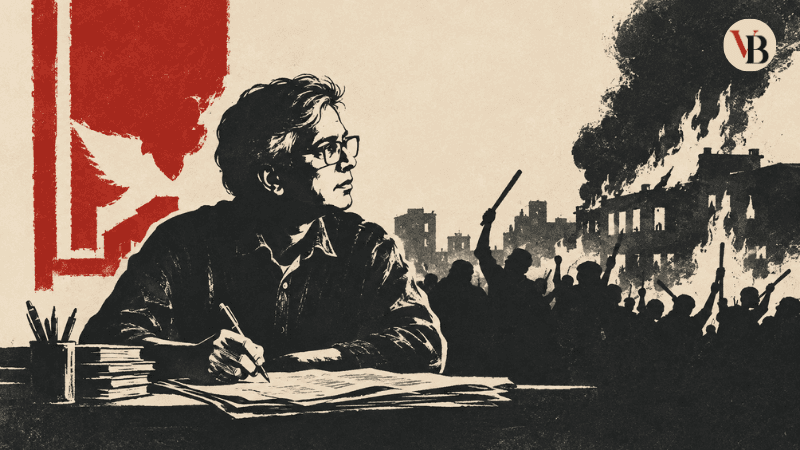
Then, on 18 December 2025, the offices of Prothom Alo and The Daily Star were attacked and set ablaze amid a wider eruption of violence and destruction. Once again, I thought of the columns of 1999 and 2005. I wondered whether the old voice would return. It did not, at least not in the form I had expected.
Matiur Rahman did condemn the violence in interviews and in a speech at a forum. But there was no sustained, sharply argued column of the kind that had once defined his public voice.
Why? Was he afraid? Fear, in itself, would hardly have been irrational.
I have lived through several of Bangladesh’s turbulent political transitions. I was old enough to witness the fall of the Ershad regime, the opposition movement against the BNP government from 1994 onwards, the unrest surrounding the aftermath of the 1 October 2001 election, the crisis that followed the BNP government’s transfer of power in 2006 and the violence surrounding the 29 December 2008 election.
But what I witnessed after 5 August 2024 felt different in scale and character.
I had never before seen newspaper offices and television stations attacked in such a manner, or witnessed such widespread vandalism, looting, occupation and arson. Nor had I seen hundreds of journalists lose their jobs almost overnight.
More disturbing still was the emergence of what came to be described as “ghost” murder cases, in which journalists could find themselves named as accused despite, in some accounts, having no connection with the alleged victims. Journalists who had simply attended press conferences, asked questions or prepared reports as part of their professional duties could suddenly find themselves facing criminal cases and imprisonment.
If those accounts are accurate, they represent a profound departure from the norms of a functioning democracy.
The arrest of journalist Anis Alamgir over remarks made on a television talk show, and the harassment of Manjurul Alam Panna – reportedly first by people acting as a mob and later through his arrest by police – are among the episodes that will remain troubling markers of this period.
The “jiyafat” spectacle outside Prothom Alo and The Daily Star, followed by attacks and arson at both offices, represented another kind of intimidation.
Matiur Rahman had surely never witnessed destruction on such a scale directed at the institutions with which he had been associated.
Perhaps, then, fear did play a part.
It is important, however, not to romanticise the past.
The Prothom Alo office was under considerable pressure during the Awami League years. Cases were filed against its editor. Sheikh Hasina and members of her cabinet repeatedly criticised him in public.
But the office itself was not attacked. Its editor did not spend a day in prison. Nor, as far as I recall, were journalists systematically forced out of their jobs simply because the government disliked their work.
When journalist Rozina Islam was arrested, professional journalists took to the streets. The then deputy education minister was declared unwelcome at Dhaka Reporters Unity. Journalists protested despite the restrictions imposed during the Covid pandemic.
The government eventually released Rozina Islam.
In October 2022, the Detective Branch submitted a final report saying that Rozina was not guilty. Yet the case remained entangled in what I regard as bureaucratic inertia.
The same bureaucracy had earlier been implicated in the brutal midnight assault on journalists in Kurigram on 13 March 2020. An official investigation reportedly identified four people – Parvin Sultana, Nazim Uddin, SM Rahatul Islam and Rintu Bikash Chakma – in connection with the incident. Yet, in my view, accountability never followed.
There is no denying that the Awami League government allowed sections of the bureaucracy, particularly within the administration cadre, to acquire enormous power. In different parts of the country, officials were accused of abusing that power, sometimes even against members or supporters of the ruling party itself.
The government’s dependence on bureaucracy, combined with efforts to engineer controlled elections, ultimately helped create a system in which administrative authority often appeared to outrun accountability. In my assessment, that contributed to the alienation of both the government and the Awami League from large sections of society.
The injustices of that period should not be minimised.
But professional journalism also requires us to recognise another reality: despite the pressure, journalists could still protest. They could still publish criticism. They could still challenge power.
That is why my own experience of the Yunus interim government felt so different.
I came to believe that Matiur Rahman’s pen had not merely become quieter. Prothom Alo itself increasingly appeared to me to be taking the side of the interim administration.
In October 2024, for the first time since I rented my first home in Dhaka in 2001, I told my newspaper vendor: “Please don’t deliver Prothom Alo anymore.”
The decision followed the interview with the then chief adviser that appeared under Matiur Rahman’s name on 7 and 8 October.
As a journalist, I had reached a point where I no longer felt I could keep at home a newspaper that, in my judgment, had begun to resemble a government mouthpiece.
For me, the changing character of Prothom Alo became one of the clearest ways of understanding the condition of press freedom during the Yunus interim government.
Yet there were exceptions.
Even in that atmosphere, some journalists and news organisations continued to demonstrate what I understand as professional journalism.
I remember watching New Age editor Nurul Kabir interview the head of the interim government. For me, it was a professional benchmark.
After the offices of Prothom Alo and The Daily Star were set on fire, Nurul Kabir went to the scene. Even after being harassed by the mob, he remained there and continued to say what he believed needed to be said.
In my assessment, two organisations stood out during this period: New Age and bdnews24.com.
Both continued to publish reporting and opinion while, despite the risks, attempting to maintain professional standards.
Then came the death of Toufique Imrose Khalidi, the editor-in-chief of bdnews24.com, on 3 October while receiving treatment in a London hospital.
His death cast a deep shadow over Bangladesh’s media community.
Khalidi was not simply an accomplished journalist. He was one of the pioneers of Bangladesh’s digital news industry, and he built an institution where there had previously been very little. Through his work, he created employment for journalists and established a distinctive model of online journalism.
His leadership earned respect far beyond his own newsroom.
He should be remembered as one of the important figures in the history of Bangladeshi journalism.
Yet even as the profession mourned him, another, less admirable side of journalism revealed itself.
There has always been envy in the profession. The less secure some people are in their own achievements, the more tempted they can become to diminish those who have achieved more.
After Khalidi’s death, some people took to social media in Bangla and English to portray him as an ally of “fascists”.
The accusation was depressingly familiar.
During the Awami League years, critics of the government were often dismissed as “Jamaat-Shibir”. After 5 August 2024, a different label became fashionable: “ally of the fascists”.
The labels changed. The instinct did not.
Those who defend the legacy of the 1971 Liberation War, advocate rationality and civility, speak for human rights, object to vulgar calls for sexual violence against women or question the sudden accumulation of wealth by some beneficiaries of the July uprising can, in my view, find themselves branded with that label.
What troubles me most is the selective memory behind it.
Some of the journalists now most eager to use such labels did not, as far as I saw, publicly protest the repression of journalists during the Awami League’s 17 years in power. They did not speak out against the Digital Security Act.
When Rozina Islam was arrested, professional journalists spent days protesting at Dhaka Reporters Unity and outside the National Press Club, despite the restrictions imposed during the pandemic. I did not see some of those who now present themselves as champions of the July uprising standing alongside them.
Nor, to my knowledge, did they make their support visible online.
Instead, many continued working for international media organisations and major newspapers and weeklies, took consultancy assignments and pursued advertising businesses. They enjoyed the opportunities available to them while, in my view, remaining largely silent.
Then the political landscape changed.
Some suddenly emerged as major beneficiaries of the new order. Some began presenting themselves as the contractors of journalism, the custodians of conscience.
This is where the damage becomes deeper than political hypocrisy.
Journalism is not a title. It is a discipline.
An editor is not made an editor merely by acquiring a designation. A journalist does not become a guardian of public conscience by appearing on television and speaking loudly.
The profession requires reporting, judgement, courage, accuracy and a willingness to stand beside others when doing so is inconvenient.
Some of those who now speak most loudly, in my assessment, have never produced an exceptional investigation, written a memorable column, built a major media institution, created meaningful employment for other journalists or demonstrated leadership in a moment of crisis.
Some became “editors” almost overnight after the political changes.
Their principal contribution, I fear, has therefore become the denigration of people whose achievements they cannot match.
That is a dangerous place for journalism to find itself.
The profession is increasingly being held hostage by voices that appear to have little regard for professional ethics, intellectual honesty or even the basic dignity of disagreement.
They appear on television in the name of journalism and contribute, instead, to the coarsening of public debate. They speak in ways that deepen hostility and division while diminishing the standing of those who have spent decades doing the difficult, often thankless work of journalism.
At the same time, some seek access to government-linked opportunities and financial advantage.
To question them can itself become risky.
Once, the culture of fear in Bangladeshi journalism was created primarily by governments.
I fear that a new culture of fear has emerged – one produced not only by those who hold formal power, but also by people who claim to speak on behalf of journalism.
There have always been sycophants in the profession. But the opportunism I have witnessed during the interim government has, in my view, reached a new level.
The consequences are not merely personal.
When people repeatedly make irrational or inflammatory statements while claiming to represent journalism, the credibility of the entire profession is diminished. When accomplished journalists are subjected to smear campaigns, the damage extends beyond the individuals being targeted.
It damages the public’s faith in journalism itself.
And that matters because journalism has always been more than a business.
There was a time when journalism in Bangladesh was understood as a profession for educated, thoughtful people. Journalists were expected to educate society, expose injustice, question authority and give voice to people who had little power of their own.
That tradition is now under strain.
The question is whether the lamp of professional journalism will finally be extinguished beneath the darkness created by the uninformed – by fear, opportunism, political loyalty and the appetite for easy labels.
Or whether the pen will once again become what it ought to be: not a weapon for settling scores, but a small, stubborn light.
Perhaps that is the real test.
And perhaps the example of editors such as Matiur Rahman remains important precisely because, in different and difficult times, he showed that journalism can still speak upwards – towards power – rather than merely sideways, towards the crowd.
The darkness is not inevitable.
But someone has to keep the lamp burning.
Rased Mehedi
Editor, Views Bangladesh
Leave A Comment