

Which direction are the upcoming election results heading?
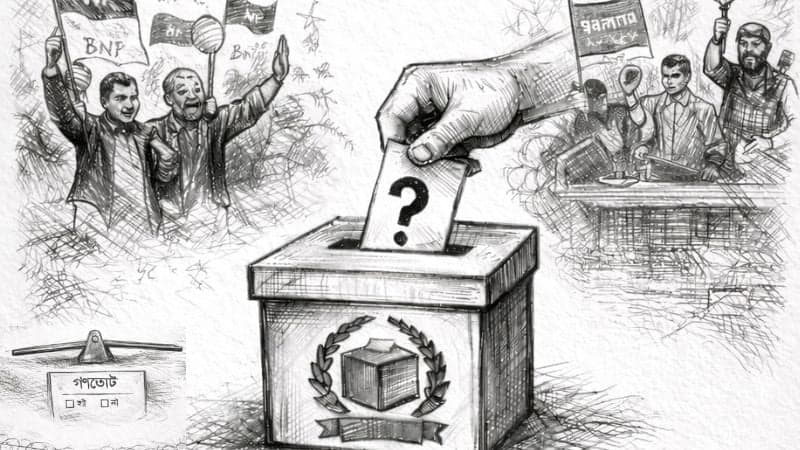
What will be the outcome of the upcoming national election? Which political party will lead the new government? Or will no party secure a majority, resulting in a coalition government? Such questions now preoccupy the public mind. The most crucial question is: Which path will the newly elected government take Bangladesh down? Given the state of Bangladesh over the past 16 years, and the political situation witnessed over the past 18 months, the new government's biggest challenge will be maintaining political and economic stability. A new question has also emerged recently: If a political party whose leadership has declared thaWhat will be the outcome of the upcoming national election? Which political party will lead the new government? Or will no party secure a majority, resulting in a coalition government? Such questions now preoccupy the public mind. The most crucial question is: Which path will the newly elected government take Bangladesh down? Given the state of Bangladesh over the past 16 years, and the political situation witnessed over the past 18 months, the new government's biggest challenge will be maintaining political and economic stability. A new question has also emerged recently: If a political party whose leadership has declared that women will never hold top positions comes to power, will women's roles in senior government posts, their participation in economic activities, and women's education be curtailed?t women will never hold top positions comes to power, will women's roles in senior government posts, their participation in economic activities, and women's education be curtailed?
Until recently, the most pressing question was whether the February 12 election would take place at all. Since political parties began official campaigning, those concerns have largely subsided. Against this backdrop, intense discussions about the election's likely outcome are taking place everywhere—from tea stalls to newsrooms. Here we examine key factors and determinants to provide a reasonable assessment of where the election results may be heading.
This national election is fundamentally different in nature. Previously, Bangladesh held elections under either a party government or a non-partisan caretaker government. This marks the first election under an interim government that, while non-partisan in character, cannot claim complete impartiality. The government came to power through the unprecedented student-led July uprising. In his first address after taking office, Chief Adviser Dr Muhammad Yunus stated that the students and citizens who led the July uprising were his "employers." While the uprising was led by students and the public, several political parties and leaders ultimately emerged at the forefront. Those political parties and prominent leaders who led the uprising essentially represent the student-public as employers. All political parties that led the July mass uprising are contesting the election; therefore, the government shows no favouritism toward any particular party. However, since several student leaders who led the July uprising are contesting this election, some governmental bias toward them as employers would not be unreasonable. For this reason, at least a marginal doubt remains about the government's complete impartiality.
Predictions of a two-party contest have emerged. A narrative suggesting massive public support for Jamaat-e-Islami has been building for nearly a year. Yet historical analysis of all national elections in independent Bangladesh's 54-year history shows that Jamaat should not even be competing with BNP. However, several factors have bolstered the narrative of dramatically increased support for Jamaat: the closeness between many student leaders who led the uprising and Jamaat, Islami Chhatra Shibir victories in various university student unions, and the recent electoral alliance with NCIP—a political party formed by student leaders who led the July uprising.
The reality, however, is that despite Awami League's absence from the election, the party retains a substantial vote bank—approximately 35-40 percent based on analysis of the 1991, 1996, 2001, and 2008 elections. BNP's vote bank is also considerably larger than Jamaat's (BNP 30-35 percent, Jamaat approximately 10 percent). Therefore, how Awami League's vote bank decides will significantly influence the February 12 election outcome. If these voters support BNP or Jatiya Party, Jamaat's results could mirror the 2001 election (17 seats). With Bangladesh Khilafat Majlish allied with Jamaat, some additional Hefazat-e-Islam votes may accrue. This could bring Jamaat's tally to around twenty seats or slightly more. However, if Jamaat captures a substantial portion of Awami League's vote bank, securing over a hundred seats would not be surprising. Awami League's vote bank effectively serves as the fulcrum determining this election's results. If these voters stay home, it could negatively impact turnout. Poor turnout could question the election's international credibility, regardless of results—a concern raised by the European Union election observation mission.
Jamaat leaders initially spoke moderately after the July uprising, which was well-received across society. Over time, however, their rhetoric became increasingly unrestrained. When Jamaat central leader Shahjahan Chowdhury publicly declared that "government administration and police personnel must act on Jamaat leaders' orders," ordinary citizens became genuinely alarmed about a potential Jamaat-led government.
Multiple videos of Jamaat candidates selling "tickets to heaven" have gone viral. BNP Chairperson Tarique Rahman responded: "Such activities by Jamaat leaders constitute shirk (idolatry) in Islamic terms. Only Almighty Allah has the power to grant paradise. When Jamaat leaders claim that power, it is unquestionably shirk." This electoral tactic is not new—Jamaat leaders have employed it since the 1986 election. This raises questions about their political judgment. Today's middle-aged and young voters possess far greater religious knowledge than in the 1980s and 1990s. Consequently, ordinary people clearly understand that selling "tickets to heaven" represents gross deception and the sin of shirk. While this may have been considered effective in the past, this electoral strategy is more likely to backfire against Jamaat this time.
Another notable development is the conduct of Islami Chhatra Shibir leaders elected to university student unions in recent months, which has alarmed the public. At nearly every university, these student leaders have harassed teachers and journalists. Had they minimum respect for freedom of expression, they would understand that differing opinions, alternative views, or criticism do not justify physical assault. Previously, when parties were in power, Chhatra Dal or Chhatra League leaders engaged in campus hooliganism. Now Chhatra Shibir leaders in student unions display similar behaviour. This alarms any conscious, aware citizen. If Jamaat leaders cannot instil this basic understanding in Chhatra Shibir leaders, what would their MPs' conduct be in each constituency if they take power? Awami League was removed due to public anger at their misrule. Now those creating similarly problematic examples—can they see themselves in the mirror?
In an Al Jazeera interview, Jamaat Amir Dr Shafiqur Rahman stated that no woman will ever hold Jamaat's top positions—this is party policy. He justified this with tired arguments about women's physical limitations. Yet in this very Bangladesh, two women have served as prime minister and leader of the opposition. In Pakistan, Benazir Bhutto gave birth while serving as prime minister in 1990 without governmental disruption. Top positions extend beyond prime minister or party chief. Government administration includes top positions at every level: UNOs at the field level, DCs at the district level, secretaries heading ministries. According to Jamaat's stated policy, if they form government, no female officials could become UNOs, DCs, or secretaries. They could not serve as director generals, directors, college principals, or office heads. One might even fear a ban on women taking the BCS examination, since government service is complex and demanding. I cannot say how much the Jamaat Amir considered before making this statement to Al Jazeera, but its impact is far-reaching and likely to significantly harm Jamaat's electoral prospects. This statement will undoubtedly diminish their international credibility as well.
Turning to BNP: the party's major internal problem is extortionists and sycophants. Like Awami League leaders, another significant problem is their failure to engage in self-criticism and tendency toward complacent self-satisfaction. Since the July uprising, Jamaat and other opposition parties have made extensive extortion allegations against BNP—allegations that are not baseless. These extortion charges are certainly troubling BNP candidates during campaigning and may negatively impact results. BNP's central leaders appear surrounded by sycophants. Several videos show sycophants forcibly mistreating journalists and ordinary workers at meetings, with central leaders bearing responsibility. If BNP's central leadership fails to address negative publicity by remaining blind to sycophants, they risk falling short of expected results.
Jatiya Party, as usual, may secure some regional seats. If they receive Awami League vote bank support, their seat count could exceed previous totals. Regarding other political parties, the electoral reality offers little worth discussing.
The referendum represents a significant component of this election. The National Consensus Commission maintains that the July Charter should be adopted based on inter-party consensus, though BNP holds some reservations. The referendum essentially concerns implementing the July Charter. Constitutional experts including Dr Shahdeen Malik have questioned whether a national referendum can precede parliamentary legislation under the constitution. Massive public expenditure is funding the "yes" campaign, generating controversy. Questions persist about how and where allocated campaign funds are being spent. Despite controversies, given the July Charter's importance, this referendum is as significant as the parliamentary election on February 12. Some will vote yes; others have the democratic right to vote no. National Consensus Commission members and political parties officially supporting "yes" may campaign accordingly. However, the government's use of public employees to campaign for "yes" votes is highly objectionable and morally questionable. The Election Commission finally clarified in a letter to returning officers that "no government official or employee may take sides in the referendum accompanying the February 12 parliamentary election. Campaigning for either 'yes' or 'no' constitutes a punishable offence." This firm Election Commission action is encouraging. We hope the February 12 election will be free and fair, with accurate results presented to the nation.
Finally, as a media professional, I must raise a crucial question about press freedom. Following the July uprising, journalists have faced mass murder charges, and several media offices have been attacked and firebombed. Multiple TV channels have been pressured to dismiss journalists without cause. Important positions including editorships at several outlets have been seized overnight. Attempts were made to burn journalists alive at Prothom Alo and Daily Star offices—unprecedented in our history. While political parties issued routine condemnations, no strong action has been taken to apprehend perpetrators. During Awami League's 17 years in power, several journalists suffered torture and harassment for expressing opinions. Unfortunately, during the interim government's 18 months, journalists have similarly faced torture, harassment through fabricated cases without specific charges, and imprisonment. Political parties took extremely weak positions against these incidents. While BNP central leaders occasionally spoke out about journalist harassment, other political parties essentially ignored such incidents.
This is the fundamental fear: governments change, but journalist persecution continues. Political manifestos will likely contain eloquent language about press freedom and opposing journalist harassment. But parties that fail to speak out against journalist harassment even while in opposition—whose student wings actively intimidate journalists and openly threaten dissenting voices on talk shows—raise serious questions about whether journalism or rational discourse will survive if they gain power. Voters therefore bear tremendous responsibility. Voter judgment will determine both the election outcome and Bangladesh's direction forward.
Rased Mehedi, Editor, Views Bangladesh
Leave A Comment
You need login first to leave a comment