
Why Cox’s Bazar resort fire spread so rapidly
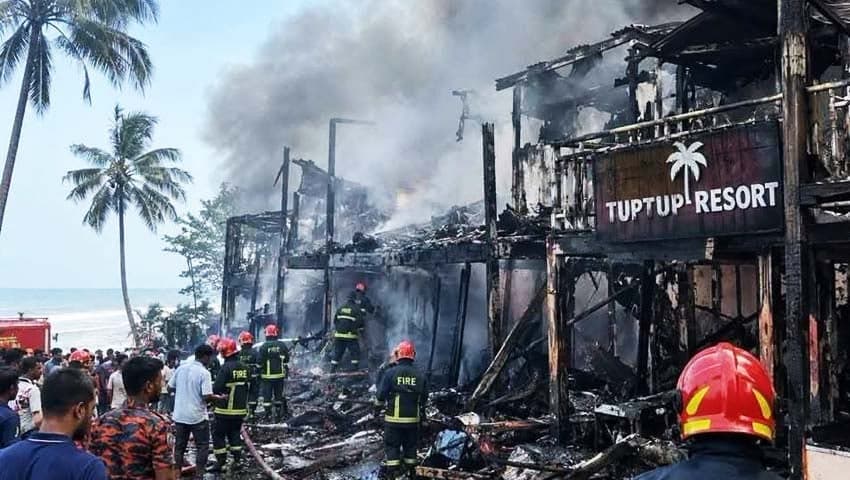

A devastating fire broke out on the morning of Saturday at the Tuptup Resto & Resort in the Patuartek area of Inani, Cox's Bazar. According to reports released so far, 10 people have died and several others have been injured in the incident.
What is the possible cause of the fire?
According to the latest news reports, two theories regarding the origin of the fire have emerged:
•Fire originating from a kitchen stove: The Deputy Commissioner of Cox's Bazar has suggested that the fire may have started from a kitchen stove.
•Electrical short circuit: A report, citing the person in charge of the resort, points to an electrical short circuit as the cause.
However, the actual source of the fire has not yet been definitively confirmed. Until the investigation is complete, neither of these possibilities can be declared the confirmed cause.
Why did the fire spread so rapidly?
According to the Fire Service, there were several critical fire safety shortcomings:
1. Wooden structures: The use of combustible wood caused the fire to spread quickly.
2. Strong sea winds: The wind accelerated the spread of the fire.
3. Lack of fire alarms and firefighting equipment: There were no provisions for detecting or extinguishing the fire in its early stages.
4. Absence of fire safety licenses and plans: The Fire Service stated that the resort was operating without the required fire safety approvals.
My Assessment as a Fire Safety Consultant
The key lesson from this incident is that it is essential to investigate not only how the fire started, but also why it spread so rapidly and why the guests were unable to escape safely.
In particular, the investigation should examine:
•Whether fire detection and alarm systems were in place.
•Whether adequate and functional firefighting equipment was available.
•Whether there were sufficient and safe exits, including emergency escape routes.
•Whether fire risks—such as those posed by combustible construction materials and kitchen operations—were properly managed.
•Whether emergency lighting, an emergency response plan, and procedures for evacuating guests were in place.
These are potential areas for investigation; the final findings regarding all specific shortcomings are not yet known.
Fire Safety Guidelines for Wooden Resorts
In the case of wooden resorts, the risk of fire can be higher than in conventional buildings; wood is highly combustible, fire can spread rapidly, and it may be difficult to detect a fire if it spreads within wooden roofs or walls. Fire Safety Guidelines for Wooden Resorts
In the case of wooden resorts, the risk of fire can be higher than in conventional buildings; wood is highly combustible, fire can spread rapidly, and it may be difficult to detect a fire if it spreads within wooden roofs or walls.
Fire safety systems required for a wooden resort
1. Fire Detection & Alarm System
• Appropriate smoke or heat detectors in every guest room, corridor, reception area, and essential service area.
• Manual Call Points (MCPs), sounders/strobes, and a fire alarm control panel.
• Audible alarms capable of waking guests who are asleep at night.
• Selection of suitable detectors for kitchens to avoid false alarms caused by smoke or steam.
• In cases involving multiple cottages, the design must specify how the alarms across all buildings will be monitored and coordinated.
2. Automatic Fire Sprinkler System
• The necessity of installing sprinklers in resort rooms, corridors, restaurants, and other high-risk areas must be determined based on the building's classification, height, size, construction method, and applicable codes.
• Given the risk of rapid fire spread in timber-based structures, an automatic sprinkler system covering the entire building serves as a robust safety measure.
• Water sources, fire pumps, control valves, flow switches, alarm valves, and an adequate water supply must be provided in accordance with the design specifications.
• For design and installation, the relevant version of the NFPA 13 standard may be followed.
3. Portable Fire Extinguishers And Hose System
• ABC Dry Chemical Powder Extinguishers are suitable for general risks.
• For electrical equipment and kitchen-related risks, use CO₂ or an appropriate alternative.
• For deep-fat fryers, use a Class K or an equivalent Wet Chemical Extinguisher.
• Depending on the size, layout, and risk profile of the resort, provide hose reels, hydrants, and access points for the fire brigade.
• Fire extinguishers must be kept in locations that are clearly visible, unobstructed, and easily accessible for immediate use.
4. Means of Egress ও Emergency Lighting
• Safe exit routes from every guest room.
• Adequate and independent exits in compliance with applicable codes; in large or multi-story buildings, one must not rely on a single staircase or door.
• Exit signs, emergency lighting, and doors that can be easily opened, even at night.
• No obstructions should be placed in front of doors, on balconies, or in corridors.
• Doors, locks, and alternative rescue provisions must be reviewed to prevent the risk of becoming trapped inside a bathroom.
5. Passive Fire Protection
• Tested fire-retardant treatments or coatings suitable for timber.
• Assessment of the fire resistance of timber beams, columns, and joints.
• Installation of fire-rated partitions, doors, and fire-stopping for service penetrations, as required.
• Maintenance of safe separation distances or appropriate fire-separation measures between cottages.
• Blocking of paths through which fire could spread—such as roof voids, spaces within timber walls, and service ducts. Important: Fire-retardant coating does not make wood completely fireproof. Specific product test results, usage and maintenance must be verified.
Other important security measures
Fire Water Supply: Adequate water, pump capacity, and necessary reserves
Electrical Safety: Proper cable sizing, MCB/MCCB, RCD/RCBO (where applicable), earthing, and overload protection
Kitchen Safety: Safe installation of stoves and gas lines, emergency shut-offs, and fire suppression systems tailored to the type of cooking
LPG Safety: Safe placement of cylinders/tanks, proper ventilation, leak control, and appropriate gas detection systems
Lightning Protection: Lightning and surge protection systems based on location, height, and risk assessment
Fire Service Access: Accessible routes for fire service vehicles, access to water sources, and pathways suitable for rescue operations
Emergency Management: Evacuation plans, designated assembly points, trained personnel, and regular fire drills
Which codes and approvals should be followed in Bangladesh?
Depending on the type and location of the project, the following aspects should be examined:
• BNBC 2020: Building usage, construction, fire safety, means of egress, and applicable fire protection provisions.
• Fire Prevention and Extinguishing Rules, 2014: Applicable legal requirements.
• NFPA 13: Design and installation of automatic sprinkler systems.
• NFPA 72: Applicable provisions for fire alarm and signaling systems.
• NFPA 101: Evaluation of life safety, occupancy, and means of egress.
The checklist to be used before approving the resort design
➢ Building occupancy and fire risk assessment completed
➢ Approved architectural and fire safety drawings prepared
➢ Verification of required exits and evacuation routes
➢ Verification of fire alarm and sprinkler system designs
➢ Verification of fire water tank and pump calculations
➢ Verification of fire-retardant treatment for timber
➢ Fire risk assessment for electrical, LPG, and kitchen facilities completed
➢ Fire service access and emergency assembly points ensured
➢ Installation testing, commissioning, and acceptance tests completed
➢ Fire safety training, evacuation drills, and maintenance plans prepared
AS PER NFPA STANDARD
Under the NFPA 101 Life Safety Code, wooden resorts are generally classified under Hotels and Dormitories (transient occupancies with more than 16 persons) or Lodging and Rooming Houses (16 or fewer persons), depending on size. Because wood is a Class A combustible material, strict fire safety controls apply to construction, active protection, egress, and interior finishes
Construction and Wood Treatment
• Type of Construction: NFPA 101 links allowable building height and area to the type of construction defined in NFPA 220. Heavy timber or unprotected/protected wood-frame structures must respect strict square footage and height caps.
• Fire-Retardant Treatments: Structural timber, exposed wood framing, or decorative woodwork often require treatment or coatings conforming to NFPA 703 (Standard for Fire-Retardant-Treated Wood and Fire-Retardant Coatings).
• Interior Finishes: Wall and ceiling finishes must meet strict flame spread index (FSI) and smoke developed index ratings (typically Class A or Class B interior wall and ceiling finishes in corridors and exit ways) to prevent rapid surface fire propagation
Automatic Fire Sprinkler Systems
• Mandatory Sprinklers: New hotels, dormitories, and transient lodging facilities of almost any size or height constructed with combustible (wood) frames generally require a complete automatic fire sprinkler system designed and installed per NFPA 13, NFPA 13R, or NFPA 13D.
• Water Supply & Supervision: Sprinkler control valves must be electrically supervised or locked open to ensure water flow integrity
Fire Alarm and Detection Systems
• Guest Rooms / Sleeping Units: Individual sleeping units require interconnected local smoke alarms or smoke detectors.
• General Building Alarms: Activation of corridor smoke detectors, water-flow sprinkler alarms, or manual pull stations must trigger a building-wide audible and visual notification signal to initiate immediate evacuation.
• Carbon Monoxide (CO) Detection: Required near fuel-burning appliances, central heating plants, or attached garages per recent NFPA 101 editions
Means of Egress (Escape Routes)
• Number of Exits: Every sleeping room and floor level must have access to at least two independent and remote means of egress.
• Travel Distance: Maximum travel distance to an exit is strictly limited—typically capped around 150 feet in unsprinklered sections or extended up to 200–250 feet if the entire resort is protected by an approved sprinkler system.
• Dead-End Corridors: Minimized or restricted to strict maximum lengths (e.g., 20 to 50 feet depending on sprinkler status) to prevent occupants from becoming trapped in blind hallways.
• Exit Doors & Lighting: Doors must swing in the direction of egress, feature panic hardware where applicable, and maintain emergency lighting and illuminated exit signs powered by backup systems
Operational Safety and Maintenance
• Emergency Plans & Drills: Staff must be trained in emergency action plans, periodic fire drills, and guest notification protocols.
• Portable Fire Extinguishers: Placed throughout corridors, kitchens, and common areas in accordance with NFPA standards.
• Inspection & Testing: Fire alarms, emergency lighting, and sprinkler systems require scheduled routine inspections, tests, and maintenance log
Below is more specific information regarding fire safety for wooden resorts:
NEW VS. EXISTING BUILDINGS
According to the NFPA 101 code, regulations differ slightly between newly constructed resorts and those already in operation:
•New Buildings: For any newly constructed wooden resort, the installation of a complete Automatic Sprinkler System (NFPA 13) and a modern addressable fire alarm system is mandatory.
•Existing Buildings: In the case of older or pre-existing structures, if certain requirements cannot be met due to the building's design or layout, alternative life-safety measures (such as additional fire exits or early-warning smoke detection systems) may be implemented, subject to approval by the fire authority.
Placement of Fire Extinguishers
•General Areas: At least one handheld fire extinguisher (typically an ABC dry chemical type) must be provided within every 75 feet in corridors and lobbies.
•High-Risk Areas: In areas such as commercial kitchens, laundry rooms, or boiler rooms, appropriate fire extinguishers (e.g., Class K for kitchens) must be placed either inside or immediately outside the space.
Emergency Lighting & Signage
•Backup Power: A backup battery or generator system must be in place to ensure that fire exit signs and emergency corridor lighting remain operational for at least 90 minutes in the event of a power failure.
•Directional Signage: It is essential to ensure that fire exit signs are clearly visible from any turn or point within a corridor.
Providing more detailed information about your specific wooden resort would allow for more precise guidance.
For wooden resorts or cottages, fire safety measures must be implemented with greater rigor—in accordance with NFPA (National Fire Protection Association) and IBC (International Building Code) standards—due to the highly combustible nature of wood.
According to the International Building Code (IBC)
➢ Occupancy Classification: Resorts or cottages are generally classified as R-1 (Residential, transient).
➢ Automatic Sprinklers: Sprinklers are mandatory for R-1 buildings constructed of wood.
➢ Fire Alarm System: Includes smoke detectors, manual pull stations, and notification appliances.
➢ Fire Resistance Rating: Wooden structures must be fire-rated for a specified duration (typically 1 hour or more).
➢ Exit Requirements: Multiple exits on each floor, clear signage, and emergency lighting.
➢ Carbon Monoxide Detection: In accordance with the IBC, CO detectors must be installed in guest rooms and common areas.
There are three main criteria used in designing a timber structure or fire safety plan:
1. IBC (International Building Code),
2. NFPA (National Fire Protection Association) and
3. Eurocode 5 (European Standard).
It is important to consider the following points for proper planning and security:
• Height and number of storeys: How many storeys will the building be and what is its total height? (According to the code, the stringency of the fire rating increases as the height of the building increases).
• Type of wood: Are you using Mass Timber/CLT or Light-frame?
Responsibilities and Duties of the Fire Service
I believe the Bangladesh Fire Service should identify high-risk buildings and take appropriate measures. The Bangladesh Fire Service and Civil Defence cannot simply sit back after identifying problems; they must ensure proper legal enforcement. Buildings that are at risk should be identified, and necessary measures must be taken to prevent major accidents—such as the one that occurred at the 'Tup Tup' resort in Cox's Bazar.
Responsibilities and Duties of a Building Owner
Owners of all types of buildings—whether resorts, hotels, residential structures, commercial establishments, or industrial facilities—must remain vigilant and responsible within their respective domains. It is essential to adhere to the aforementioned guidelines and all relevant regulations concerning the construction and maintenance of buildings; doing so will ensure the safety of our lives and property.
ENGR. M.A. RASHID TIPU, CFPS
NFPA, CFPS- 4773
Certified Fire Protection Specialist
Fire And Life Safety International Consultant
Leave A Comment