

Why shortage hits country hard as petrol, octane produced locally
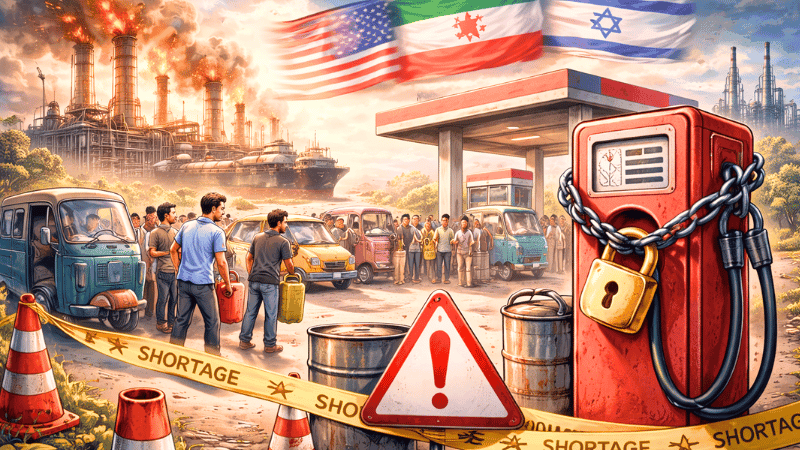

The demand for fuel oil in Bangladesh is constantly increasing, and behind this increase in demand is the impact of industrialization, rapid expansion of the transport sector, and urbanization. Despite the country's capacity to produce petrol and octane, most pumps are experiencing a severe crisis. Such a turbulent situation of petrol and octane is a matter of surprise to many. However, in reality, this crisis is not only the result of internal problems, but is also deeply related to global politics, especially the ongoing war between Iran and the United States and Israel.
The main center for fuel oil refining in Bangladesh is Eastern Refinery Limited, which produces petrol, octane, and various fuels from crude oil. However, this production is much less than the country's total demand, resulting in dependence on imports. This import-dependent structure has made Bangladesh a part of the instability of the international market.
The process of producing petrol and octane is mainly related to the refining of crude oil. In refineries, crude oil is heated at high temperatures and separated into different layers, which is called fractional distillation. Petrol is produced from the lighter fraction and octane is produced as a high-quality fuel. But this production is completely dependent on raw materials, imported oil. This is where the impact of global conflict comes directly.
A large part of the world's oil supply comes from the Middle East, where Iran is a major producer. Iran's ongoing conflict with the United States and Israel has destabilized the region. As tensions rise, Iran's oil exports are disrupted, reducing supply in the international market and increasing prices. At the same time, this instability also affects gas supplies, because Bangladesh is dependent on important centers like Ras Laffan Industrial City in Qatar for LNG imports. If the overall security risks in the Middle East increase, there is a risk of disruption to this LNG supply, which further increases the pressure on the energy sector. Since Bangladesh is dependent on imports for both oil and gas, this price increase and supply uncertainty directly puts pressure on the country's economy and creates instability in the market.
Another major impact of this conflict is on the Strait of Hormuz, which is one of the world's most important oil transportation routes. A significant amount of the world's oil is transported through this route. The global supply chain has already been severely damaged due to the disruption of this route during the Iran war. As a result, oil prices have suddenly increased, as well as supply shortages. Which has also affected Bangladesh.
Its impact is not only on oil, but also on the gas market. Bangladesh is largely dependent on LNG imports, and a large part of this supply comes from Qatar, especially from important centers like Ras Laffan Industrial City. The recent attacks in this area have created additional concerns for Bangladesh. The disruption of LNG supply has also created problems in power generation. The use of oil as an alternative to solve this problem has increased. As a result, the pressure on petrol and octane has increased further.
The internal weakness of the fuel supply system in Bangladesh has also exacerbated this global impact. As the country has limited storage capacity, it is not possible to store fuel for a long time. As a result, even a slight instability in the international market has quickly affected the domestic market. Moreover, the pipeline and transport infrastructure are not fully developed, which is causing disruptions in supply, which has exacerbated the crisis.
International shipping costs and insurance costs have also increased due to the war situation. Therefore, the cost of importing oil has increased, which has put pressure on both the government and consumers. At the same time, due to uncertainty in the market, many traders are creating artificial crises by creating excessive storage and disruptions in supply.
On the other hand, there is also a problem on the demand side. Currently, as the heat has started and the Boro season is underway, and the pressure on the transport sector during Eid increases, the demand for fuel has suddenly increased. At the same time, the international oil market is unstable and there are problems with imports, which has made the crisis more acute.
All in all, it can be seen that although the country has petrol and octane production, it is not enough to meet the demand. Added to this are global political tensions such as the Iran-US-Israel conflict, which are making oil and gas supplies uncertain. As a result, Bangladesh's energy crisis is not just a result of internal constraints but is part of a complex global reality. To address this situation, multifaceted initiatives are needed - increasing production, diversifying import sources, increasing storage capacity, and ensuring the use of alternative fuels. The government must take full responsibility for this. In this case, only if the government takes the right steps now will it pave the way for a way out of the long-term crisis of petrol-octane.
Leave A Comment
You need login first to leave a comment