
Why Sir Mark Tully relevant to Bangladesh
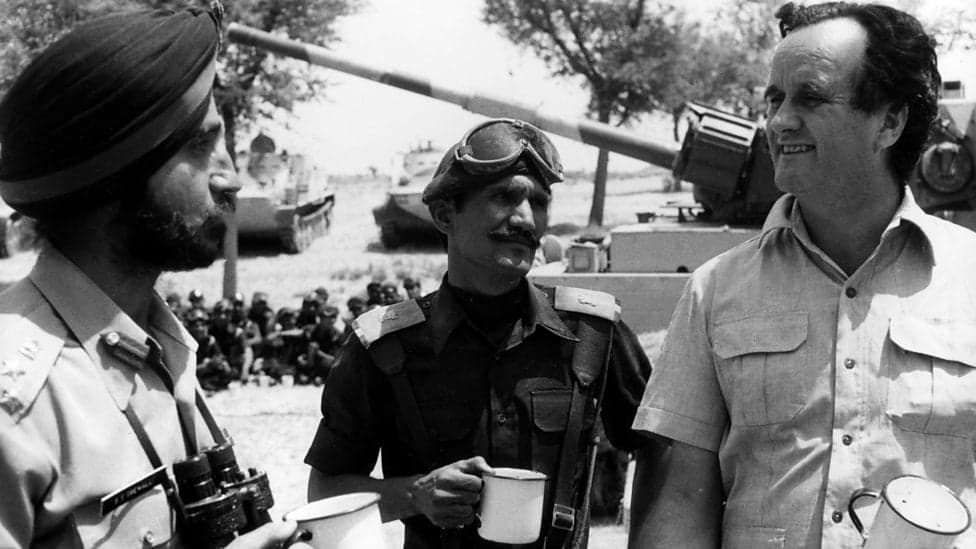

Sir Mark Tully, the BBC journalist known as the "Voice of India," has passed away. He was one of the few Western reporters who, during the 1971 Liberation War, exposed Pakistan’s atrocities in Bangladesh to the world. He brought the truth before the global audience against Western hypocrisy and Pakistan’s lies.
To cover the war, he came to then East Pakistan in the last week of April 1971. On that one and only occasion, the Pakistani government permitted just two journalists to enter the territory. When it became difficult to report the true events of the independence struggle under the strict control of the Pakistani military in 1971, Mark Tully became a familiar name to the Bangladeshi people by regularly broadcasting news and analysis of the liberation war on the BBC.
For many Bangladeshis, the BBC meant Mark Tully. Those who had radios at home would listen intently morning and evening, waiting for his voice on the BBC.The excitement in his voice spread to the young freedom fighters as well. He played an unparalleled role in building international public opinion in favor of Bangladesh.
Mark Tully said that on that 1971 trip he travelled by road from Dhaka to Rajshahi. Recalling the journey, he said, “When the Pakistani army reached the border areas and thought they had the situation under control, they allowed us to go. With me was Clare Hollingworth, the war correspondent for the British Telegraph.” He told the BBC, “Because we were able to move around independently and see the situation for ourselves, our reporting carried special weight. We understood that there had been widespread massacres. On the road from Dhaka to Rajshahi I saw village after village burned on both sides of the road.”
For his role in helping Bangladesh achieve independence through coverage of the liberation war, Tully was awarded the “Muktijuddho Maitri Sammanona” by Bangladesh in 2012.
Tully was born in Kolkata. His father was a British businessman at a leading British-owned partner company under the control of the British Raj. During the first decade of his childhood he lived in India. Later he studied at schools in England, attending Taunton School, Marlborough College and Trinity Hall, where he studied theology. He then considered becoming a priest in the Church of England at Cambridge, but after two terms at Lincoln Theological College he abandoned that idea and decided to pursue journalism.
He joined the BBC in 1964 and returned to India in 1965 as a correspondent. During his time in South Asia he witnessed many major events. He regularly reported on subjects ranging from the India-Pakistan war and Bangladesh’s war of independence to the Bhopal gas disaster, Operation Blue Star and its aftermath including the assassination of Indira Gandhi, the anti-Sikh riots, and the assassination of Rajiv Gandhi.
Mark Tully resigned from the BBC in 1994. Arguments with colleague John Burt (later Director-General) were the main reason. "He accused Burt of" "running the media in fear" "and" "undermining the BBC and undermining colleagues morally." Since then, he started freelance journalism and worked as a presenter.
Mark Tully was awarded the OBE in 1985. He was awarded the Padma Shri in 1992. He was knighted in the 2002 New Year Honours. He was awarded the Padma Bhushan in 2005.
He published his first book 'Amritsar: Mrs. Gandhi's Last Battle' in 1985. He co-authored the book with his colleague and BBC Delhi correspondent Satish Jacob. The book details the events of Operation Bluestar at the Golden Temple in Amritsar, the suppression of Sikh insurgents by the Indian Army, etc. Also, in 1992, one of Tully's best books, 'No Full Stops in India', was published.
Leave A Comment
You need login first to leave a comment