
Why Teesta master plan crucial for Bangladesh's interest
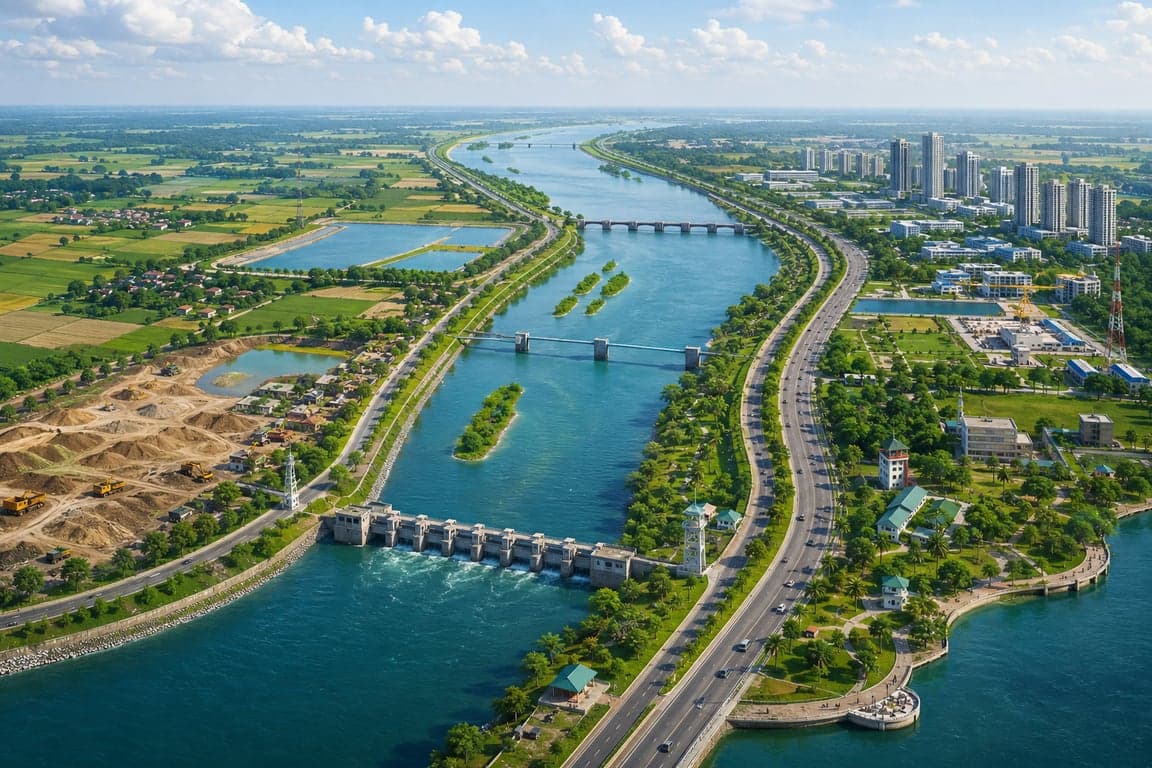

The lives and livelihoods of millions of people in the northern region of Bangladesh are closely intertwined with the fate of the Teesta River. After decades of suffering caused by India's upstream water diversion through the Gazoldoba Barrage, Bangladesh's long-awaited Teesta Master Plan is finally moving toward implementation, aiming to restore the river and transform the country's northern region.
The Origin of the Teesta Crisis
The Teesta River originates in the Indian state of Sikkim. Stretching approximately 405 kilometers, around 290 kilometers of the river flow through Sikkim and West Bengal in India, while the remaining 115 kilometers run through Bangladesh. The river enters Bangladesh via Lalmonirhat district, flows through Rangpur, Kurigram, and Gaibandha, and eventually joins the Jamuna River at Fulchhari in Gaibandha.
Historically, Sikkim was a British protectorate rather than a directly administered province during colonial rule. Following the partition of the Indian subcontinent in 1947, Sikkim effectively remained an independent kingdom until India formally incorporated it as its 22nd state on May 16, 1975. As long as Sikkim remained outside the Indian Union, there was no major dispute over the Teesta's water.
The situation changed dramatically in 1998 when India commissioned the Gazoldoba Barrage upstream and began diverting substantial volumes of water. Since then, downstream Bangladesh has faced severe consequences. Northern districts have experienced acute water shortages during the dry season, while devastating riverbank erosion and flash floods have become common during the monsoon. These changes have severely disrupted agriculture, damaged ecosystems, destroyed settlements, and pushed many river-dependent communities deeper into poverty.
Of the 115 kilometers of the Teesta flowing through Bangladesh, approximately 45 kilometers are highly vulnerable to erosion, with nearly 20 kilometers considered critically affected. Areas such as Rajarhat, Ulipur, and Chilmari in Kurigram district suffer extensive riverbank erosion every year. Similar problems also affect Lalmonirhat, Nilphamari, Rangpur, and Gaibandha.
For decades, no permanent and effective solution could be implemented to address these recurring disasters. As a result, people across the Teesta basin have consistently demanded the implementation of the Teesta Master Plan to restore the river, prevent erosion and flooding, and ensure sufficient irrigation water during the dry season.
What Does the Teesta Master Plan Include?
Officially known as the Comprehensive Management and Restoration of the Teesta River Project, the master plan proposes a comprehensive transformation of the river and its surrounding areas.
The project includes dredging approximately 102 kilometers of the river to increase its depth by nearly 10 meters. This would enable the river to store excess monsoon water while reducing flood risks by confining the river to a stable main channel.
To address dry-season water shortages, large reservoirs will be constructed to preserve surplus monsoon water for irrigation during winter months.
The project also aims to reclaim around 171 square kilometers of land currently occupied by sandbars and degraded riverbeds. These reclaimed lands would be converted into productive agricultural fields and developed into planned satellite towns, industrial zones, and economic hubs.
Additionally, 203 kilometers of guide embankments will be built along both sides of the river to permanently prevent riverbank erosion. Scenic marine-drive style roads are planned atop these embankments, accompanied by satellite cities, river ports, tourism centers, hotels, motels, and restaurants.
To ensure security and public safety throughout the region, new police stations, Coast Guard facilities, and military camps are also proposed.
Above all, the project seeks to fully restore the Teesta River, permanently reduce riverbank erosion, minimize flood risks, revive natural water flow, alleviate water scarcity, and improve the navigability of the river and its tributaries.
From Years of Stagnation to Renewed Momentum
The history of the Teesta Master Plan illustrates how political considerations repeatedly delayed its implementation.
Initial feasibility studies began in 2016. Both China and India later expressed strong interest in financing and implementing the project. India, in particular, sought to secure the project for strategic reasons.
During a visit to Bangladesh in May 2024, India's then Foreign Secretary Vinay Kwatra reiterated New Delhi's interest in investing in the project. The then Awami League government also favored Indian financing, largely due to geopolitical considerations.
Following her visit to China, former Prime Minister Sheikh Hasina stated at a press conference on July 14, 2024, that although China was ready to undertake the project, she preferred India to implement it and provide the necessary support.
However, only three weeks later, the Awami League government was overthrown following a mass uprising.
The subsequent interim government led by Professor Muhammad Yunus revived the stalled initiative following his visit to China in March 2025. Bangladesh formally requested approximately US$543 million in Chinese loans to finance the project's first phase and initiated discussions on a bilateral financing agreement.
On July 5, 2025, Planning Adviser Wahiduddin Mahmud informed the media that the interim government was highly interested in implementing the project with Chinese financing and that China also intended to make a significant investment. According to him, work on the final design was progressing rapidly, after which the project proposal and financial agreement would proceed simultaneously.
According to various media reports, the first phase is expected to begin in 2026 and conclude by 2029. Bangladesh's Ministry of Water Resources has confirmed that the detailed feasibility study has been completed by China's state-owned Power Construction Corporation of China (PowerChina), one of the world's leading infrastructure developers.
A major breakthrough came during Bangladeshi Prime Minister Tarique Rahman's historic visit to China from June 22 to 26, 2026. During the visit, he held separate bilateral meetings with Chinese Premier Li Qiang and President Xi Jinping, along with an additional private meeting with President Xi. Implementation of the Teesta Master Plan featured prominently in these discussions.
On June 25, Bangladesh and China signed thirteen Memoranda of Understanding (MoUs), one of the most significant being cooperation on integrated river and water resources management. Under this agreement, China formally committed to providing technical support for the implementation of the Comprehensive Management and Restoration of the Teesta River Project.
Furthermore, the joint 16-point declaration issued by both governments reaffirmed China's commitment to providing financial and technical assistance to Bangladesh to the fullest extent possible. High-level experts from both countries also agreed to expedite the joint feasibility assessment and finalize the project's design.
According to Bangladesh's Ministry of Water Resources, field-level implementation is scheduled to commence during the 2026–27 fiscal year, marking the project's transition from planning to actual execution.
The Indian Dimension
As the project advances with Chinese support, sections of the Indian media have portrayed it through a geopolitical and security lens rather than as an economic and infrastructure initiative.
It is worth recalling that India extended a US$4.5 billion line of credit in 2017 to finance 17 development projects in Bangladesh. Yet, even after eight years, many of those projects remain unfinished, with several never progressing beyond the planning stage.
Bangladesh and India share 54 transboundary rivers, but only the Ganges Water Sharing Treaty has been concluded. Despite years of negotiations, no agreement has been reached on the Teesta River.
A Teesta water-sharing agreement was expected during Indian Prime Minister Manmohan Singh's visit to Bangladesh in 2011, but it collapsed after objections from West Bengal Chief Minister Mamata Banerjee. The issue remained unresolved throughout Prime Minister Narendra Modi's tenure despite repeated discussions in bilateral meetings.
Given this reality, Bangladesh increasingly views domestic water conservation through the Teesta Master Plan as the most practical and sustainable solution. Considering China's technical expertise in large-scale river engineering, implementing the project with Chinese cooperation appears to be a realistic option.
Can the Project Succeed Without India's Water?
A common question raised by critics is whether the project will remain effective if India completely halts upstream water releases after its completion. Some argue that Bangladesh should instead prioritize negotiating a bilateral water-sharing agreement with India. A closer examination, however, suggests that this concern is largely misplaced.
Bangladesh has never secured a formal Teesta water-sharing agreement with India, and there is currently little indication that such an agreement will materialize in the foreseeable future. In practice, India already provides very limited water during the dry season. The real opportunity lies elsewhere.
Bangladesh receives abundant rainfall during the monsoon, while India routinely releases large volumes of excess water downstream when opening the gates of its upstream barrages. By constructing reservoirs under the Teesta Master Plan, Bangladesh can capture and store this surplus monsoon water for use during the dry season.
Such storage would provide irrigation for agriculture, maintain environmental flows in the river, and significantly reduce the impacts of seasonal water scarcity, regardless of whether additional upstream water is released by India.
[Author: Zubayer Hasan is a Political Analyst]
Leave A Comment