
Tonight’s European storm
Will Spanish armada, Portuguese artistry, or Croat experience prevail
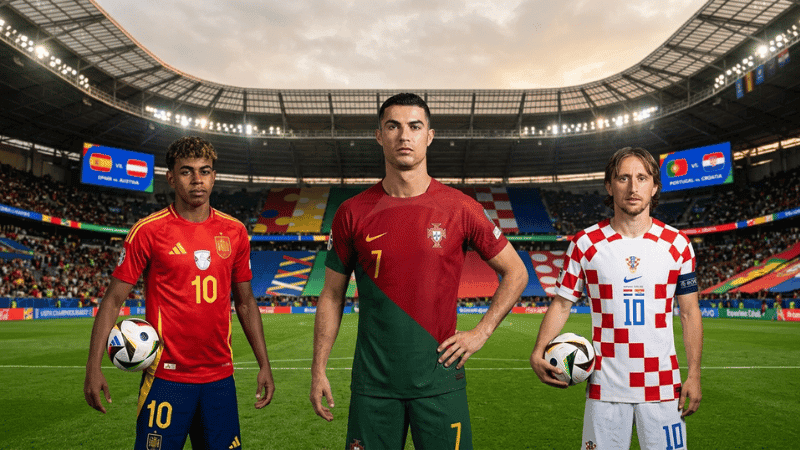

In the knockout stages of the World Cup, statistics can provide confidence, but never guarantees. History has shown time and again that the team looking superior on paper does not always emerge victorious. A single misplaced pass, a corner kick, a sudden counter-attack, or a moment of individual brilliance from a player can completely rewrite the narrative of the entire tournament. On this very stage of uncertainty, four European powerhouses—Spain, Austria, Portugal, and Croatia—will battle for a ticket to the quarter-finals on Thursday (July 2).
Spain and Austria will face off at the AT&T Stadium in Dallas. In terms of statistics, Spain is significantly ahead at 10pm. According to the forecasts of football analysts' models and supercomputers, Spain has a 69.1% chance of winning in regulation time, compared to Austria's 12.3%, with an 18.6% probability of a draw.
The head-to-head international history between the two teams also favors Spain. In their 11 meetings, Spain has won 5, Austria has won 3, and the remaining 3 ended in draws. However, Austria still looks back proudly at one chapter of history—their 2-1 victory over Spain in the 1978 World Cup. On the other hand, Spain holds the memory of a devastating 9-0 win during the Euro qualifiers. Thus, the relationship between these two teams is not just about numbers, but also about revenge and self-proof.
This Spanish team's biggest identity is their dominance over the ball. Possessing the ball for over 65% of the time across three matches in the group stage, they barely allowed their opponents to play. In the midfield, Rodri, Pedri, Mikel Merino, Martin Zubimendi, and Gavi act as the conductors of rhythm. Their short passes break down the opponent's pressing. On the two wings, Lamine Yamal and Nico Williams are repeatedly putting the opponent's defense in trouble with their pace, dribbling, and one-on-one situations. Ball possession, positional switching, and patiently building up attacks are Spain's greatest weapons.
Austria's plan is exactly the opposite. They know that keeping the ball for a long time will be difficult. Therefore, their objective will be to maintain defensive discipline and wait for Spain to make mistakes. Captain Marcel Sabitzer is the main reliance for recovering the ball in midfield and building quick counter-attacks. Konrad Laimer plays a crucial role in closing down the opponent's passing lanes and in transitions. Where Spain is the artist, Austria is the symbol of labor and discipline.
In the other match of the day at the Toronto Stadium, the battle between Portugal and Croatia is tactically even more subtle. Although Portugal is slightly ahead in recent head-to-head encounters, most of the matches were decided by a one-goal margin or ended in a draw. Consequently, past history also suggests that a small mistake in this battle could demand a heavy price.
The focal point of Portugal's attack is Bruno Fernandes. His visionary passes, line-breaking through balls, and long-range shots can put the opponent's defense in trouble in an instant. On the wing, Rafael Leão's pace and dribbling are capable of changing the course of the match. In the midfield, Portugal usually maintains 55% to 60% of ball possession, aiming to pin the opponent down in their own half.
On the other hand, Croatia's strength lies in their experience. Luka Modrić remains one of the best midfielders in the world at controlling the tempo of the game. Alongside him, Mateo Kovačić relieves pressure through short passes and lays the foundation for attacks. Croatia might lag slightly behind in ball possession, but their mental resilience to shift the match's rhythm and their tactical discipline are their greatest assets.
Analysis indicates that Spain is the clear favorite. Portugal is also ahead on paper. However, in the World Cup knockouts, the favorite tag is never a guarantee of victory. This is where the biggest upsets, the most talked-about comebacks, and the most unbelievable stories in football history have been born.
Tonight is therefore not just about two matches; it is a clash of four different football philosophies. On one side is the artistry of Spanish possession, on the other is Austria's resistance; on one side is Portugal's creative attack, on the other is the silent power of Croatia's experience. When the final whistle blows, two teams will exit, and two teams will move forward. But whatever the outcome, tonight is ready to write another memorable chapter in the history of the World Cup.
Leave A Comment