
Yamal-Rodri vs De Bruyne-Lukaku: The clash of two European superpowers
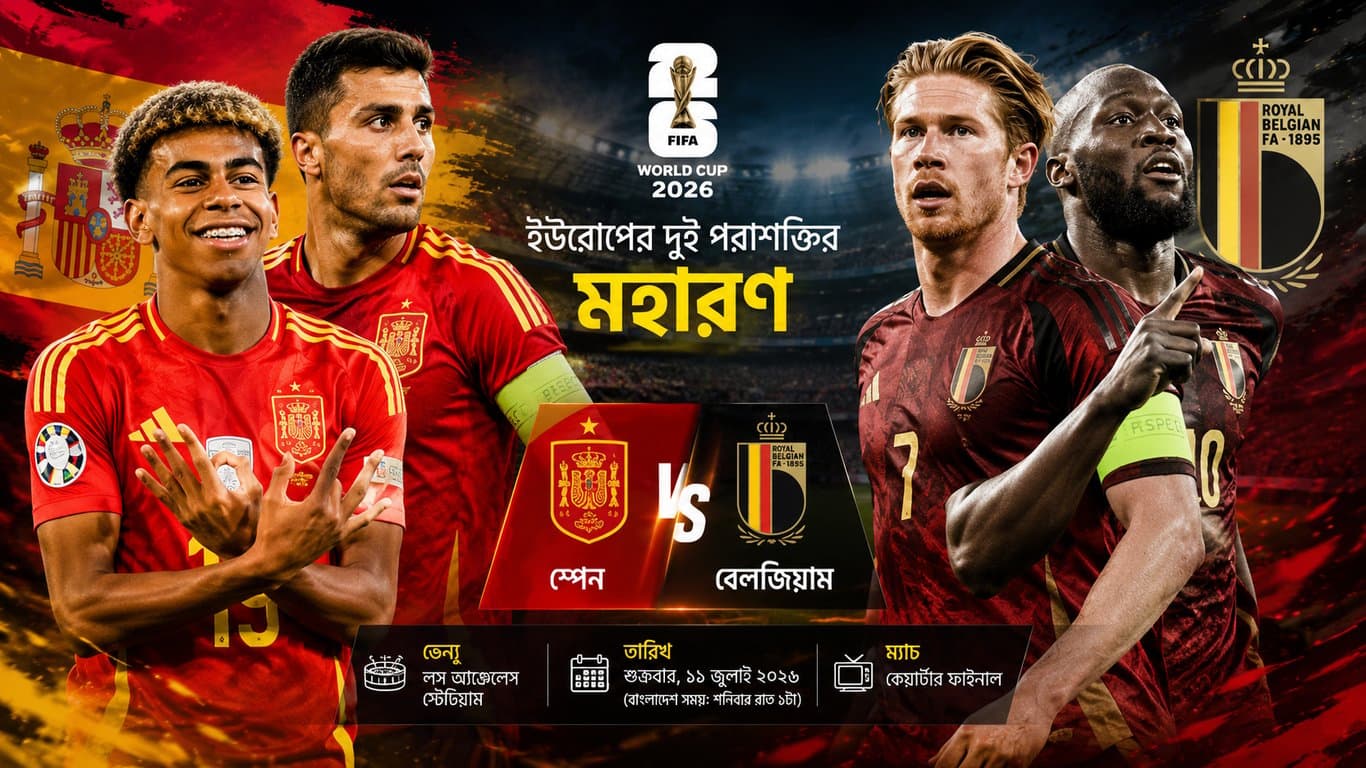

Today, Spain and Belgium, the two European superpowers, are facing each other in one of the most exciting quarter-finals of the 2026 World Cup. On one hand, the most organized and impenetrable defense of the tournament, on the other hand, a devastating attack that is gradually getting back into rhythm. The match will start at 12 noon local time on Friday at the Los Angeles Stadium, 1 am Bangladesh time on Saturday.
Belgium is returning to form
Belgium's World Cup journey under Rudi Garcia did not start very smoothly. Despite topping Group 'G', their performance was not consistent. However, the face of the Red Devils has completely changed in the knockout stage.
After defeating Senegal 3-2 in extra time in the last 32 match, they are at the peak of confidence after beating co-hosts USA 4-1 in the last 16.
Charles de Ketteler scored twice against the United States. Later, Hans Vannaken and substitute Romelu Lukaku added two more goals. Interestingly, Lukaku's three goals in this World Cup have come from the bench. Only Cameroon legend Roger Milla has scored more goals in a single tournament as a substitute in World Cup history—four in 1990.
Not only the results, but the statistics also show that Belgium is in great shape in attack. Their shot-to-goal rate in this World Cup is 12.1 percent, which is Belgium's second highest since 1966. They are taking an average of 21.4 shots per match with a total of 107 shots in five matches, which is one of their best offensive performances in World Cup history. In other words, Garcia's team is now much more effective in both creating and taking advantage of opportunities.
Spain's impenetrable wall ahead
The biggest test for Belgium, however, awaits the Spanish defense. Luis de la Fuente's team has not conceded a single goal in this World Cup so far. They kept a clean sheet for the sixth consecutive match, beating Portugal 1-0 in the last 16, a new record in World Cup history.
The numbers are even more astonishing: Spain have not conceded a goal in 10 hours and 9 minutes at the World Cup. Their expected goals per match average in this tournament is just 0.30, one of the best defensive records of any team in the final stages of the World Cup. That is, Spain has not only not conceded a goal, but also has not allowed its opponents to create any big chances.
The new Spain under Yamal-Rodri
One of Spain's mainstays in attack is the young Lamine Yamal. At just 19 years old, he has already completed 17 successful dribbles in this World Cup. Only Kylian Mbappe (22) and Jamal Musiala (19) have dribbled more successfully in a World Cup since 1966.
Rodri, on the other hand, has become the team's true mastermind in midfield. His 80 line-breaking passes in this World Cup are the best by a Spanish player since the 2010 World Cup-winning team. Rodri's passing, Pedri's creativity and Yamal's pace - this trio has made Spain one of the favorites to win the World Cup again.
Spain's woes: Strikers' off-form
However, Spain also has a major weakness. Captain and main striker Mikel Oyarzabal played well in the group stage but could not maintain consistency against strong defenses in the knockout stage. The other two forwards, Borja Iglesias and Ferran Torres, have also not been able to live up to expectations. As a result, Spain has to rely heavily on the midfielders for goals; midfielder Mikel Merino scored the only winning goal against Portugal.
Added to this is the injury to Nico Williams. His pace and dribbling on the left wing added a different dimension to Spain's attack. In his absence, the pressure on Yamal to create more was increased, and there was a fear that Spain's attack would become somewhat predictable. However, De la Fuente's team was able to cover up that weakness to a large extent with possession, positional football and control of the midfield.
History will also give De la Fuente confidence. Under him, Spain has advanced to the next round in all six knockout ties of major tournaments. Only two coaches in history have won all of their first seven knockout ties against European teams—Vittorio Pozzo (Italy, 1934-1938) and Vicente del Bosque (Spain, 2010-2012). De la Fuente will also join that list if he wins today.
Tactical battle between the two coaches
According to many analysts, this is going to be the most tactical match of the entire World Cup.
Spain usually play in a 4-3-3 formation. Their philosophy is to attack with short passes, keep possession and tire the opposition. Rodri controls the pace of the game as a deep-lying playmaker, Pedri and Merino support the attack from midfield, and the two full-backs move up and widen the field. Yamal cuts in from the right to create chances.
Garcia's Belgium, on the other hand, will likely play in a 4-2-3-1 formation. Their main weapon will be to defend in a relatively low block and quickly counter-attack the ball. Kevin De Bruyne's creativity, Jeremy Douco's pace and De Ketteler's ability to create chances inside the box could put Spain's defence to a tough test. Lukaku could also be used as a 'super-sub' again - his strength and finishing could be a big weapon for Belgium against tired defenders.
A few duels could decide the fate of the match: Rodri vs. De Bruyne in midfield—whoever controls the ball will set the pace of the match. If Yamal can be stopped, Spain's attack could be blunted, while Doku could be in danger in quick transitions. And if Lukaku comes on in the last half hour, the match could change.
All in all, this is not just a tactical chess game between the two teams, but also between the two coaches. Spain will want to wear Belgium out by keeping the ball in possession for a long time, and Belgium will wait for a mistake from Spain—so that a counterattack can change the fate of the match.
History in Spain's favor
Recent history, however, puts Spain ahead. After losing in the 1980 Euro, Spain is unbeaten in its last 11 matches against Belgium—9 wins, 2 draws. The goal difference in the last five matches is 13-1!
However, the World Cup memories are happy for Belgium. Belgium eliminated Spain in a tiebreaker after a 1-1 draw in the quarter-finals of the 1986 World Cup. Four years later, Spain won 2-1 in the group stage in 1990.
On paper, Spain are slightly ahead – their defence is the best in the tournament, their midfield is one of the strongest in the world, and their success rate in big matches under De la Fuente is enviable. But Belgium's current attack is not to be taken lightly. Even if Spain are slight favourites at 1-0 or 2-1, this is a match that could easily go to extra time or a tiebreaker. The team that can maintain control of the midfield and exploit minor mistakes from their opponents will book their place in the semi-finals.
Leave A Comment