
13th National Elections: Young voters to act as trump card
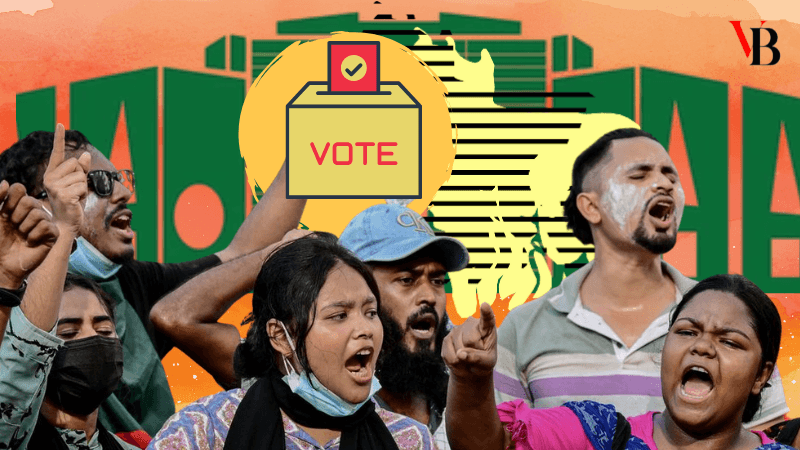

From the streets to the virtual world, the pages of history—1947, 1952, 1971, 1990—echo with the triumph of youth. In the July mass uprising too, young people played the most prominent role everywhere. After a long wait of seventeen months, the 13th National Parliamentary Election is finally set to take place. For the first time since the 2008 election, there is widespread enthusiasm among young voters. Major political parties are once again recalculating their strategies with youth voters in mind. Youth has become the trump card; whoever wins the youth, wins Parliament—it has come to that.
According to the latest data from the Election Commission, the total number of voters in the country is around 127.6 million. Of these, about 43.2 million voters fall within the 18–33 age bracket as defined by the National Youth Policy—nearly one-third of the total electorate. The BNP has already prioritized youth demands in its election manifesto, even announcing special policies for content creators. Its student wing, the Jatiyatabadi Chhatra Dal, is running various youth-focused campaigns.
Supporters of the party also view Tarique Rahman as an icon for young people. To attract young voters, the BNP has adopted the slogan: “The first vote of youth should be for the Sheaf of Paddy.”
The NCP, known as a political party born out of the mass uprising, largely comprises young leaders and voters alike. They have been vocal both online and offline to draw in young voters.
Jamaat-e-Islami recently unveiled major plans centered on skilled manpower development and employment for youth during its policy dialogue.
Although Jamaat’s student organization has achieved success in student union elections at various universities, the party aims to expand this popularity nationwide.
To understand the “sentiments of youth” ahead of the 13th election, Views Bangladesh spoke with young people from different parts of the country.
Rubina Jahan Tithi, a Philosophy student at Jahangirnagar University and a familiar face in debates and social initiatives, also took part in the July movement. She previously harbored skepticism about the electoral environment and credibility. “Earlier, elections were mostly associated with controversy and mistrust,” she said.
“Although I was a voter in the 2024 election, I did not cast my vote that year because I doubted whether it would be fair.”
While she is optimistic about the preparations and administrative activities ahead of the 13th election, she still has some concerns.
Speaking about voting, she said, “Youth is the trump card. On February 12, I will be casting my first vote in my life. There is comparatively more discussion this time about administrative preparation and participation. However, how fair the election will be can only be understood on the day of voting.”
Although women make up nearly half of the electorate, candidates often fail to reach most women voters due to various social constraints. Tithi believes that only a fair and impartial election can ensure women’s safety and deliver a better future for Bangladesh. “All parties talk about women’s security and rights in their manifestos, but without implementation these promises are meaningless. What I expect is a fair, neutral election and real implementation of all commitments made by candidates, including ensuring women’s safety,” she said.
Mahbub Rabbani, who played an active role in the anti-discrimination movement in Faridganj upazila, is currently studying Electrical and Electronic Engineering at Presidency University. He was very hopeful about post-uprising Bangladesh, dreaming of a new country where oppression and injustice would decline.
However, he is now deeply disappointed. “Due to non-cooperative behavior by the administration, secretariat, law enforcement agencies, and other institutions, we could not reap the fruits of the mass uprising. The interim government was also indifferent in this regard,” he said.
Referring to his constituency, Chandpur-4, he noted, “Although there are eight candidates, the contest is clearly between two. While everyone talks about development in their manifestos, they are not vocal about social security and good governance. I cannot fully trust any candidate.”
Despite his disappointment, he remains hopeful about Bangladesh’s future. He has decided to vote “Yes” in the referendum, though he has not yet chosen a candidate. He emphasized that he will vote for an honest and competent candidate.
Sagar Gazi, a student of Finance and Banking at Begum Rokeya University, will be voting for the first time and is eager about the opportunity.
However, he wants more time to decide on a candidate. “The National Parliament is the highest law-making body of the country. Its primary responsibilities are lawmaking, approving the budget, and ensuring government accountability on behalf of the people. That is why educated individuals should enter Parliament,” he said.
He added, “Whoever wins and goes to Parliament this time should have knowledge about the country and the outside world.”
Calling on the public, he said, “Voters should boycott those who are ignorant, extremist, corrupt, or contesting the election merely to build houses in ‘Begum Para’.”
In the Farmgate area of the capital, Views Bangladesh spoke with Mamun, 27, who came to Dhaka to learn driving with hopes of going abroad. His home is in Rangpur. He cast his first vote in the last election and is more excited this time. Although he could predict the outcome last time, he finds it difficult to do so now.
However, he feels the election atmosphere is not as vibrant as before. “Previously, banners and festoons everywhere created a distinct election vibe. Loudspeaker campaigns and songs added a new dimension,” he recalled. He plans to go home during the election holiday to vote. Asked whom he would vote for, he said, “My friends and I will go to the polling center together and vote for whoever we collectively decide on.”
Selina Shifa, a student of Biomedical Engineering at the Bangladesh University of Health Sciences, has not yet been able to trust any political party and is dissatisfied with the overall political environment. Still, she remains hopeful about this election. “Whoever comes to power or becomes a parliamentary representative must stand for insaf—justice. Regardless of political affiliation, every citizen should be treated fairly. No innocent person should suffer due to political vengeance,” she said.
She also expressed her desire for strict administrative oversight in rebuilding future Bangladesh.
Leave A Comment
You need login first to leave a comment