
74 eminent citizens express solidarity with demand to repeal DU women's dorm curfew
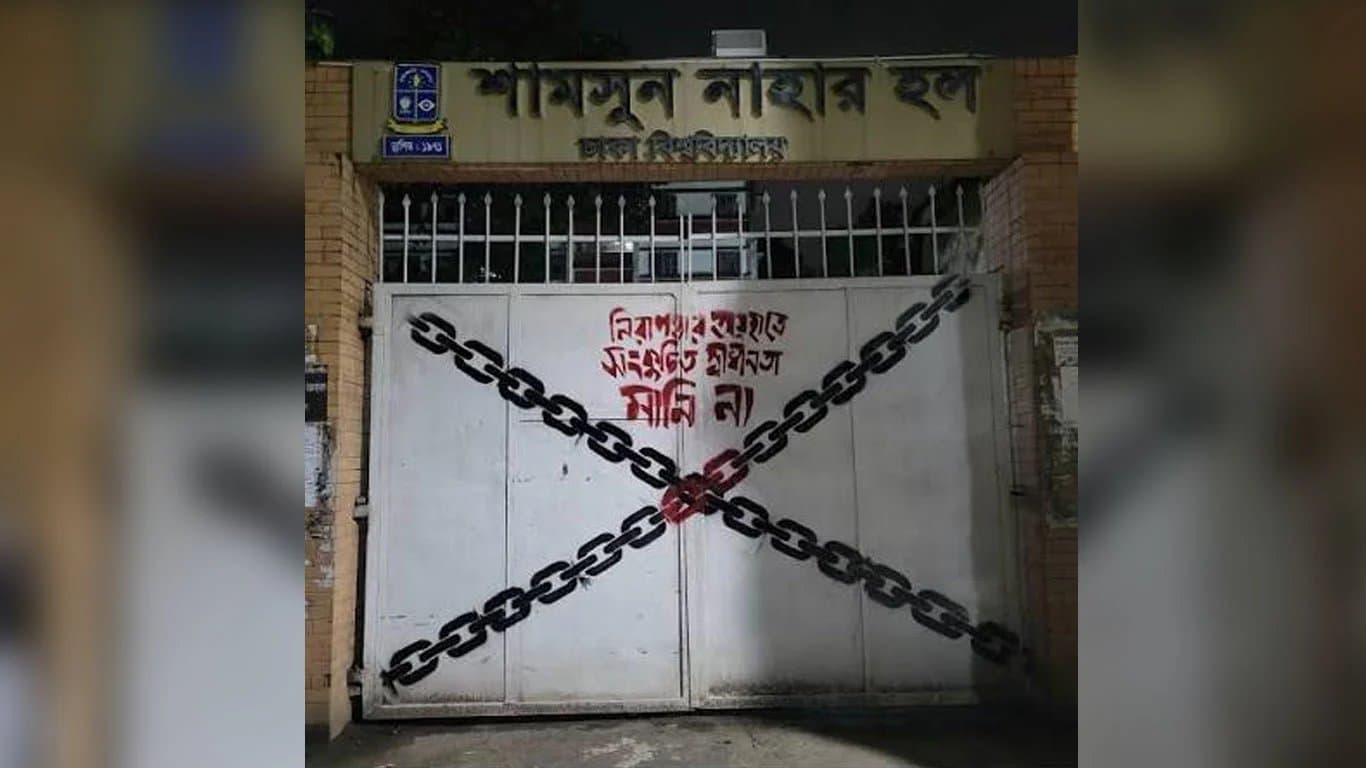

Seventy-four eminent citizens from various professions, including teachers, writers, journalists, artists and human rights activists, have expressed solidarity with students demanding the repeal of the evening curfew at Dhaka University's female dormitories. In a statement on Sunday, they opposed the restriction requiring students to enter halls by 10pm.
Poet and writer Nahid Hasan sent the statement to the media on Monday.
The statement said that during the 2024 mass uprising, students had taken to the streets defying the curfew. Yet even after the uprising, students are having to protest to demand its abolition.
The signatories said a student arriving in Dhaka from a distant area early in the morning may not be allowed into the hall before the designated time, may face traffic delays returning after tuition, or may be unable to go to hospital at night without a guardian present.
They said arguments for keeping the curfew — security, administrative control over residents' movement, social conservatism and hall management — need to be reconsidered.
The statement added that while risks may exist outside at night, the existence of risk and the justification for limiting rights are separate issues. Ensuring security is the responsibility of the state and the university administration. Safe public transport, adequate lighting, police services, swift justice and public safety must be ensured; confining women indoors is not the solution.
The signatories noted that limiting the freedom of potential victims out of fear of crime effectively shifts blame to the victim. If it is unsafe to be out at night, the question should be how to make public spaces safe at night, not why women students should be out at night.
The statement also said the state or university administration may impose reasonable restrictions applicable to all, but restricting freedom solely based on being a woman raises questions of discrimination.
The signatories also referenced the 1973 ordinance of Dhaka University, noting that it contains no provision for a curfew. They expressed solidarity with students demanding the curfew's abolition.
Those expressing solidarity include economist and writer Professor Anu Muhammad, philosopher Professor Salimullah Khan, photojournalist Shahidul Alam, TIB Executive Director Iftekharuzzaman, novelist Moinul Ahsan Saber, DU Professor Kamrul Hasan Mamun, writer and activist Professor Azfar Hossain, human rights activist Rezaur Rahman Lenin, Arup Rahi, Umama Fatema, political analyst Firoz Ahmed, researcher Pavel Partha, North South University Senior Lecturer Anupam Debashish Roy, Hill Women's Federation President Niti Chakma, journalist and researcher Sadik Mahbub Islam, filmmaker Khondkar Sumon, lawyer Manjur Al Matin, journalist and filmmaker Monjurul Islam Megh, and poet Soayeb Mahmud.
Recently, under the banner of 'Obrodhbasini' (Women under Curfew), a group of female students, including candidates of the leftist 'Pratirodh Parshad' panel for DUCSU, have been carrying out various programmes demanding 24-hour hall access, entry for non-resident students with valid IDs, and access for mothers and sisters to the halls. Similar demands are also being raised under the banner of 'Baishammyahin Hall Chai' (We Want Discrimination-Free Halls).
Leave A Comment