

94,143 hectares brought under wheat cultivation in Rajshahi region
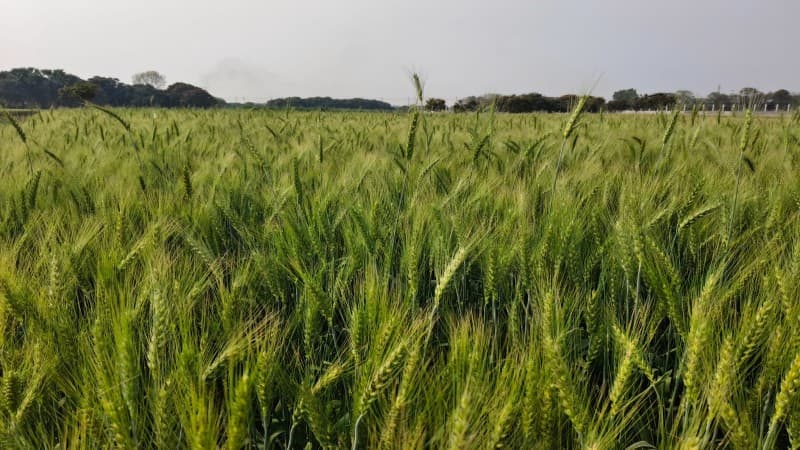

A total of 94,143 hectares of land have been brought under wheat cultivation this season in the Rajshahi region, covering Naogaon, Rajshahi, Chapainawabganj and Natore. Wheat cultivation has increased slightly compared to last year.
Abdul Hakim, a resident of Bhagail village in Godagari upazila, Rajshahi, said a bumper yield of wheat is expected. Like last year, extensive wheat cultivation has taken place in Rajshahi this year as well. Wheat fields across the Rajshahi region are lush with green leaves. Farmers are hopeful of getting 10 to 12 maunds of wheat per bigha this year. Along with that, there is potential for getting much higher prices in the market. Those cultivating wheat this year have the prospect of becoming well-established.
It is known that after harvesting Aman paddy, many farmers have cultivated wheat instead of potatoes or mustard. Visiting various fields across the district, one can see extensive wheat cultivation beautifying the landscape. Previously, wheat was cultivated extensively in almost every field across various upazilas of the four districts. However, currently, farmers are more inclined towards potato cultivation, causing wheat cultivation to diminish day by day. But over the past few years, wheat cultivation in Rajshahi has been quite good compared to demand.
Altaf Hossain, a resident of Nezampur in Nachol upazila, Chapainawabganj, said he had a good yield from wheat cultivation last year. Last year, he cultivated wheat on one and a half bighas of land and got 15 maunds. He hopes it will be good this year as well.
Farhad Ali, a wheat farmer from the same area, said this year he cultivated wheat on land where he previously grew paddy. The wheat crop has been very good. Cultivating wheat cost Tk 13,000 to 15,000 per bigha. However, there were many hassles with Bangladesh Agricultural Development Corporation (BADC) fertiliser. If the price had not been so high, the cost would have been lower. There aren't many diseases affecting the wheat this year. But rodent attacks have become a problem. Rats cannot be stopped; they are cutting down the wheat plants and destroying them.
According to information from the Divisional Office of the Department of Agricultural Extension, Rajshahi, in the fiscal year 2022-2023, wheat was produced on 22,000 hectares in Rajshahi district, yielding 91,377 metric tons. In Naogaon district, 62,440 metric tons were produced on 16,650 hectares. In Chapainawabganj district, 1,07,340 metric tons were produced on 24,397 hectares. In Natore district, 1,15,437 metric tons were produced on 27,095 hectares. The total production in the four districts was 3,76,594 metric tons.
In the fiscal year 2023-2024, in Rajshahi district, 99,850 metric tons were produced on 23,492 hectares. In Naogaon district, 64,655 metric tons were produced on 17,150 hectares. In Chapainawabganj district, 1,07,340 metric tons were produced on 26,955 hectares. In Natore district, 1,04,898 metric tons were produced on 25,245 hectares. The total production in the four districts was 3,88,268 metric tons.
In the fiscal year 2024-2025, wheat was produced on 23,510 hectares in Rajshahi district, on 17,150 hectares in Naogaon, on 31,470 hectares in Chapainawabganj, and on 21,037 hectares in Natore. The total cultivation area in the four districts was 93,876 hectares. Production figures for this fiscal year are not yet available.
In the fiscal year 2025-2026, wheat has been cultivated on 23,552 hectares in Rajshahi district, 18,020 hectares in Naogaon, 31,070 hectares in Chapainawabganj, and 21,501 hectares in Natore. The total cultivation area in the four districts stands at 94,143 hectares. Production figures for this fiscal year are not yet available.
Abdur Razzak, Sub-Assistant Agriculture Officer of Paba upazila, Rajshahi, told Views Bangladesh that if there are no natural calamities, the region will see a bumper wheat yield this season. To meet the demand for flour, wheat cultivation has increased in this area. Farmers have been provided with training, access to improved technology, fertiliser, irrigation, and quality seeds.
Mohammad Nasir Uddin, Deputy Director of the Department of Agricultural Extension, Rajshahi, told Views Bangladesh that no diseases have been detected in the wheat this year. Therefore, a good yield is expected. Fertiliser management was very good. Farmers did not face any kind of hardship.
Leave A Comment
You need login first to leave a comment