
Central Asia awakens in world at war
A fresh geography lesson for Bangladesh
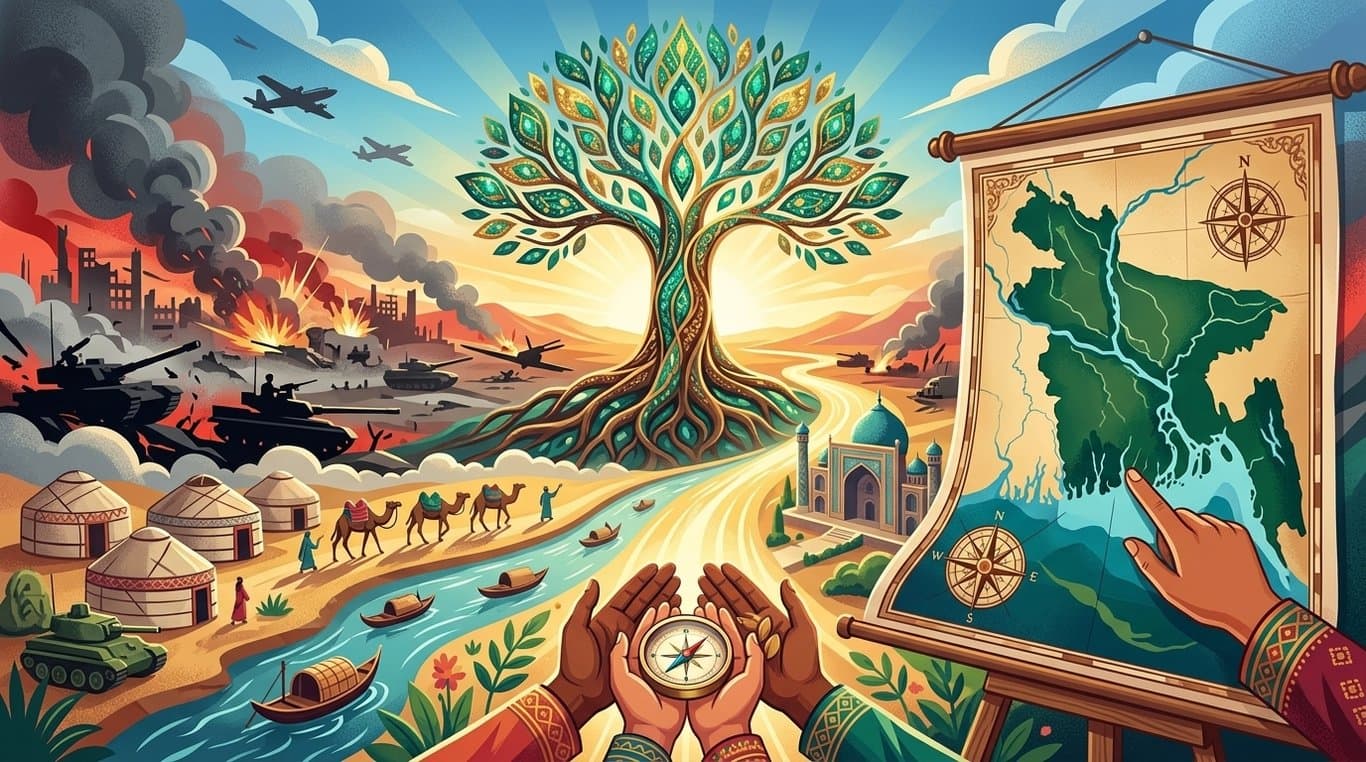

The world is deeply unsettled. Everywhere, the drums of war are beating, the balance of power is shifting, and old maps are being redrawn. Maps, too, have a silent language. In times of peace, a desert, a mountain range or a landlocked region may appear to be little more than coloured patches on a page. But when war breaks out, their value is reassessed. A port is no longer merely a port; a railway becomes a strategic asset; a strait becomes a vital artery for global energy supplies; and a neighbouring country can suddenly become a market, a corridor or a security buffer.
The world of 2026 stands amid precisely such a recalculation. Wars no longer merely redraw borders; they reshape ports, railways, energy prices, trade routes and even the value of alliances. When the movement of a few ships is disrupted in the Strait of Hormuz, the shock can eventually be felt in electricity bills in Dhaka. The prolonged war in Ukraine has shaken the foundations of Russia’s traditional sphere of influence. New defence equations in the Middle East are casting their shadow as far as South Asia. And amid this instability, the five countries of Central Asia—Kazakhstan, Uzbekistan, Kyrgyzstan, Tajikistan and Turkmenistan—are beginning to look at their geography with new eyes.
They are surrounded by major powers. Russia lies to the north; China to the east; Iran and Afghanistan to the south, with India and Pakistan farther beyond; and Europe lies across the Caspian Sea to the west. For decades, this geography was seen as a weakness. They had no access to the sea, limited routes to the outside world and sat between major powers—making their territory seem destined to become a chessboard for the strategies of others.
Now, they are trying to turn that same geography into an asset. Some are building roads and railways with China; some are maintaining security ties with Russia; some are seeking access to the sea through Iran; others are opening new avenues of cooperation with India in uranium, technology, trade and defence.
Their realisation is simple: standing under the shadow of a single major power does not guarantee security. The more doors you have, the less vulnerable you are to being trapped behind one.
This is where the significance of Central Asia’s transformation lies. The five countries are not rushing into a new military bloc. Instead, they are opening several doors at once. They are maintaining their longstanding ties with Russia, accepting Chinese investment, deepening strategic relations with Europe, seeking access to Iranian transport routes and expanding cooperation with India in minerals, technology and defence.
In other words, they are no longer willing to remain merely within the spheres of influence of major powers. Instead, they are trying to turn competition among those powers into bargaining power of their own.
Central Asia was once casually described as “Russia’s backyard”. That identity has not disappeared entirely. As a legacy of the Soviet era, Moscow’s influence remains deeply entrenched in language, labour markets, security, rail connectivity and energy systems. But the war in Ukraine has placed prolonged pressure on Russia’s economy, military capabilities and strategic attention.
Governments across Central Asia have therefore recognised that maintaining relations with Moscow is necessary—but if Moscow is their only source of security and economic dependence, that very relationship could one day become a vulnerability.
China had entered this space long before that. Through its Belt and Road Initiative, Beijing has invested heavily in roads, railways, power projects, pipelines and mining. For China, Central Asia is more than just a neighbourhood; it is a vast land bridge linking it with Europe, Russia, Iran and West Asia. The region’s uranium, gas, copper, gold and other critical minerals are also directly connected to China’s industrial and energy security.
But even here, the five Central Asian states are becoming more cautious. They need China—but they do not want China to be their only option.
That is why Europe has entered the equation, with a growing interest in minerals, energy, transport and alternative supply chains. A region where Moscow once held the dominant door now has Beijing, Brussels, Ankara, Tehran and New Delhi opening their own.
India’s historical and cultural links with Central Asia are longstanding, but geography has always been a practical obstacle. It is difficult for India to reach Central Asia by land without passing through Pakistan. That is why Iran’s Chabahar port is more than simply a port for New Delhi; it is an alternative gateway to Afghanistan and Central Asia.
India is seeking to use this gateway to deepen economic engagement with the five Central Asian states. Its recent improvement in relations with Uzbekistan is part of that broader strategy. Indian Prime Minister Narendra Modi’s visit to Tashkent on 29 August went beyond diplomatic ceremony. During the visit, India and Uzbekistan elevated their bilateral relationship from a “strategic partnership” to a “comprehensive strategic partnership”. The two countries also signed 11 agreements and took several important steps to institutionalise cooperation and promote commercial initiatives over the longer term.
The goal of significantly increasing trade, securing long-term uranium supplies, exploring critical minerals, expanding digital payments and technology cooperation, and strengthening defence ties all point to India’s ambition to establish not merely a diplomatic presence in Central Asia, but an economic and strategic foothold as well.
India has understood that a presence in Central Asia is not simply about flying a diplomatic flag. It is also about securing a place in the energy systems, supply chains, technological networks and transport routes of the future.
Yet it would be misleading to portray this as an Indian campaign to displace China or Russia. Moscow and Beijing still wield economic and security influence in Central Asia many times greater than India’s.
There are also important changes taking place within Central Asia itself. Efforts to resolve the longstanding border disputes between Kyrgyzstan and Tajikistan, improved relations between Uzbekistan and its neighbours, and rising intra-regional trade all point to a simple realisation: if you want to negotiate effectively with outside powers, you must first make peace in your own neighbourhood.
If the smell of gunpowder constantly hangs over a border, trade trucks cannot move freely.
For South Asia, this lesson is somewhat uncomfortable. In our region, disputes over borders, transit, water, ports and political mistrust continue to hold back enormous economic potential. Central Asia, at least, is trying to move in the opposite direction. It has its own old disputes, but the countries of the region are beginning to see borders not merely as fences of sovereignty, but also as routes for the movement of goods and people.
For Bangladesh, this is particularly significant.
Bangladesh is not a neighbour of Central Asia. Yet the impact of this geopolitical transformation can reach our doorstep in three critical areas: energy, trade and foreign policy.
First, a large share of Bangladesh’s imported energy comes from the Middle East. Whenever tensions rise around the Strait of Hormuz, shipping costs, insurance premiums, transportation expenses and global energy prices tend to rise. A war thousands of miles away can then put pressure on electricity-generation costs, industry and Bangladesh’s foreign-exchange reserves.
The second lesson concerns connectivity and trade. Bangladesh sits at the mouth of the Bay of Bengal. It has the ports of Chattogram and Mongla. India is next door, China is within reach, the vast markets of Southeast Asia are nearby, and major Indian Ocean trade routes lie ahead.
This geography would be a dream for many landlocked countries.
But geography does not generate wealth by itself. It must be transformed into an economic asset through railways, roads, ports, efficient customs systems, regional connectivity and steady, capable diplomacy.
The countries of Central Asia, despite having no access to the sea, are trying to make railways an alternative to maritime routes. Bangladesh, sitting on the doorstep of the sea, cannot afford to lose its opportunities for connectivity. If it does, that would not be a failure of geography—it would be a failure of policy.
The third lesson concerns foreign policy.
For decades, Bangladesh has adhered to the principle of “friendship to all, malice towards none”. That principle remains valuable. But in today’s world, another word must be added to it: alternatives.
Bangladesh will continue to have economic ties with China, connectivity and security ties with India, important markets in the United States and Europe, and energy and labour-market links with the Middle East.
But no single power, market or supply route should become so indispensable that, in times of crisis, Bangladesh’s room for independent decision-making is drastically reduced.
That is essentially what the five Central Asian countries are doing today. They are not abandoning Russia, confronting China or keeping India at arm’s length. Instead, they are expanding their partnerships, creating more alternatives and, in doing so, strengthening their bargaining power.
This is why the awakening of Central Asia is not merely a distant diplomatic story involving five countries. It is a reminder for Bangladesh to take a fresh look at its own map.
In a world at war, power is no longer measured by military strength alone. Ports, railways, energy sources, markets, supply routes and diplomatic options are also forms of power.
Kazakhstan, Uzbekistan and Turkmenistan have no sea, yet they are turning the limitations of their geography into bargaining assets.
Bangladesh has the Bay of Bengal. It has ports, a large market, a strategic location and enormous potential for regional connectivity. What it needs now is to ensure that this geography does not become merely the playing field for someone else’s strategy, but a strategic asset serving Bangladesh’s own interests.
Central Asia has begun to understand the value of its map.
For Bangladesh, it is time to start keeping its own account.
Leave A Comment