
Super powers brings new rulers
Afghan refugees are left huddled at the feet of democracy
On August 16, 2021, the Taliban captured Kabul just a day prior. The last stage of the US military's withdrawal was still in progress. At Hamid Karzai International Airport, events transpired that day which appeared to challenge any straightforward characterization of disorder.
It was, perhaps, the moment when an entire nation suddenly realised that even on their own soil, the promise of safety could disappear overnight.
Thousands of people crowded the runway. Who would get on which plane, whose name was on a list, where a plane was headed—all of that seemed secondary. When a grey US Air Force C-17 Globemaster began moving, hundreds of people ran after it. Some reached for the aircraft. Others tried to climb onto its landing gear.
The US Air Force later said the crew decided to leave Kabul as the security situation deteriorated rapidly after the aircraft was surrounded by hundreds of Afghan civilians. Human remains were later found in the aircraft's wheel well.
Images of people falling from the plane after take-off spread around the world.
There can be many political interpretations of that scene. But there is only one deeply human one: some people clung to an aircraft even after knowing they might die, because remaining on the ground seemed even more terrifying than death.
Twenty years earlier, the United States had entered Afghanistan with war, enormous resources and the promise of building a new political order. Twenty years later, when it left, the people standing on the Kabul runway had no political theory in their hands. They had only the instinct to survive.
That instinct soon spread across Afghanistan's roads and borders, through the crossings at Torkham and Chaman.
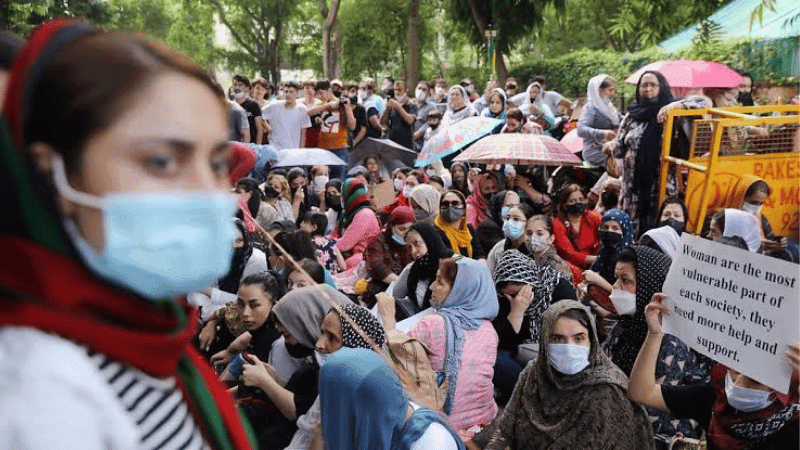
After the Taliban returned to power, thousands of former soldiers, government employees, journalists, rights activists, women and students fled to Pakistan.
For many, Pakistan became the nearest place of refuge. But five years later, even the meaning of that refuge has changed.
Pakistan effectively began its Illegal Foreigners' Repatriation Plan in 2023. Islamabad has argued that no country can be expected to host undocumented foreigners indefinitely, while concerns over border security, terrorism and Pakistan's increasingly strained relationship with the Taliban government have also shaped the policy. Those concerns cannot simply be dismissed.
But when the logic of the state collides with the vulnerability of human beings, that too cannot be brushed aside.
According to United Nations figures cited in a recent Radio Free Europe investigation, more than 2.6 million Afghans have been forced or pressured to return from Pakistan since the large-scale repatriation drive began in 2023.
That number, however, cannot tell the stories hidden inside it. It does not say who locked the door of a home for the last time at night, who carried a sleeping child into a vehicle, or who looked back one final time before crossing Torkham.
Numbers do not tell those stories.
Perhaps the more unsettling figure lies elsewhere. Pakistan's Foreign Ministry says around 16,000 vulnerable Afghans have been temporarily exempted from repatriation on humanitarian grounds. But the UN refugee agency has warned that tens of thousands of Afghans in Pakistan could face serious risks if returned to Afghanistan.
On paper, the difference between those numbers may look like statistics. In real life, it represents tens of thousands of people living without certainty.
One former Afghan military officer described how Pakistani police had detained and deported him twice over the past two years. Each time, he secretly made his way back into Pakistan because returning to Afghanistan meant risking his life.
Now he rarely leaves his home unless absolutely necessary. He avoids Afghan clothing so that he will not be identified. He avoids talking to strangers. He does not go to restaurants. His life has narrowed to one calculation: how to avoid being noticed by the police.
Another woman, a women's rights activist, lives outside Islamabad with her two brothers. She says that even when she falls ill, she is afraid to see a doctor. If her identity becomes known, she fears the police could be informed.
When a person has to hide even the clothes that reveal where they come from, exile is no longer simply about losing a country.
It becomes a life lived in fear. That fear is not imaginary. A 2025 report by the UN Assistance Mission in Afghanistan and the UN human rights office documented cases of torture, ill-treatment, arbitrary detention and threats to personal safety among people forcibly returned to Afghanistan. Women and girls, former government and security personnel, journalists and civil society activists were identified as particularly vulnerable.
And now, perhaps, the most painful chapter of this long refugee story is being written around Afghan women studying medicine.
Take Alishba, a pseudonym used for her protection. She is studying medicine in Lahore. On September 8, she was working a night shift in a hospital's gynaecology ward when messages began arriving on her phone one after another.
At first, she could not believe that Pakistani authorities had ordered Afghan students to leave their universities. By the following morning, she discovered that her own name was on the list.
On September 1, the Pakistan Medical and Dental Council ordered medical and dental institutions to facilitate the return of enrolled Afghan students to Afghanistan.
The order also barred new admissions, transfers and migrations of Afghan students for the current academic year. More than 200 Afghan medical and dental students across Pakistan could be affected.
Twenty-four hours is enough to pack a bag. You can put in some clothes, your passport and a few important documents.
But where do you pack four years of medical education? Where do you put the night shifts, the exam preparations, the first patient you treated, the first time you held a stethoscope? These are not belongings that can be handed over at a border checkpoint.
Alishba's situation is even more complicated because she did not come to Pakistan illegally. Like many others, she came through the Allama Iqbal Scholarship Programme, administered by Pakistan's Higher Education Commission in cooperation with the Pakistani embassy in Kabul. Her visa was processed. She was admitted to university. She spent years studying under a system supported by the Pakistani state.
Then, almost overnight, the ground beneath her future shifted. On September 11, the Lahore High Court temporarily suspended the PMDC's directives after 13 Afghan medical students, including seven women, challenged the orders.
The court allowed the affected students to continue their studies, sit for examinations and return to their hostels while seeking responses from the relevant authorities.
For now, they can study.
But it is the phrase “for now” that defines the lives of so many Afghans in Pakistan.
For now, the police have not come. For now, the visa remains valid. For now, they can attend classes. For now, they will not be sent across the border.
But people cannot build a future out of “for now.” For Afghan women, the uncertainty is even more devastating. Afghanistan is now the only country in the world where girls and women are barred from secondary and higher education.
For a female student studying medicine in Pakistan, being sent home may not simply mean leaving a university. It could mean losing her educational future altogether.
A male student may still find some path back into education in Afghanistan. For a woman, “going back” can mean that the road to higher education ends permanently.
Alishba told Al Jazeera that her mother had dreamed of seeing her daughter graduate as a doctor and had even prepared a graduation dress for her. Now, in one corner of Alishba's room sits an emergency bag containing documents and a change of clothes.
In her mother's cupboard is the graduation dress. Between those two bags lies much of the Afghan crisis.
On one side is a homeland she is afraid to return to. On the other is a country that gave her refuge but cannot guarantee that she will be allowed to stay.
Pakistan has the right to protect its security. It has the right to control its borders. But the strength of a state cannot be measured only by its ability to force people out.
The ability to distinguish between those who pose a security threat and those who are themselves at risk is also a measure of state strength.
So is the ability to make exceptions for people who would face persecution if returned, for women whose education would end the moment they crossed the border, and for students whom the state itself brought to Pakistan on scholarships and allowed to spend years building a future.
The law may be the same for everyone. But danger is not.
On the map, Afghanistan exists. Pakistan exists. Between them are borders, fences, checkpoints and flags.
What is missing is a secure place to call home. And even when these people are forced to return, there is no guarantee that home will still be a place where they can live with dignity and safety.
The stories of Afghan refugees in Pakistan are no longer simply stories of Afghan suffering. They are a reflection of one of the most disturbing geopolitical realities of our time.
Across much of the world, the aftermath of war has produced a strange landscape: countries still have borders, flags and capitals, but for millions of people, the word “home” no longer means a safe place.
From Kabul to Baghdad, from the battlefields of the Middle East to the unstable geographies of Africa, wars have been declared over many times. Soldiers have gone home. Military bases have been dismantled.
Leaders have delivered victory speeches. But when a war ends, the war of the refugee often begins.
And that war is the same everywhere.
It is the search for a safe room. A legal document. A school for a child. A hospital bed. A night when the sound of someone knocking at the door does not make the heart race.
For those who have lost a country, perhaps that is all they are asking for—not another promise from a great power, not another political order, not another flag.
Just a place where tomorrow is not something they have to fear.
Leave A Comment