
Arming neighbours in name of checking enemy: Pakistan's perilous game under guise of peace
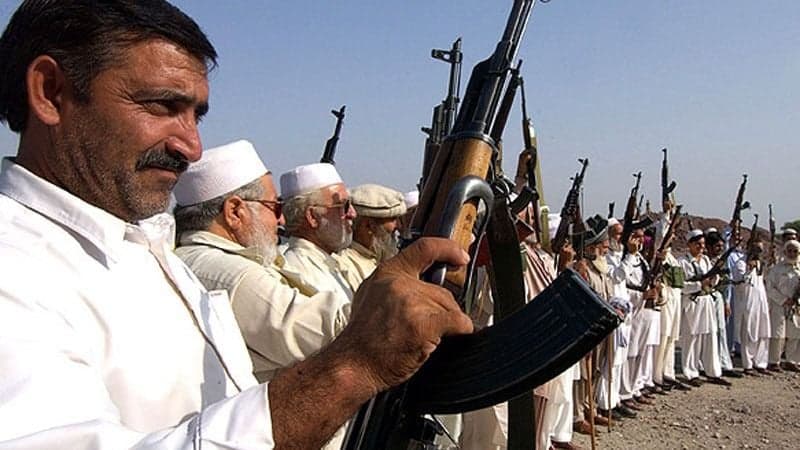

A state possesses firearms, which is a natural occurrence. These firearms are accompanied by regulations, uniforms, a hierarchy of command, and, ideally, a system of accountability. Police conduct can be scrutinized for misconduct, military actions can be subject to discussion, and a government's security strategies can be contested in legislative bodies or judicial courts.
However, when a state declares, "My firearms are insufficient. You too shall carry a firearm and monitor your neighbor," the matter transcends mere security. The introduction of firearms brings suspicion into society. Historical rivalries are reignited by this suspicion. Soon, a conflict that initially involved the state and armed factions spills over into community spaces, pitting neighbor against neighbor.
This seems to be the trajectory of events in Pakistan's Khyber Pakhtunkhwa and Balochistan. There are claims that, in a bid to combat separatist groups and movements advocating for Baloch independence, the Pakistani state has been establishing local entities under titles such as Aman Lashkar and Peace Committees, collecting intelligence from local inhabitants and, in certain instances, providing them with arms.
Pakistan's present security environment encompasses various entities broadly categorized as "peace committees." These have been identified by multiple names, including Aman Lashkars, Peace Committees, Police Aman Committees, and village defense committees. Additionally, there exist local armed resistance factions, tribal jirga committees, and civilian efforts aimed at combating religious extremism.
The operations of these local organizations have rekindled a longstanding and concerning inquiry: Should citizens be armed and set against their own neighbors under the guise of protection? The terminology implies tranquility. Aman translates to peace, as does the term peace itself. The irony lies in the fact that the means employed to achieve this peace can sometimes involve firearms.
This leads us to the pivotal question: Can a state guarantee one citizen's safety by arming another and positioning him against his neighbor? This inquiry extends beyond the realm of political theorists.
Pakistan has previously engaged in such practices—and has faced consequences. In the struggle against the Taliban in Khyber Pakhtunkhwa, numerous Aman Lashkars and Peace Committees were established from local inhabitants. These were not conventional military or police forces.
Community members were mobilized to protect their neighborhoods, provide intelligence on suspected individuals, and, in certain instances, engage in armed resistance.
The Adezai Aman Lashkar in Peshawar serves as a notable example. A report from The Express Tribune in 2015 indicated that this civilian militia was created in 2008 from local residents. Some participants were subsequently enlisted as special police officers on a contractual basis, receiving monthly stipends and government-issued firearms.
The initiative commenced with the objective of combating militancy. However, over time, accusations surfaced regarding the misuse of authority, mistreatment of local citizens, and the increasing dominance of armed members.
As situations evolved, the government subsequently took steps to retrieve weapons from various groups.
A report from the Express Tribune in 2017 further highlighted the complexity of the situation through comments made by a leader of the Lashkar in the region. They claimed that, at one point, local Lashkars were intentionally placed in harm's way to redirect militants' focus away from the police. Once their utility waned, the state distanced itself from these groups.
From the state's viewpoint, the logic may seem simple: there is a threat today, thus provide weapons; circumstances shift tomorrow, hence retrieve them.
However, human relationships do not function like an inventory of arms. A rifle can be returned. A magazine can be accounted for. The identity of the individual to whom a weapon was issued can be documented. Yet, memories cannot be so easily seized.
Who harbored suspicions about whom? Who shared intelligence regarding whom? Who led security forces to whose residence? Such memories do not vanish when the weapons are reclaimed.
When the state informs one villager that another individual is not only its adversary but also his, it may secure a temporary ally. Simultaneously, it establishes a new division within the community.
A militant organization may be an adversary of the state. The state is entitled to take lawful action against armed separatist factions. However, once that conflict transcends the realm of regular security forces and involves ordinary citizens, the distinctions of identity become obscured.
Pakistan's security situation is undoubtedly grave. As reported by the Centre for Research and Security Studies (CRSS) for the second quarter of 2026, there were 267 incidents related to militant attacks and counterterrorism operations from April to June, resulting in 774 fatalities and 336 injuries.
Approximately 96 percent of these deaths occurred in Khyber Pakhtunkhwa and Balochistan, with 475 fatalities in Khyber Pakhtunkhwa and 265 in Balochistan.
Consequently, the crisis in Islamabad is tangible. The resurgence of the Tehreek-e-Taliban Pakistan (TTP) and the activities of armed Baloch groups present significant security challenges for the Pakistani state.
Moreover, it is evident that local cooperation is crucial in remote regions. Residents are aware of which mountain paths are being traversed by unfamiliar individuals at night, which homes have recently welcomed unknown occupants, and where suspicious activities are occurring. This information can be invaluable to law enforcement agencies.
However, there is a critical distinction between a citizen who provides information and one who wields a weapon. The former aids the state, while the latter becomes an active participant in the conflict.
This distinction is central to the ongoing security discourse in Pakistan. In July 2026, Jamiat Ulema-e-Islam-Fazl leader Maulana Fazlur Rahman expressed opposition to the notion of transforming ordinary citizens into Lashkars to combat armed groups.
His argument was straightforward: the state possesses security forces, and the duty of ensuring security should not be delegated to ordinary citizens.
His caution was particularly noteworthy. Security forces may vacate an area at any time. In contrast, local residents remain. They continue to frequent the same markets, worship in the same mosques, dispute over the same borders, and remain integral to the same social structure.
If a relationship founded on firearms is established among them, the conclusion of the conflict does not automatically signify the cessation of animosity.
An analysis published on 31 July 2026 by The Diplomatic Monitor similarly questioned whether Pakistan was reinforcing its formal security institutions or progressively transferring security duties to local communities and informal armed groups. It characterized the deployment of state-aligned armed groups in Balochistan to combat nationalist movements as a form of security "outsourcing."
Awami National Party president Senator Aimal Wali Khan has posed a comparable inquiry. In statements reported on 18 July 2026, he contended that addressing militancy is a constitutional obligation of the state, not of individual citizens.
His inquiry strikes at the core of Pakistan's security conundrum: if the state already maintains police, armed forces, paramilitary units, and intelligence agencies, why should ordinary individuals in Khyber Pakhtunkhwa be compelled to take up arms once more?
Aimal Wali Khan's stance holds particular significance as his party has endured years of lethal violence for opposing the Pakistani Taliban.
However, perhaps the most crucial response has emerged from the local populace themselves. In February 2025, elders, political representatives, and business leaders from various tribes convened at a Tirah Qaumi Jirga and resolved that no new tribal Lashkar or peace committee would be established. Local inhabitants would also refrain from taking up arms against banned militant organizations.
Their message was unequivocal: the state bears the responsibility for restoring peace. Concurrently, they dismissed the notion of becoming armed supporters of either security forces or militants. Instead, they established an unarmed negotiating committee aimed at preventing bloodshed.
The residents of Tirah did not oppose peace; rather, they opposed the concept of resorting to arms in the name of peace. South Asian history provides ample warnings regarding the consequences of citizens being organized against one another.
When a state fosters armed divisions within a local community, distinguishing between the 'loyal' and the 'disloyal', or the 'patriotic' and the 'anti-state', these divisions seldom vanish once the conflict concludes.
While the state may alter its list of adversaries, society transforms its relational map. A person who was once merely a neighbor can become categorized as 'one of them'.
Such injuries cannot be remedied by governmental proclamations. The state's duty is not to convert citizens into warriors; rather, it is to establish a framework that allows citizens to exercise their right to live securely without being compelled to become warriors themselves.
When a state shifts its security responsibilities onto ordinary citizens, two significant risks arise. Firstly, public trust in state institutions begins to diminish. Secondly, a type of conflict emerges within society that lacks a formal ceasefire.
A firearm has one distinct advantage: it possesses a serial number. It can be documented under the name of the individual to whom it was issued, and it can ultimately be returned. Distrust, however, lacks a serial number.
Hostility does not come with an arsenal. If an individual believes that their neighbor has informed the state against them, that memory cannot simply be stored in a government facility.
This is why arming citizens in the name of peace may seem to provide a swift resolution, yet it harbors a slow-acting poison within.
Militancy may one day decline. Soldiers may return to their barracks. Police checkpoints may disappear. But for a state that once encouraged one neighbour to stand against another in the name of security, the hardest task may still remain: Teaching people to trust one another again.
Leave A Comment