
Artwork’s ‘71-24’ balance scale sparks debate at Rajshahi University
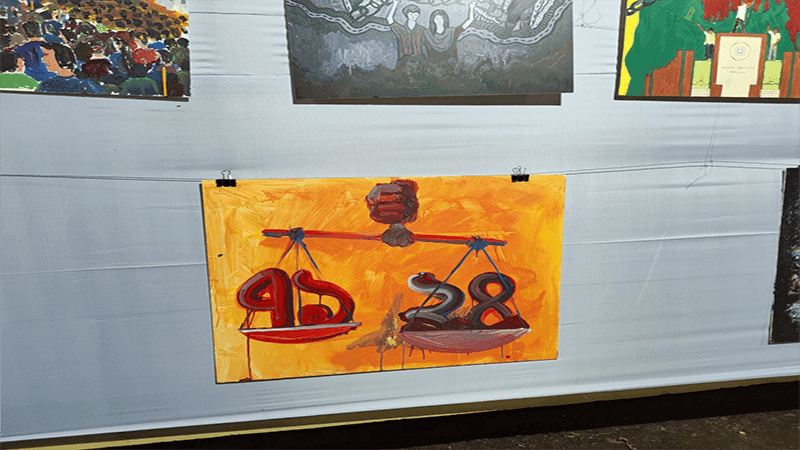

An artwork displayed at a Rajshahi University exhibition marking the July Uprising has sparked criticism among students after its visual depiction appeared to suggest that 2024 carries greater weight than 1971.
The artwork shows a clenched hand holding a balance scale. The two sides are marked “71” in red and “24” in dark shades, with the side carrying “24” positioned slightly lower.
The visual prompted criticism from students after the three-day exhibition, titled “July Mass Uprising: A Free Homeland Through Colours and Brushes,” opened on Sunday morning.
Fouad Ratul, convener of the university unit of the Socialist Students’ Front, said presenting 1971 and 2024 as competing historical moments could undermine public unity.
“Pitting 1971 against 2024 only creates division and ultimately benefits the forces that suffered defeat,” he said.
Sultan Ahmed Rahi, president of the university unit of the Jatiyatabadi Chhatra Dal, said 1971 remains the country's foundational history, while 2024 represents an important chapter.
“Making 2024 significant does not require diminishing 1971. One history does not need to be insulted to establish another,” he said.
Hafez Mehedi Hasan, general secretary of the university unit of Islami Chhatra Shibir, also said the two events occurred in different historical contexts and should not be placed in opposition to each other.
“We do not want to put 1971 and 2024 against each other. Rather, we want to move forward by drawing inspiration from both,” he said.
The artist, who requested anonymity, offered a different interpretation of the work. He said the artwork was intended to portray the unequal comparison between 1971 and 2024, rather than suggest that one was historically more important than the other.
“Since July, a group has been trying to present 2024 as being in opposition to 1971. My work should not be interpreted in that way. It is an allegorical representation. I wanted to depict this unequal comparison between 1971 and 2024,” the artist said.
Mohammad Ali, dean of the university's Faculty of Fine Arts, said he was not on campus and had not yet seen the artworks, so he could not comment on the specific piece.
Asked about the selection process, he said the artworks had been selected through registration, with the process overseen by Professor Ariful Islam of the Department of Ceramics and Sculpture.
Professor Ariful Islam said he had been handling responsibilities in the dean's absence and acknowledged that he had signed a letter related to the exhibition.
“Honestly, I only signed a letter. The artworks were submitted without being properly reviewed,” he said.
University Public Relations Administrator Professor Kamruzzaman said the exhibition was primarily organised under the supervision of the Faculty of Fine Arts. The public relations office, he said, was responsible only for allocating the exhibition venue at the Senate building and had no involvement in the artwork itself.
The exhibition, titled “July Mass Uprising: A Free Homeland Through Colours and Brushes,” will continue until 8:00pm Tuesday.
It features 80 artworks in various mediums produced during an art camp organised by the Faculty of Fine Arts to mark July Mass Uprising Day 2026.
Leave A Comment