
Awareness rally in Shyamnagar calls for ‘3 Nos’ to protect Sundarbans
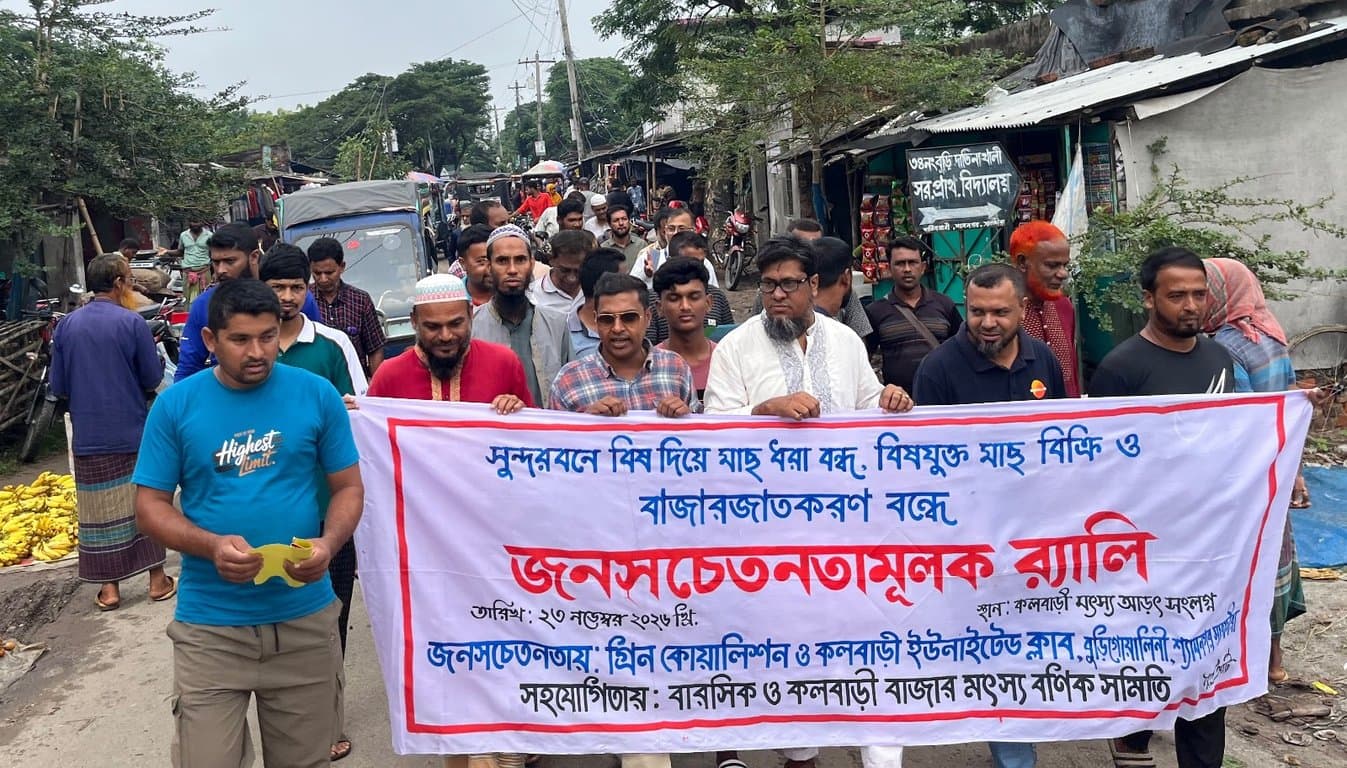

A public awareness rally and street meeting were held in Shyamnagar, Satkhira, calling for an end to the use of poison in the rivers and canals of the Sundarbans to catch fish. The campaign also urged people to prevent the sale of poisoned fish and protect aquatic biodiversity and the livelihoods of communities dependent on the forest.
The programme called for a collective social movement based on three commitments: “We will not catch fish using poison, we will not allow the sale of poisoned fish, and we will not buy poisoned fish.”
The rally began at 8am on Sunday (23 November) near the Kalbari fish market. Jointly organised by the Burigoalini Union Green Coalition and Kalbari United Club, it passed through several roads before ending at the Kalbari Bazar fish market premises. A street meeting was held there afterwards.
Speakers highlighted the harmful effects of using toxic chemicals to catch fish in the rivers and canals of the Sundarbans. They urged fishermen, fish traders, market operators and consumers to play responsible roles in stopping the practice.
The meeting was chaired by Md Muhsin Billah, president of the Burigoalini Union Green Coalition and a local teacher. It was conducted by Md Selimur Razi Bappi, joint convener of Kalbari United Club.
Among those who addressed the gathering were Md Zillur Rahman, family planning officer of Burigoalini Union; Md Farhad Hossain Munna, convener of Kalbari United Club and a Bangladeshi expatriate in the United States; Md Shariful Islam, joint general secretary of the Burigoalini Union Green Coalition; Md Wahidul Islam, Md Afzal Hossain, Abu Mosa Moyna, Md Mizanur Rahman, Md Rahmat Ali, Md Rafiqul Islam, Mofizur Rahman of BARCIK, Maruf Hossain, S M Osman Gani Sohag and Jubayer Ahmed, among others.
Speakers said the Sundarbans is not merely a forest; it is the lifeline of the coastal region, a habitat for numerous aquatic species and a vital source of livelihood for communities dependent on forest resources.
They warned that the use of poisonous chemicals to catch fish in the forest's rivers and canals had become a serious threat to the ecosystem, aquatic biodiversity, public health and natural resources.
According to the speakers, poisoning harms fish fry, fish of different sizes, shrimp, crabs and other aquatic organisms. It also contaminates river and canal water, disrupts fish reproduction and damages the natural food chain. Consuming contaminated fish may pose risks to human health. The depletion of natural fish stocks also affects genuine fishermen and their families.
The meeting called for an immediate halt to the purchase and sale, supply and marketing of fish caught using poison at the Kalbari Bazar fish market. It also urged efforts to identify such fish and prevent them from entering the market, build social resistance against those involved in the trade and ensure legal action against the offenders.
Speakers further said that turning the Kalbari Bazar fish market into a safe, environment-friendly hub for poison-free fish would require joint efforts by traders, market operators, fishermen, forest-dependent communities, the Forest Department, local representatives and the public.
They said ensuring a market for poison-free fish would help protect the Sundarbans' aquatic resources, safeguard the livelihoods of genuine fishermen and ensure access to safe food for consumers.
The programme's central message was: “We will not catch fish using poison, we will not allow the sale of poisoned fish, and we will not buy poisoned fish.” The organisers called for turning these three commitments into a broader social movement to protect the Sundarbans.
Solidarity with the campaign was expressed by SERIO, BARCIK—a national environmental research organisation and recipient of the National Environment Award—the Kalbari Bazar Fish Traders' Association and Burigoalini Union Parishad No. 9.
Leave A Comment