
Azam Khan: From gun to guitar, the immortal saga of Bangladesh's 'Pop Emperor'
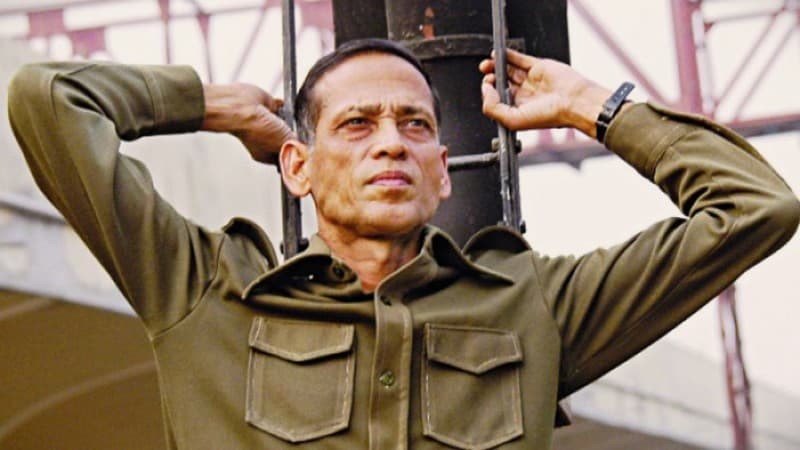

A valiant freedom fighter, a guerrilla warrior, a section commander — and a 'Pop Emperor'. Azam Khan was a unique fusion of these dual identities. He was a soldier fighting with weapons in the war of independence, and in post-war Bangladesh, he became the founding guru of Bangla pop music.
June 5 marks the death anniversary of this heroic freedom fighter and music icon, who passed away in 2011. His songs and legacy of sacrifice are being remembered with deep respect and love on this day. He remains an undisputed figure in the history of Bangla pop music, but his identity as a freedom fighter surpasses even his artistic persona.
The artiste who fought with weapons
Azam Khan's participation in the great Liberation War of 1971 was profound and heroic. At just 21, he responded to Bangabandhu Sheikh Mujibur Rahman's call for independence and joined the resistance. He served as a section commander under Sector 2, with one of his key duties being to conduct guerrilla operations near Dhaka. He fought valiantly against the Pakistani occupation forces, carrying out several daring missions that spread terror among enemy ranks.
The experience of the Liberation War left a deep imprint on Azam Khan's character, which later reflected in his music. The realities of war, poverty and oppression made his songs exceptional and profound.
A new war with a guitar: The birth of 'Uccharon'
After Bangladesh gained independence on December 16, 1971, Azam Khan laid down his gun and picked up a guitar. But he did not stop struggling. In 1972, he formed the historic band 'Uccharon' with his friends. This band marked the formal beginning of band music in Bangladesh.
When BTV broadcast his songs 'Etu Shundor Duniya-e Kichui Thakbe Na Re' and 'Char Kalema Sakkhi Debe', a stir spread across the country overnight. People realised that a new era had arrived in Bangla music.
Real stories, the language of the people
The power of Azam Khan's songs lay in their simplicity and truthfulness. He sang about the common people, the deprivations of pavement dwellers, and the anguish of a war-ravaged nation. Songs like 'Rail Lainer Oi Bastite', 'Ore Saleka Ore Maleka', 'Alal O Dulal', 'Papri Keno Bojhe Na', 'High Court-er Majare' — each seemed to echo the voice of the oppressed people of post-independence Bangladesh.
His song 'Rail Lainer Oi Bastite' highlighted the suffering of people even after independence, which deeply moved the young generation of the time. That song was not just music; it was a social document. For this reason, he became not just an artiste, but the 'Guru' of the people, the 'Emperor' of Bangla pop music.
Beyond music: Actor Azam Khan
Azam Khan was not just a singer; he was a multi-talented personality. In the 1980s, his natural performance as a Baul artiste in the 'Kala Baul' episode of the popular BTV drama series 'Hiraman' captivated audiences. In 2003, he played a powerful negative role in the film 'Godfather' directed by Shahin-Sumon, proving that his acting prowess was as remarkable as his singing. He also appeared in the 'Din Bodol' advertisement for Banglalink alongside Ayub Bachchu, which remains fresh in public memory.
On stage, Azam Khan was completely different. His unruly hair, firm stride, and the raw, genuine energy in every part of his body held audiences spellbound. He was Bangladesh's first 'rock star' on the music stage. Yet, fame never touched his ego. Despite being at the height of popularity, he lived a very ordinary life in Dhaka's Kamalapur neighbourhood.
Legacy: The tune that never stopped
Azam Khan did not just sing songs; he laid the foundation of a musical movement. Bangladesh's rich tradition of band music developed following his path. Bands like Souls, Feelings, LRB, Black and Artcell — every band in Bangladesh stands with Azam Khan as their predecessor.
He proved that Western-style music is possible in Bangla — and that it could be stronger and more relevant.
Farewell to immortality
After suffering from oral cancer that spread to his lungs , this legendary figure breathed his last at Dhaka's Combined Military Hospital (CMH) on June 5, 2011. He was 61 . Although his death marked the end of an era, his songs and his courage have achieved immortality in the hearts of Bengalis.
He was honoured with the Ekushey Padak posthumously in 2019 and the Independence Award posthumously in 2025 .
The man who fought the Pakistani occupation forces with weapons returned with a guitar on his shoulder to gift Bengalis with countless timeless songs. Azam Khan is not just a pop star; he is an undeniable truth of our Liberation War and an inseparable part of our culture. He was a hero. He was a guru. He was the Pop Emperor. Guru Azam Khan — Salute!
Leave A Comment