
Balochistan under shadow of 1971: Map changes, strategy doesn't
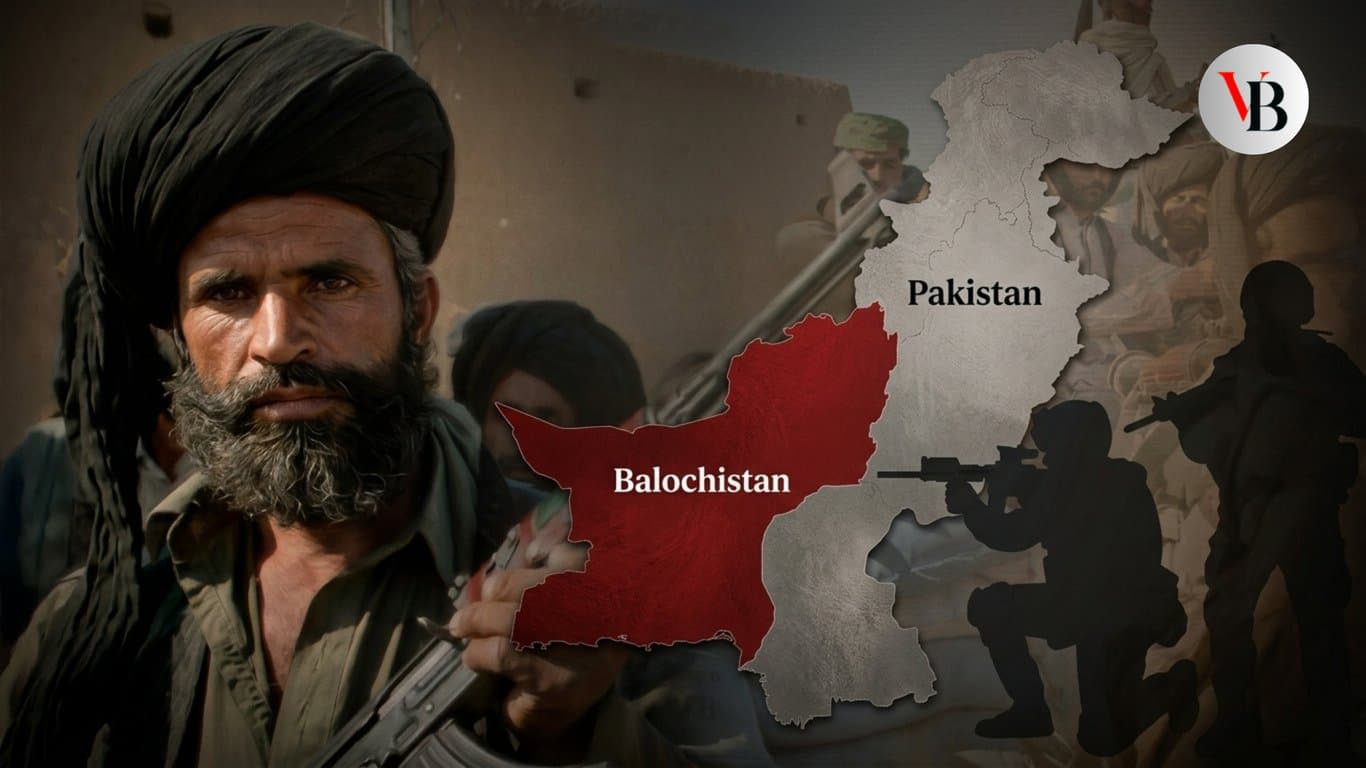

In the official narrative of Pakistan, the term "peace" is associated with a troubling history. Elections occur, parliament convenes, and prime ministers are sworn in; however, alongside political authority looms an unseen presence—the military chief of the country, whose sway often surpasses that of the elected prime minister. When political ties between the central government and a peripheral region deteriorate, the discourse of dialogue is swiftly supplanted by the discourse of security.
This language was evident in East Pakistan in 1971. Today, as we turn our attention to Balochistan, located on Pakistan's western border, it appears that some elements of that historical lexicon are resurfacing.
Although the circumstances have changed, the history is distinct, and the political dynamics of Bangladesh and Balochistan differ significantly, the military's strategy of pitting one segment of the local populace against another is so recognizable that it inevitably evokes memories for Bangladeshis of the "era of 1971."
The ongoing crisis in Balochistan has not arisen suddenly. Covering approximately 44 percent of Pakistan's land area, this province is abundant in natural resources, yet its relationship with the central government has been fraught with conflict for over seventy years. From the annexation of Kalat into Pakistan in 1948 to a series of insurgencies, Baloch political movements have consistently been at odds with the central authority. However, there is a notable distinction in the current phase.
Earlier movements can largely be characterized as uprisings led by tribal forces and chiefs from mountainous regions. However, this explanation is no longer adequate. Presently, a third generation of educated Baloch has emerged, inheriting the legacy of years of deprivation and conflict. This is not a formal historical categorization, but rather a reflection of an evolving social reality.
University students, the urban middle class, youth, and women are becoming increasingly prominent in Baloch politics. Some take to the streets holding photographs of the missing. Others advocate for human rights and equitable access to the province's resources. Some find themselves imprisoned, while others from this same generation are gravitating towards armed groups.
In essence, Pakistan is now facing not just the armed Baloch separatists dispersed throughout the Sulaiman Mountains, Kirthar Range, Toba Kakar Mountains, and the Makran coastal ranges, but also the collective frustration of an entire generation.
An organization may be prohibited. Numerous fighters may be eliminated. However, if an entire generation comes to perceive that the state does not represent them, what military action can extinguish that conviction? There exists another dimension to this crisis that warrants recognition.
Baloch armed groups have not solely targeted Pakistan's military-controlled security forces. At various times, they have also assaulted civilians, infrastructure, and individuals accused of being informants. Consequently, Pakistan's security concerns are indeed valid. Claims of state repression do not legitimize the killing of innocent individuals by insurgents. If the state perpetrates a crime, it is a crime of the state; if insurgents commit one, it is a crime of the insurgents. The blood of one cannot absolve the blood of the other.
But the real question is: How is Pakistan responding to this crisis?
For many years, Balochistan has faced accusations regarding enforced disappearances, extrajudicial killings, extended detentions, and torture. Activists advocating for Baloch rights have also reported instances of repression.
Simultaneously, various reports have surfaced from different regions within the province concerning the existence of pro-state local "peace committees," Aman Lashkar groups, and other armed local entities. It is important to note that these do not constitute a singular, centrally organized "Aman Lashkar," and it would be historically misleading to categorize them all under the same umbrella.
However, whenever a segment of the local populace is utilized as an auxiliary to the state security forces—to identify, monitor, or confront another segment of the same community—the remnants of an old Pakistani strategy become apparent. This strategy is well-known to the citizens of Bangladesh.
In 1971, the Pakistan Army was equipped with firearms, tanks, and ammunition. Yet, it lacked an understanding of the social dynamics within each village. It was unaware of who the freedom fighters were, which individuals had fled across the border, which households provided sustenance to members of the liberation forces at night, who supported the Awami League, or who remained silent while secretly yearning for an independent Bangladesh. However, the neighbors were aware. The Pakistan Army then augmented its firepower with the insights of local collaborators.
On April 10, 1971, the structure of the Peace Committee was established in Bangladesh with the declared aim of safeguarding Pakistan’s territorial integrity and aiding the Pakistani forces in quelling the Liberation War.
Subsequently, groups such as the Razakar, Al-Badr, and Al-Shams emerged as local auxiliary forces for Pakistan’s military operations. The state provided the weaponry; local collaborators pinpointed the individuals. The state was familiar with the routes; local inhabitants knew which homes to target.
The organization was named the "Peace Committee." This title conjures an almost ludicrously tranquil image—white doves soaring across a pristine sky. However, alongside the emergence of Bangladesh, Pakistan armed some of its own citizens. The connection with Balochistan is not found in identical occurrences, but rather in the underlying strategy.
In East Pakistan, local individuals were enlisted to pinpoint supporters of independence, collect intelligence, and undermine the social structures of resistance. The potential effectiveness of pro-state local armed factions in Balochistan resides in a similar context: they possess not only knowledge of the mountainous terrain but also an understanding of interpersonal relationships.
Who is related to whom? Who interacts socially with whom? Which family aligns with the state? Which family is deemed suspicious? For an external security force, a region is merely geography. For a local informant, it represents a network of relationships.
When the state weaponizes that network of relationships for security purposes, the conflict transcends the simple dichotomy of state versus insurgents. It permeates village courtyards, marketplaces, tribal affiliations, familial ties, and neighborly relationships.
One individual may provide intelligence to the state; in the eyes of another, he becomes a traitor. One family may be regarded as "loyal" by security forces, while another is branded as "suspicious." Security operations in Balochistan may eventually cease. However, the wounds of identity can persist for decades.
The state may apprehend certain insurgents. Concurrently, it may establish an invisible divide within society—one that perpetuates the conflict of "us versus them" across generations.
Bangladesh understands the cost of independence and borders. In 1971, Pakistan did not only take lives; it also destroyed trust among individuals. A bullet can penetrate the body, but a bullet of suspicion lingers.
At that exact moment, on December 14, teachers, doctors, journalists, writers, and intellectuals were forcibly taken from their homes and murdered. The involvement of Al-Badr is particularly well chronicled in the history of that atrocity.
The strategy of a defeated military force was brutally straightforward: if the nation could not be preserved, at the very least, its intellectual foundation could be dismantled.
Bangladesh achieved independence. However, on the dawn of that independence, we received more than just a flag. We inherited fields of death, vacant seats, absent loved ones, and a society that viewed each other with distrust.
Even after 55 years, the political and social implications of the term "Razakar" illustrate how local auxiliary forces may fail in military endeavors yet leave a lasting toxicity within society. A bullet may take a life once, but the memory of betrayal by a neighbor can endure for generations.
This is why the rise of Balochistan's current third generation of educated youth is particularly alarming.
This generation communicates in the language of universities. They articulate the principles of human rights. They engage in the discourse of global communication. Yet, simultaneously, some among them, having lost hope, are gravitating towards violence. Consequently, Pakistan is confronted with two divergent paths.
The challenging path involves conducting credible investigations into claims of enforced disappearances and political oppression, upholding the rule of law, ensuring fair political representation, fostering dialogue regarding resource distribution, and allowing space for peaceful dissent.
The straightforward approach is a timeworn one: increased operations, heightened arrests, additional checkpoints, and the pursuit of individuals within the local populace who will identify others on behalf of the state.
The peril of this straightforward approach lies in the fact that its immediate advantages are apparent, while its long-term repercussions are often overlooked.
The state may apprehend ten combatants today. However, if concurrently it fosters the sentiment among a hundred young individuals that "this state does not represent me," a tactical success in security can ultimately morph into a political setback. This is where history resonates most uncomfortably.
Currently, Balochistan has its own terminology for state-aligned local forces. In 1971, there existed the Al-Badr and Razakar forces. There were also "Peace Committees" and local auxiliary groups. The nomenclature may evolve. Yet, if the underlying objective remains unchanged—to incite individuals against their own community in the name of state security—does altering the name genuinely transform the strategy?
In 1971, the toxic ideology that Pakistan instilled in the society of East Bengal was the concept of pitting one Bengali against another. If a Baloch is similarly manipulated against another Baloch today, the social discord may ultimately surpass the military conflict. States eventually undergo transformation. Checkpoints vanish. Weapons are stored away. The signs of committees are removed. Yet, the neighborhood persists. The people endure.
And so does the sentence:
“The people from that house handed us over.”
Bangladesh knows how long that sentence can survive.
Who can predict the ultimate trajectory of this third educated generation of Baloch? What path will their movement follow? Will armed conflict escalate, or will a political resolution emerge? Is there a possibility that Balochistan will achieve independence? The answers remain unwritten by history. However, let us consider a scenario where the conflict ceases. Imagine a political agreement is reached. Envision, even, the arrival of independence.
What will follow? Will Baloch society be compelled to confront the painful reckoning of its past? Who allied with the state? Who sided with the insurgents? Who betrayed whom? Whose brother vanished? Whose hands bear the blood of others? Bangladesh understands that the date of independence can be recorded.
Yet, the date when a society's wounds are finally healed cannot be documented. Does this imply that the future of Balochistan is destined to mirror that of Bangladesh? Another map? Another triumph? And consequently, another enduring scar? History must not replicate the experience of Bangladesh in this context. Let there be fewer new graves than newly established states across the globe. Let the value of human freedom surpass the significance of a new flag.
When individuals advocate for their language, rights, dignity, and future, the state's dialogue with them should occur at the political table—not through the threat of a gun directed at their neighbor. For while firearms can secure territory, they cannot protect the human spirit.
Leave A Comment