

Bangladesh delegation joins 79th World Health Assembly
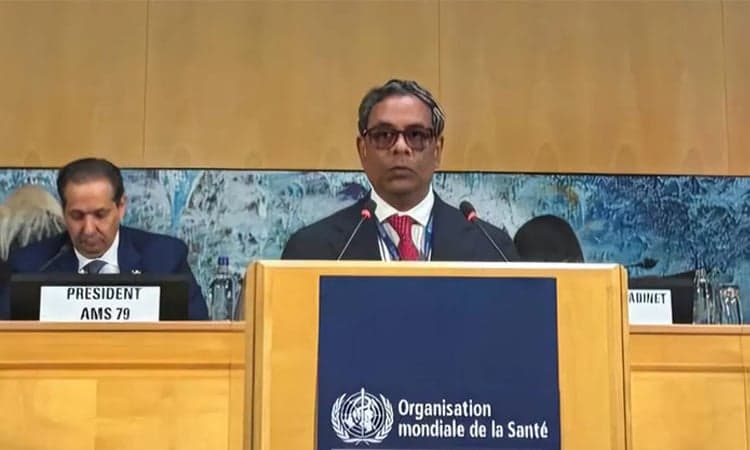

State Minister for Health and Family Welfare Dr. M. A. Muhit is leading the Bangladesh delegation at the '79th World Health Assembly' that began in Geneva, Switzerland. In his speech on behalf of Bangladesh, he said that the new government has placed health at the very center of national development. However, more than 70 percent of the country's total health expenditure still has to be paid by people from their own pockets, which is pushing many families into poverty.
Dr. M. A. Muhit said that to change this situation, the government is gradually increasing the government health allocation and working on integrated primary healthcare for all, effective referral system and modern digitalization.
A press release said that Bangladesh’s official statement was delivered at the main plenary session of the conference on May 19 by State Minister for Health and Family Welfare Dr. M A Muhit, who is leading a six-member high-level delegation at the world’s largest global health gathering, in Dhaka on Thursday (May 21).
In addition to the main session, Dr. M. A. Muhit also participated in the policy-making meeting of the Global Vaccine Alliance, a side event of the World Health Assembly, with health ministers from various countries. During this time, he outlined the ongoing health reforms of the current government and said that the government is working to expand healthcare for all, coordinate health information between the public and private sectors, strengthen the prevention of infectious diseases and strengthen activities to combat mental health, disability-friendly services and non-communicable diseases. He also said that various programs are being taken to increase health awareness and healthy lifestyles.
In his speech at the World Health Assembly, the State Minister for Health expressed concern about the negative health impact on Bangladesh, which is on the front lines of climate risk, and said that climate change is rapidly changing the pattern of diseases and creating serious additional pressure on the country's existing medical system. In addition, the long-term presence of over 1.3 million Rohingya refugees forcibly displaced from Myanmar has become a huge burden on Bangladesh's limited healthcare and infrastructure.
At the time, the Minister of State for Health called on world leaders to quickly finalize a safe, transparent, accountable and equitable 'Pathogen Access and Benefit Sharing' mechanism. Recalling the severe impact of global health financing cuts, conflicts and humanitarian crises on low- and middle-income countries, he urged for efficient use of resources. In particular, he stressed the need to strengthen global cooperation to combat silent killers such as non-communicable diseases and antimicrobial resistance.
Leave A Comment
You need login first to leave a comment