
Bangladesh missing out on $5 trillion halal market, exports still below $1bn
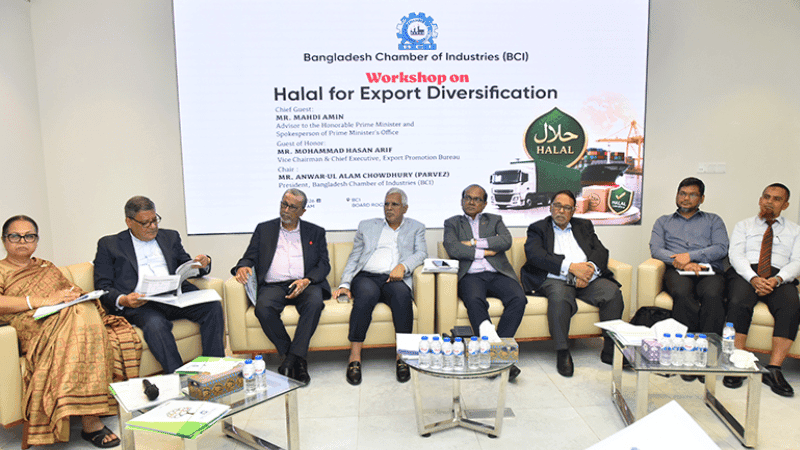

Despite the global halal economy surpassing $5 trillion, Bangladesh is exporting less than $1 billion worth of halal products annually, according to the sector stakeholders.
Speakers at a workshop titled "Halal for Export Diversification", organised by the Bangladesh Chamber of Industries (BCI) in Dhaka, said stronger policy support, internationally recognised certification and modern infrastructure are essential for Bangladesh to expand its footprint in the global halal industry.
According to Export Promotion Bureau (EPB) Vice Chairman and CEO Mohammad Hasan Arif, the global halal economy is now valued at around $5.2 trillion, while Bangladesh's annual halal exports stand at only $850 million.
He said the country remains largely dependent on food and agricultural exports despite significant opportunities in cosmetics, pharmaceuticals, fashion, tourism, manufacturing, fintech, education and research.
Arif identified the absence of a globally recognised national halal certification authority as one of the biggest barriers to export growth, saying a certification body similar to those in Malaysia or Türkiye would help Bangladeshi exporters access new international markets.
BCI President Anwar-ul Alam Chowdhury Parvez said the global halal market could reach $9.45 trillion by 2034, presenting a major opportunity for Bangladesh to boost exports of pharmaceuticals, ready-made garments, agricultural products and other value-added goods.
Presenting the keynote paper, Dr Md Mominul Islam, Assistant Professor at IUBAT, noted that Bangladesh has yet to cross the $1 billion mark in halal exports despite its strong agricultural base and industrial capacity.
Industry representatives also raised concerns over the cost and complexity of obtaining halal certification. They said Bangladesh currently has only around 300 halal-certified companies and 600–700 exportable halal products, compared with more than 2 million halal products produced by 25,000 manufacturers worldwide.
They called for internationally recognised certification, affordable compliance, modern testing laboratories, digital traceability and skilled manpower to unlock the sector's export potential.
Leave A Comment