
Bangladesh to initiate CEPA talks with India to reduce trade deficit
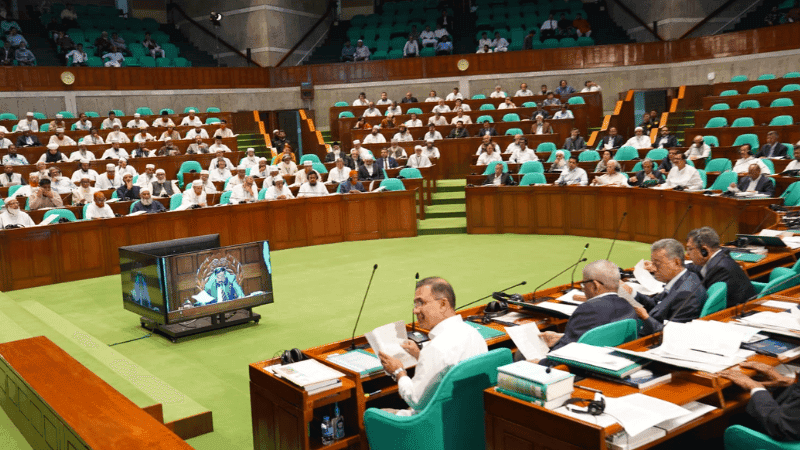

The government has initiated steps to implement the Comprehensive Economic Partnership Agreement (CEPA) with India to reduce the bilateral trade imbalance. The Minister for Commerce, Khandaker Abdul Muktadir, disclosed this in a written response during a parliamentary session.
During the question-and-answer session of Parliament held with Speaker Hafiz Uddin Ahmad in the chair, State Minister for Commerce Shariful Alam delivered the response on behalf of the absent Commerce Minister on Thursday (July 9).
According to government data, bilateral trade between Bangladesh and India amounted to USD 11,388.33 million in the 2024–25 fiscal year. Out of this, Bangladesh exported goods worth USD 1,764.23 million to the Indian market.
The Commerce Minister stated that to reduce the trade deficit, the government is pursuing policies aimed at developing domestic industries, increasing the production of import-substitute products, discouraging the import of goods that can be produced locally, and encouraging the import of raw materials and capital machinery.
He added that the proposed Import Policy Order 2026–2029 emphasizes enhancing the competitive capacity of domestic industries, ensuring the proper utilization of foreign exchange, and making the import management of essential commodities easier, more transparent, and up-to-date.
Responding to another query in Parliament, the minister informed that Bangladesh currently has Free Trade Agreements (FTAs) with two countries. Bilateral trade agreements were signed with Bhutan on December 6, 2020, and with Japan on February 6, 2026.
Meanwhile, regarding the recent conflict in the Middle East involving Iran, the Commerce Minister noted that the situation has created temporary uncertainties in the global energy market, maritime cargo transportation, international insurance systems, and supply chains. Particularly, due to the heightened security risks centered around the Strait of Hormuz, upward pressure has been created on the prices of crude oil, LNG, LPG, and maritime shipping costs in the international market.
However, he stated that while Bangladesh is not a direct party to this conflict, certain indirect economic risks have emerged due to its integration with the global economy. Nevertheless, no direct or quantifiable financial losses to Bangladesh's economy, trade, or commerce have been recorded so far due to this conflict.
Leave A Comment