

Bangladesh's climate change preparedness and challenges
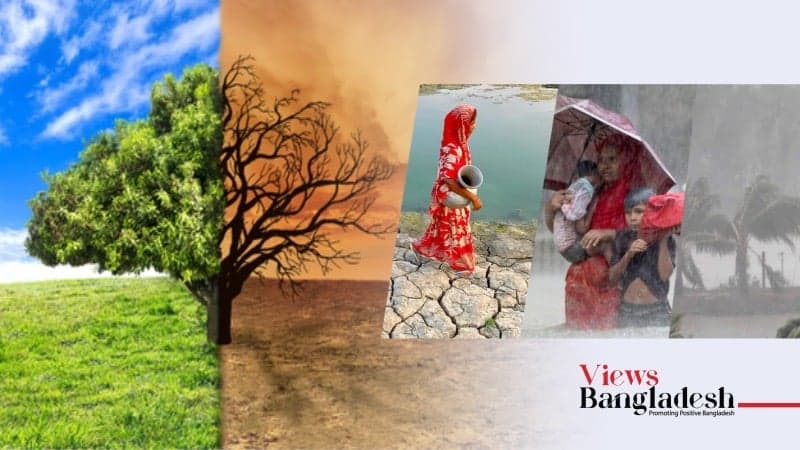

One of the most talked-about scientists of the modern world, Stephen Hawking, predicted the future by saying, Climate change will destroy the world in the next 600 years." Due to climate change, earth will resemble the planet Venus, where temperatures will soar to 250 degrees, and sulfuric acid rain will occur. We are currently facing a major catastrophe due to this climate change." Bangladesh is one of the most vulnerable countries in the world due to climate change. The country's millions of citizens have been directly affected by various catastrophic natural disasters such as cyclones, floods, landslides, droughts, and salinity intrusion at various times. Due to climate change, approximately 65 lakh people in Bangladesh have become climate refugees.
As temperatures continue to rise, the risk of three to four crore people in Bangladesh becoming climate refugees in the next few years is imminent. In this situation, how prepared is Bangladesh to tackle the challenges posed by climate change, and what measures are in place to address this issue?
Like many other countries around the world, Bangladesh has also taken preparations to combat the challenges of climate change. Through science-based weather and climate forecasting and improved services, the "Bangladesh Regional Weather and Climate Services Project (Component-E)" under the 'Rupkalpa-2041' initiative aims to enhance the quality of weather services. When implemented, this project is expected to significantly improve the quality of weather services in the country.
With a focus on addressing climate change and disaster mitigation, Bangladesh has adopted the "Bangladesh Delta Plan 2100" and the Eighth Five-Year Plan, both spanning a century. Due to advancements in modern technology, natural disasters and human-induced disasters are on the rise globally, making it even more crucial to prioritize disaster management alongside climate change mitigation efforts.
To receive advance warnings about disasters and daily weather updates, a toll-free service has been initiated in Bangladesh, accessible by dialing '1090' on mobile phones. The government has taken seven significant steps to improve the quality of agricultural and weather forecasting and advisory services, including the establishment of seven new agricultural weather monitoring stations. Five weather observation centers, nine seismic monitoring centers, and 14 river ports have been established in pursuit of disaster mitigation in Bangladesh. Additionally, three satellite ground stations have been set up. The installation of two modern Doppler radars is currently underway. Satellite telephone facilities are available in thirteen coastal districts of the country. All of these initiatives play a crucial role in effectively addressing the challenges of weather and climate change adaptation.
In the devastating cyclone of 1970, about 10 lakh people lost their lives. The then-Pakistani government did not issue any immediate warnings or alerts regarding this disaster. Immediately after independence two radars were installed in Cox's Bazar and Patuakhali’s Khepupara to provide early warning of cyclones and the institutional structure of disaster management was built. In the battle against climate change, the conservation of mangrove forests takes precedence. According to the Ministry of Environment, Forests, and Climate Change, Bangladesh is actively engaged in the preservation of mangroves in its coastal regions. Alongside mangrove conservation, efforts are underway for reforestation, which not only helps mitigate carbon emissions but also serves as a natural barrier against cyclones.
Mangrove afforestation provides several additional benefits, including biodiversity enhancement, fish habitat, and ecotourism opportunities. However, it is a costly endeavor, as annually, approximately 40 kilometers of mangrove plantation is being carried out along the coastal line. The conservation of mangroves in the protected Sundarbans region alone will require more than 10,500 crore Bangladeshi Taka (about 1.25 billion USD) over the next 30 years. Funding for these initiatives will largely come from climate funds. Additionally, proactive measures have been taken to establish early warning systems and construct shelters. Embankments are being built around low-lying lands to protect agriculture, households, and infrastructure from floods and cyclones. Productivity of employed labor in agriculture is being increased through investments and training, aiming to reduce the impact of future disasters. In regions prone to cyclones, efforts have been made to relocate approximately 10 lakh people to safer areas over the next decade following significant cyclone damages.
Over the past two decades, seawater intrusion into rivers, canals, streams, and ponds has been on the rise. Additionally, the intrusion of seawater into inland areas has been exacerbated by shrimp farming practices, where seawater is deliberately introduced into coastal areas. This has had detrimental effects on agriculture, fisheries, livestock, and the biodiversity of coastal forests. In response to the current situation, adaptive measures are being implemented to address the changing conditions, including adopting saline-resistant crop varieties.
The strategy adopted to overcome the negative impact on human life and livelihood due to climate change is called climate risk adaptation. This includes acquiring the knowledge and skills necessary for practices such as rainwater harvesting, water storage, and conservation, efficient water reuse, salinity management, and water use for wildlife and birds.
Climate-resilient breeds of livestock and successful poultry and poultry farming have been achieved among region-specific resilient species. Animal production of resilient species is facilitated through artificial reproduction methods. Livestock management encourages the cultivation of livestock-friendly crops, tree planting, and fruit tree propagation, promoting the use of resilient grasses for feed production, distributing region-specific grass seeds among the general population, improving agricultural management, and implementing measures for soil erosion control and afforestation.
There is no alternative to communication and management for resettlement, repopulation, animal production, conservation, market development, and overall development. Roads are being constructed, repaired, and infrastructure is being established as per demand. An Information and Communication Technology (ICT) development project is underway to facilitate rapid information exchange and communication.
In the battle against climate change, it is essential to recycle greenhouse gases from the animal husbandry sector and reuse them through processes such as solar power generation or recycling, with the aim of reducing reliance on natural resources and promoting sustainable energy production.
Lubna Yeasmin, joint secretary (Climate Change Division-1) of the Ministry of Environment, Forests and Climate Change, told Views Bangladesh that several initiatives have been taken to prepare for climate change and reduce risks. These initiatives include providing local communities with awareness about preparedness and understanding the use of shelters.
The management of livestock and poultry food and water supply at shelters, following the disaster and contingency policies adopted by various countries around the world, building cyclone-resistant homes, distributing literature on biodiversity conservation among university students for long-term disaster preparedness and mitigation, providing leadership and support to the general public for disaster preparedness and involvement in the work of local non-governmental organizations and civil society organizations, forming volunteer groups for disaster preparedness and response, establishing mechanisms to support them, and arranging alternative livelihoods to ensure that the impact of climate change does not harm people are some of the initiatives taken.
Additionally, in the last 10 years, various initiatives have been taken for the extreme poor, such as the Employment Generation Program, rural infrastructure development and monitoring, implementation of 130 projects worth Tk 1061 crore by the Palli Unnayan Board, humanitarian initiatives including cash and food distribution for the destitute, the KaBiKha program, VGF (Vulnerable Group Feeding), assistance for flood-prone and river-erosion-prone areas, construction of shelters, mobile technology use for sending early disaster warnings, awareness and educational programs, Bangladesh Forest Research Institute, natural disaster management, Bangladesh National Herbarium (taxonomy research on plant resources), forest and biodiversity conservation, monitoring of groundwater quality, Blue Economy-related programs, wildlife and biodiversity conservation regulations, industrial pollution control, establishment of ETPs (Effluent Treatment Plants), air pollution control, environmentally friendly banking, and green financing, among others.
In the face of climate change challenges, experts believe that Bangladesh will experience specific impacts such as rising sea levels, increased cyclone intensity, and more frequent heatwaves. These threats can have significant economic implications for the country and could potentially displace millions of people, especially in the southern regions.
Recent research has shown that due to climate change, Bangladesh is experiencing an alarming increase in temperatures. Over the past 50 years, the average temperature has risen by 0.5 degrees Celsius. This trend is expected to continue, and it is feared that by 2050, the country may experience an additional 1-2 degrees Celsius increase in temperature. This ongoing rise in temperature has already had a significant impact on human health, particularly in areas with extreme heat. Health effects include dehydration, fatigue, and other heat-related illnesses.
The results of research indicate that the impact of climate change in Bangladesh is significant, and it is expected to worsen in the future. For example, a study published in the "Nature Climate Change" journal suggests that due to climate change, by 2070, there could be an increase in heat-related mortality rates in Bangladesh. If no mitigation measures are taken, between 2030 and 2070, Bangladesh could experience an annual increase in heat-related mortality rates by 2.6%. The rising temperatures can also have adverse effects on agriculture, leading to crop losses and food security issues. Extreme heat can damage crops, reduce yields and affect food security. As temperatures rise, demand for air conditioning and other cooling systems increases, leading to higher energy consumption and greenhouse gas emissions. Higher temperatures can cause water evaporation, leading to droughts and drinking water shortages, which can affect agriculture, drinking water supply and sanitation.
Bangladesh is experiencing rapid urbanization, with more people moving to cities, especially Dhaka and other major urban centers. This urbanization can exacerbate the heat island effect, where urban areas become hotter than surrounding rural areas, primarily due to human activities like building and road construction. Increased temperatures in urban areas can have significant impacts, including harming crops, reducing agricultural productivity, and affecting food security.
In the context of extreme heat, the overall impact of climate change on Bangladesh is significant, and urgent measures are necessary. Mitigation strategies such as reducing greenhouse gas emissions, promoting sustainable land use practices, and improving urban infrastructure development can help mitigate the effects of climate change, create resilience, and establish the sustainability of its impacts.
The government has not taken any specific actions or initiatives to address this issue. They have acknowledged that they have not implemented any heatwave early warning systems or proactive measures to alert and protect the public from the adverse effects of extreme heat. Measures such as improved roads, irrigation systems, and water conservation facilities can help mitigate the impact of extreme heat, but the government has yet to take any initiatives in this regard, as confirmed by multiple sources within the Ministry of Climate Change.
Providing opportunities for vulnerable and impoverished communities to access cooling systems, such as electric fans, can reduce the risk of heat-related illnesses. Promoting energy efficiency and renewable energy sources, like solar power, can also help mitigate the emission of greenhouse gases, thereby reducing the impacts of climate change. Implementing sustainable practices and resilient infrastructure, such as efficient cooling systems and robust energy solutions, can alleviate the adverse effects of extreme heat associated with climate change.
Sharif Jamil, general secretary of Bangladesh Paribesh Andolon (BAPA), told Views Bangladesh that it is essential to focus on both adaptation and mitigation skills to combat the effects of climate change in Bangladesh. Adaptation measures, such as improving water and climate-resilient agricultural practices, can help the population cope with the impacts of climate change.
At the same time, mitigation strategies such as the promotion of renewable energy sources and reduction of greenhouse gas emissions can help limit the magnitude of climate change impacts and decrease their severity. However, the government has been somewhat indifferent to these measures.
He said that there are several effective solutions available for combating the effects of climate change, which can be implemented to mitigate their impacts, particularly in the face of extreme events like cyclones and floods.
These measures include constructing cyclone and wind-resistant homes and other buildings, as well as investing in coastal and drainage infrastructure. Additionally, improved coastal and drainage systems can help mitigate the impacts of these events. Adapting to changes in precipitation patterns is crucial for Bangladesh, as both floods and droughts are becoming more frequent. Enhanced water management, including irrigation and water storage, can help mitigate the impacts of these events. Reducing greenhouse gas emissions is of paramount importance in combating climate change. Encouraging the use of renewable energy sources such as solar and wind power, as well as promoting energy efficiency, can help reduce greenhouse gas emissions in urban areas, including the capital, Dhaka. Greening urban areas can also mitigate the heat island effect in cities, which results from the concentration of buildings and concrete surfaces that absorb and radiate heat, making urban areas warmer than their surroundings. This can be achieved through afforestation, the creation of green spaces, and sustainable urban planning.
Climate expert Dr Atiq Rahman told Views Bangladesh that "Bangladesh is one of the countries on the list of nations affected by climate change. However, when it comes to temperature control, Bangladesh may not have done much, because the problem is global. The solution lies in the direction of the developed countries. We are facing more disasters here, rivers are eroding, more and more cyclones, floods are occurring. Along with that, drought is increasing in Northern Bangladesh, and salinity is increasing in Southern Bangladesh. All of this is happening due to climate change."
He said that “Heatwaves and other extreme weather events can pose a deadly threat to public health. Improved healthcare and public health education, along with the enhancement of public health infrastructure, can help mitigate these impacts. Biodiversity conservation is crucial to reducing the effects of high temperatures. Sustainable architecture, the promotion of resilient agriculture, reduction of greenhouse gas emissions, and reforestation are all measures that can help protect biodiversity and mitigate the effects of heatwaves.”
He further said that “The impact of climate change in Bangladesh is significant and poses a threat to the country's development and economic growth. However, through adaptation and mitigation measures, Bangladesh can build resilience and reduce the effects of climate change. Increasing awareness about these challenges and implementing effective solutions are essential to ensure a sustainable and prosperous future for the country.'"
Leave A Comment
You need login first to leave a comment