

Bangladesh's December dilemma: Rising fundamentalism or spirit of '71
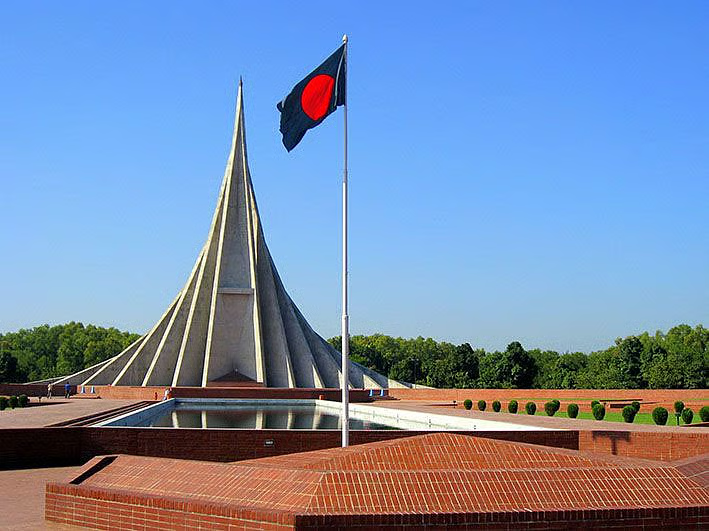

Every December, a strange light ignites in the heart of Bangladesh— victory, grief and pride blend into an overwhelming emotion. The victory of 1971 was not just the end of a war, but the triumph of a nation fighting for existence, the liberation of a civilisation. Every year, December reminds us of the sacrifices of the freedom fighters and the pride of a red-green flag born through immense struggle. Yet the question arises; 53 years after victory, are we still holding on to that spirit? Or is that light fading amid political instability, social division and the currents of time? Several recent incidents have intensified this question.
In post-uprising 2024 Bangladesh, the way fundamentalist and extremist groups have begun to rise is not only alarming but also creates fresh crises for national security and identity. Attacks on Bengali cultural and Liberation War symbols, the vandalism of sculptures of the Liberation War and Bangabandhu, attacks on Baul artists, the rise of extremism on university campuses, all these feel like a haunting repetition.
No matter how much fundamentalists try to portray fundamentalism as harmless, is that really the case? If one says that fundamentalism and thuggery are two sides of the same coin, both groups would rush to assault you. And in doing so, they would prove the idea is not false. Both are dangerous, both harmful to the nation.
Fundamentalist activism in America began after World War I, when some groups, in frustration, stood against liberalism and modernity, claiming salvation lay in returning to the Bible. They even demanded that evolution not be taught in schools. But there is a fundamental difference between their fundamentalism and ours. Here, it is far from harmless; it does not go to court—it charges forward. The horrors of 1971 proved how violent fundamentalism can be, when it turned into a killing force under the protection of the Pakistani military.
Unfortunately, fundamentalist activity is growing again in this country, just as thuggery is spreading. Many are worried, deeply anxious. There is no shortage of criticism either. Yet they are not stopping; rather, they seem to be getting stronger.
In Rajapur of Jhalokathi, the Tohidi Janata vandalised a Liberation War sculpture and replaced it with a sculpture of the Quran. Does this not signal that their anger is not toward sculptures themselves, but specifically toward Liberation War sculptures?
The provisional government of wartime Bangladesh was formed in Mujibnagar of Meherpur. On April 17, 1971, the Mujibnagar Government was formed with Bangabandhu Sheikh Mujibur Rahman as president, Syed Nazrul Islam as vice-president and Tajuddin Ahmad as prime minister. To give greater significance to the mango grove of Baidyanathtala, the site of the oath-taking, the Mujibnagar Memorial Complex was developed. After the political change on August 5 last year, more than three hundred sculptures there were vandalised. The small sculptures depicting battles across the 11 sectors of the Liberation War were destroyed. The main gate of the memorial was also torn down. Fifteen months have passed, yet no restoration has taken place. One of the two surviving Ansar battalion members who gave the guard of honour to the Mujibnagar Government, Bir Muktijoddha Azimuddin Sheikh, lamented, “Those who vandalised the Liberation War sculptures on August 5 did not understand what they destroyed!”
In Khulna, the sculpture of Sheikh Mujibur Rahman and the historic house at number 32 were bulldozed, an open insult to the forerunner of the independence struggle of a sovereign nation. Beyond this, attacks on Liberation War memorials have taken place across many regions, from Kushtia to Sylhet, from the capital to districts.
The regrets of freedom fighter Azimuddin Sheikh, shared by all freedom fighters, do not end there. It would be wrong to think the insult is limited only to the destruction of sculptures. After the victory of 1971, could they ever have imagined that December would begin with chants of “Pakistan Zindabad”? Yet that is exactly what happened at a “Qirat” conference at the South Sandwip High School field in Chattogram.
Across the country, followers of one group or another are being attacked, songs are being stopped, and in many places young people are being intimidated to keep them away from any progressive practice. Are the environments of universities normal? Groups are growing on campuses who openly reject the ideals of the Liberation War and the secular concept of the state. Research organisations and international reports frequently warn that fundamentalist elements in Bangladesh are becoming rapidly organised and are waiting to use religion as a political tool to divide society.
These recent incidents raise a single question— standing in the month of victory, is our ideological triumph now at risk?
Fundamentalists claim they will use religion to bring order to society. If that were possible, Pakistani soldiers would not have become so unruly. If anyone wants to see the true face of fundamentalists, they will find it in the Al-Badr forces of 1971—a face even more horrendous than the Pakistani soldiers. Our Liberation War sought to establish secular ideals, but that did not succeed. Later, the fascist attitude of the Awami League era, where secularism, liberation spirit was imposed rather than organically nurtured, pushed young people further away from the ideal and created resentment.
Yet the greatest strength in Bangladesh’s history has always been its youth. In 1971, young people took up arms and gave their lives. In the mass movement of 1990, they toppled military rule. And in the uprising of 2024, they proved again that Bangladesh will not bow its head. The eyes of the hundreds of thousands of young people who took to the streets burned with the same fire as the freedom fighters. “The spirit of victory” and “the value of independence” were no longer just words in history, they became the driving force of their movement.
Where extremist forces tried to intimidate people, young citizens stood firm, declaring that Bangladesh is a secular, humane and progressive state that will not surrender to those who abuse religion. Where extremists destroyed sculptures, young people stood before the broken monuments with candles. Where music was silenced, young people raised their voices again in songs of freedom. This new generation has proven that the spirit of victory has not died; it runs in our blood. It only needs to be upheld and protected in the right way.
December not only reminds us—it makes us take an oath. Do we not want a Bangladesh where the history of the Liberation War cannot be distorted? Where, if fundamentalism rises, the state, society and youth stand united and say, “No, this is not my Bangladesh”? Where culture, humanity, language, art, free thought and secularism cannot be trampled?
The month of victory reminds us that the price of independence is not limited to the war of 1971; today’s daily battles are its continuation. No matter how frightening the rise of fundamentalism becomes, the awakening of the youth has shown that Bangladesh does not stop in the face of danger. Whatever spirit of victory remains today is pure, not imposed. The country’s future is still on a path of light—if we truly uphold the ideals of victory and independence together.
Thus, December is not merely a month of memory—it is a month of vigilance, resistance and renewed awakening.
Leave A Comment
You need login first to leave a comment