
Climate migrants in Dhaka: The human face of Bangladesh’s climate crisis
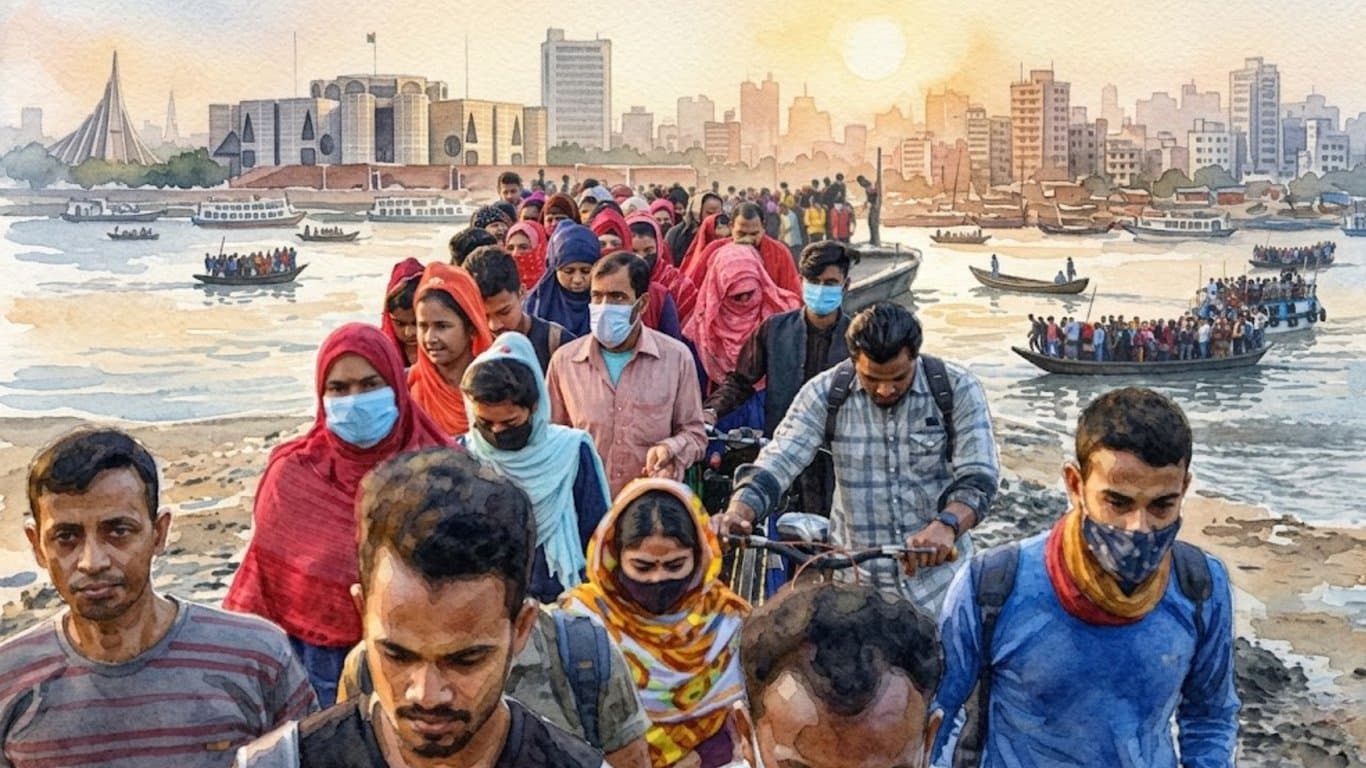

Every morning in Dhaka, millions of people pass by street vendors on crowded footpaths, rickshaw pullers weaving through impossible traffic, and construction workers laboring under the heat to build the city’s ever-expanding skyline. To many urban residents, they are simply part of Dhaka’s informal economy- visible yet invisible at the same time.
But behind many of those tired faces are untold stories of homes lost to river erosion, farmlands destroyed by salinity, villages shattered by cyclones, and families forced to leave everything behind just to survive. Their journey to Dhaka was not driven by dreams alone, but by displacement, desperation, and the harsh realities of climate injustice.
A significant number of the people working in Dhaka’s informal sector did not migrate to the capital merely in search of opportunity. They arrived because climate change destroyed the lives they once knew.
Bangladesh is now widely recognized as one of the world’s most climate-vulnerable countries. According to the Global Climate Risk Index published by Germanwatch, Bangladesh has consistently ranked among the countries most affected by extreme weather events over the past two decades. Cyclones, floods, river erosion, salinity intrusion, drought, and sea-level rise are no longer distant environmental threats. They are daily realities forcing thousands of families to abandon their homes and livelihoods every year.
The climate crisis in Bangladesh is increasingly becoming an urban crisis.
From Coastal Villages to Dhaka’s Footpaths
In the coastal districts of Satkhira, Bhola, Barguna, Patuakhali, Khulna, Bagerhat, and Cox’s Bazar, recurring cyclones and tidal surges repeatedly destroy homes, croplands, fisheries, and infrastructure. Salinity intrusion has made vast areas of agricultural land unsuitable for cultivation, while freshwater scarcity is becoming increasingly severe.
Cyclones Sidr (2007), Aila (2009), Amphan (2020), and Remal (2024) displaced millions of people across coastal Bangladesh. For many families, rebuilding after each disaster has become nearly impossible.
According to the World Bank’s “Groundswell Report,” Bangladesh could have more than 13 million internal climate migrants by 2050 if urgent climate adaptation measures are not taken. Most of these migrants are expected to move toward urban centers, especially Dhaka.
In Satkhira alone, rising salinity has dramatically reduced agricultural productivity. Farmers who once cultivated rice and vegetables are increasingly unable to sustain farming. Many are forced to lease their land for shrimp cultivation or abandon agriculture altogether. Others migrate to cities.
Meanwhile, districts such as Kurigram, Lalmonirhat, Gaibandha, Jamalpur, Sirajganj, Faridpur, Shariatpur, and Madaripur continue to experience severe river erosion. Every year, powerful rivers such as the Jamuna, Padma, and Brahmaputra swallow homes, schools, roads, and agricultural land.
River erosion is often described as a “silent disaster” because it receives far less international attention than cyclones or floods. Yet for affected families, the impacts are equally devastating. A household may lose not only land and shelter but also generations of social identity, community connection, and economic security overnight.
In the northwestern districts of Rajshahi, Naogaon, and Chapainawabganj, prolonged droughts and water scarcity are undermining agriculture-based livelihoods. Declining groundwater levels and irregular rainfall patterns are making farming increasingly uncertain.
For many climate-affected families, migration becomes not a choice but a survival strategy.
Why Dhaka?
Most climate-displaced people initially migrate to nearby towns or district headquarters. But limited employment opportunities eventually push many toward Dhaka, the country’s economic center.
The problem is that climate migrants arriving in Dhaka rarely possess the education, social networks, or financial capital required for formal employment. As a result, they enter the informal economy.
They become street vendors, rickshaw pullers, construction laborers, domestic workers, waste collectors, transport helpers, or garment workers because these occupations require minimal investment and few formal qualifications.
According to Bangladesh Bureau of Statistics (BBS) data, more than 85 percent of Bangladesh’s labor force works in the informal sector. Dhaka’s informal economy is therefore not simply an economic phenomenon. It is deeply connected to environmental displacement and climate vulnerability.
Yet urban policies rarely recognize this connection. Instead of being treated as citizens displaced by climate impacts, many climate migrants are viewed as “illegal encroachers,” “footpath occupiers,” or “urban burdens.” Eviction drives against street vendors and informal settlements often occur without addressing the structural reasons behind migration.
The irony is painful: people displaced by a crisis they did little to create are often criminalized simply for trying to survive.
Climate Change is also a Crisis of Inequality
Bangladesh contributes less than 0.5 percent of global greenhouse gas emissions, yet it remains among the countries suffering the harshest consequences of climate change.
Within Bangladesh itself, climate impacts are also deeply unequal. Those most affected are often low-income households, landless farmers, women, fishers, persons with disabilities, and marginalized communities who possess the fewest resources to adapt.
Climate migrants arriving in cities frequently end up living in informal settlements with poor sanitation, unsafe housing, limited access to healthcare, and insecure employment. Many become trapped in cycles of urban poverty.
Women climate migrants face additional challenges, including workplace exploitation, unsafe housing conditions, and increased risks of gender-based violence. Children from displaced families often experience disruptions in education and nutrition.
Climate change therefore cannot be understood solely as an environmental issue. It is simultaneously a crisis of livelihoods, public health, housing, urban governance, labor rights, and human dignity.
The Invisible Workforce Sustaining Dhaka
Ironically, the same people often marginalized in urban planning are essential to the functioning of Dhaka itself.
Street vendors provide affordable food and daily necessities to millions of urban residents. Rickshaw pullers sustain short-distance urban mobility in areas inaccessible to cars. Construction workers build roads, bridges, apartments, and commercial complexes that drive urban expansion.
Without informal workers, Dhaka’s economy would struggle to function. Yet these workers remain excluded from social protection systems, labor rights protections, climate adaptation planning, and urban policy discussions.
Most climate migrants lack legal recognition, secure housing, healthcare coverage, or financial safety nets. A single illness, eviction, flood, or economic shock can push entire families deeper into poverty.
A Question of Humanity
The next time we see a street vendor on a Dhaka footpath or a rickshaw puller struggling through traffic under extreme heat, we should ask ourselves a difficult question:
What circumstances forced them here?
Many of these individuals once had homes, land, farms, fishing livelihoods, and communities. Climate disasters, river erosion, salinity, and economic collapse pushed them toward uncertain urban survival. They are not merely migrants searching for income. They are among the frontline victims of a global climate crisis.
And if climate change continues to intensify without adequate adaptation, protection, and justice, the number of climate-displaced people moving toward cities like Dhaka will continue to rise dramatically in the coming decades.
The climate crisis is no longer confined to coastlines or riverbanks. It is already present in our streets, labor markets, housing systems, and urban inequalities. The people on Dhaka’s footpaths are not outside the climate conversation. They are at the centre of it.
Recommendations to Mitigate the Challenges Faced by Climate Migrants in Cities like Dhaka
Bangladesh has made important progress in disaster preparedness and climate adaptation over the past decades. Community-based cyclone preparedness programs, early warning systems, and climate adaptation initiatives have saved countless lives.
However, urban climate migration remains insufficiently addressed. Climate migration should not be viewed merely as a humanitarian issue; it must be integrated into national urban planning and development strategies. Several policy priorities are becoming increasingly urgent:
1. The Government of Bangladesh should establish a formal legal and policy framework to recognize people displaced by climate change as climate migrants. This recognition is essential to ensure their inclusion in national planning, social protection programs, urban services, and disaster response mechanisms.
2. Cities like Dhaka must develop affordable, safe, and climate-resilient housing for low-income climate migrants. Slum upgrading, improved sanitation, drainage systems, access to clean water, and protection from forced eviction should become major urban policy priorities.
3. Street vendors, rickshaw pullers, construction workers, domestic workers, and other informal laborers should receive access to healthcare, insurance, emergency cash support, pension schemes, and labor protections. Since many climate migrants work in the informal sector, strengthening social protection is critical for reducing urban vulnerability.
4. Climate migrants often lose their traditional farming or fishing livelihoods after displacement. The government and development partners should provide vocational training, technical education, small business support, and access to green jobs to help migrants secure safer and more stable urban employment opportunities.
5. Climate migrant communities living in informal settlements require better access to healthcare, sanitation, safe drinking water, waste management, and electricity. Expanding community clinics and affordable public services in low-income urban areas is essential for improving living conditions and public health outcomes.
6. Women and children affected by climate displacement face heightened risks of exploitation, violence, unsafe housing, child labor, and interrupted education. Policies should prioritize safe shelters, education access, childcare support, legal protection, and gender-sensitive social services for displaced families.
7. To reduce migration pressure on Dhaka, the government should invest in economic opportunities, industries, healthcare, and public services in secondary cities and vulnerable districts. Balanced regional development can help people remain closer to their communities instead of being forced into overcrowded urban centers.
8. Investments in embankments, river protection, freshwater systems, climate-resilient agriculture, mangrove restoration, and disaster preparedness programs can reduce forced displacement from coastal and river erosion-prone regions. Strengthening local resilience is one of the most effective ways to minimize climate migration.
9. Climate migrants should be included in urban planning and decision-making processes. Local governments should engage migrant communities, informal worker associations, and grassroots organizations in developing policies related to housing, transportation, labor rights, and urban adaptation strategies.
10. Bangladesh contributes very little to global carbon emissions yet suffers disproportionately from climate impacts. Wealthier industrialized countries must provide adequate climate finance, adaptation support, and loss-and-damage compensation to help vulnerable countries like Bangladesh address climate displacement and urban climate challenges.
Mamun Kabir, Human Rights and Environmental Activist, Poet, and Columnist.
Leave A Comment