
Coastal region use of chemical's and pesticides in agriculture across it's impact both economy and the environment
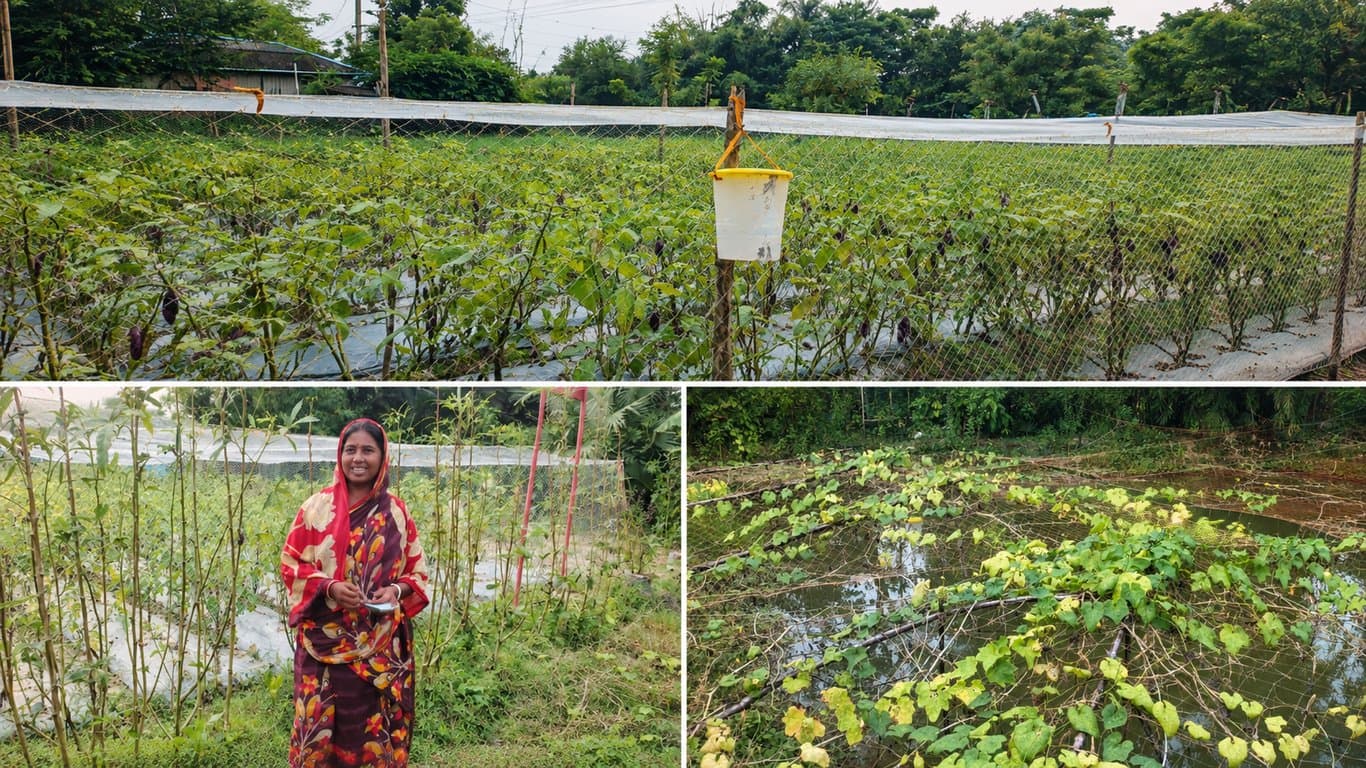

In the vast agricultural tracts of Shyamnagar Upazila, Satkhira—a coastal area adjacent to the Sundarbans in the country's south—decades of shrimp farming involving the pumping of saline river water onto croplands have caused soil salinity to rise to such an extent that it is no longer possible to cultivate crops using fresh water, even if one wished to do so. Nevertheless, local farmers have been attempting to grow fresh-water crops on their land over the past decade.
That is why they are now cultivating paddy on their agricultural land more than once a year. At the same time, they are collecting lost seed varieties and cultivating various local types of vegetables and crops. Farmers are now facing various challenges in growing crops on their land.
Rising production costs for farmers and health risks for people
The use of chemical fertilizers and pesticides in local agriculture is harming both the environment and human health, while simultaneously driving up costs for farmers. Due to soil salinity, local farmers are compelled to use these chemicals in large quantities. Consequently, the land is losing its fertility, and farmers are forced to rely heavily on chemical inputs to produce paddy and other crops; failure to apply these substances at the right time results in reduced yields.
Farmer's are compelled to use chemical fertilizers and pesticides to meet production targets. By using these chemicals, they obtain nearly five times the yield compared to cultivating paddy on a *bigha* of land using only natural fertilizers. Consequently, farmers are forced to rely on chemical fertilizers and pesticides. However, the use of these excessive inputs is depleting soil fertility and driving up production costs, leading to various adverse consequences. Farmers are producing nearly twice as much crop yield by using chemical fertilizers and pesticides compared to what they produce using natural fertilizers. However, there is a ray of hope; local farmers under Shyamnagar Upazila are gradually being encouraged to adopt natural fertilizers and organic pesticides with the assistance of BARCIK, a non-governmental research organization.
Dependence on loans
Farmers are falling into debt by using excessive fertilizers and pesticides to meet their production targets, primarily because they lack sufficient financial self-reliance. They often do not have the necessary funds on hand during the cultivation period; if they cannot apply fertilizers and pesticides on time after sowing seeds, they risk a poor harvest. Consequently, farmers are compelled to borrow money to purchase these inputs, obtaining loans during the season from seed companies, local fertilizer dealers, pesticide traders, moneylenders, and microfinance institutions. However, they have to pay installments throughout the year to repay this loan. In most small-scale farming families, it is the female members who obtain loans from microfinance institutions. At times, they are also compelled to borrow from local moneylenders at high interest rates.
Environmental degradation
The prolonged use of chemical fertilizers and pesticides in the region's agriculture has had an adverse impact on the environment. Fruit trees such as mango, jamun, lemon, coconut, sapodilla, and wax apple are no longer seen in the area. In the past, every household had various fruit trees; trees were planted for domestic use, providing timber for constructing houses and making furniture. Such trees can no longer be found today.
In the few places where coconut, wood apple, palmyra palm, or jackfruit trees still remain, they no longer bear fruit as they used to. These local varieties are on the verge of extinction due to the ravages of saline water and pesticides. In the past, the presence of diverse fruit trees provided habitats for birds to nest and thrive in the area. Now, the very existence of these birds, along with various local flora and fauna, is under threat. Due to the use of chemical fertilizers and pesticides in agriculture, creatures such as snails, frogs, snakes, and fireflies—as well as various bird species—have all but disappeared from the area. Many species have been lost completely.
Impact of corporate companies
Coastal farmers have become captive to corporate companies. Although they had long managed to sustain farming despite various other challenges, they are now unable to carry out agricultural activities outside the scope of these corporate entities. They no longer have control over their seeds; due to soil salinity in the region, cultivating local seed varieties is no longer feasible. Consequently, farmers are compelled to purchase seeds from corporate companies, and the cultivation of these seeds necessitates the use of chemical fertilizers and pesticides.
Otherwise, crops cannot be produced on the land. Farmers are forced to purchase seeds every year, whereas in the past, they used to save seeds at home from the crops harvested on their own land and could even exchange seeds with one another. Coastal farmers find themselves unable to break free from the grip of corporate companies to carry out their agricultural activities, as they lack seeds, sufficient natural fertilizers and pesticides, and substantial capital.
To survive and preserve their existence, farmers in this region are being compelled to abandon the knowledge of their ancestors and advance agriculture while held captive by corporate companies.
Rising health risks
The continuous use of chemical fertilizers and pesticides in agriculture across this region is causing various health issues linked to the vegetables and crops produced. Women and children are particularly susceptible to these ailments. The combination of high-yielding vegetable and paddy varieties and soil salinity is constantly exacerbating health risks for the local population.
Various studies have shown that women in this area suffer from a range of ailments—including uterine cancer, impaired vision, reproductive health issues, heart problems, and frequent colds and fevers—throughout the year as a result of using chemical fertilizers and pesticides on the land.
A structural crisis at the highest level
The struggle for survival faced by coastal communities fails to gain traction among the state, political circles, and the upper echelons of society. Farmers in this region have never held political significance. The agricultural challenges faced here differ vastly from those in other parts of the country; yet, the state structure lacks a dedicated unit to address the specific needs of farmers in this area. For a long time, these farmers have been campaigning for the establishment of a separate ministry or directorate to cater to the agricultural needs of this disaster-prone region.
However, no government has yet taken any significant measures for farmers and the general public to safeguard the livelihoods of farmers and the very existence of coastal communities; consequently, they have remained deprived.
Amidst such adversity, some farmers have shared a message of hope. On-site discussions were held with farmers Tumpa Rani Mondal, Kalpana Rani Mistri, and Jogesh Chandra Mondal. During extensive conversations at their farms, they explained how a local non-governmental research organization is providing technical support for the cultivation of chemical-free vegetables and paddy, as well as for the production of fruits and crops.
BARCIK, a non-governmental research organization, has long been working in Shyamnagar Upazila to safeguard the livelihoods of farmers and the region's agriculture. As part of this ongoing effort, we spoke with Tumpa Rani Mondal—a successful farmer and member of the BARCIK-organized ‘Shatobari’ initiative—at her ten-katha agricultural farm. In Kultali village of Munshiganj Union, Tumpa Rani cultivates her land using natural fertilizers and pesticides with BARCIK's support.
She recalls seeing his parents working in the fields, noting that back then, they did not need to purchase and apply vast quantities of fertilizers and pesticides. His father, uncles, grandfather, and ancestors used to cultivate the land by simply collecting household waste, vegetable scraps, and ash, and spreading this mixture on the fields once a year. Nowadays, however, seeds, fertilizers, and pesticides must be purchased from companies; company representatives often visit their homes to provide samples of new seed varieties, fertilizers, and pesticides. Nevertheless, with the support of BARCIK, he has begun collecting and preserving local seed varieties himself. She has started using natural fertilizers, pesticides, and insect traps to cultivate paddy and other crops on his own land as well as on leased land.
Regarding the use of natural fertilizers and organic pesticides, farmer Tumpa Rani Mondal states that she cultivates vegetables and paddy with the support of BARCIK, employing these natural inputs. This practice has led to the formation of a buyer group that regularly contacts her to purchase produce grown using natural fertilizers and pesticides; consequently, her vegetables and paddy are sold quickly.
We spoke with Jogesh Chandra Mondal, a farmer from Jelekhali village in Munshiganj Union, Shyamnagar Upazila, about modern agriculture. He noted that agriculture has undergone significant changes in recent times. Corporate companies are regularly engaging with marginal farmers, bringing new seeds, fertilizers, and pesticides to our markets and neighborhoods. Every year, they provide us with new varieties of hybrid vegetable and paddy seeds—sometimes for free and at other times at a nominal cost—for their initial introduction.
After cultivating these new varieties, we farmers find ourselves compelled to source seeds, fertilizers, and pesticides from the companies' dealers for the following year, driven by the prospect of higher profits. This is because the yield from these varieties is higher, whereas our indigenous and local varieties of rice and vegetables produce lower yields. We are effectively forced to work with these companies. In the past, our forefathers used to preserve seeds from local varieties to sow the following year. They cultivated their crops using natural fertilizers collected at home—such as ash, vegetable scraps, decomposed leaves, and dried cow dung.
However, prolonged exposure to saline water has led to a decline in vegetation in the area. In some places, there is virtually no vegetation left.
Jogesh Chandra Mandal further added that, like him, many other farmers are seeing a ray of hope for the future through their association with the research organization BARCIK. They have begun cultivating local seed varieties on a small scale, using natural fertilizers and pesticides.
Aalpana Rani Mistri, a farmer from Dhumghat village in Ishwaripur Union, has been associated with the research organization BARCIK for the past several years. With BARCIK's support, she has organized several groups of female farmers in the area. For nearly a decade, members of these groups have been conserving and exchanging various seeds, including those for local varieties of rice, vegetables, fruits, and flowers. Currently, Kalpana Rani Mistri maintains a collection of over four hundred different varieties of local seeds. She distributes and exchanges seeds among local farmers. The number of seeds he preserves is constantly increasing.
Agriculturist Iqbal Ahmed, Acting Deputy Director of the Satkhira District Department of Agricultural Extension (Khamarbari), stated that the Agriculture Department has undertaken various programs for the cultivation of crops, vegetables, and paddy on saline lands in Shyamnagar Upazila, a coastal area adjacent to the Sundarbans.
These initiatives include the expansion of salt-tolerant crop varieties; increased use of organic fertilizers and poly-mulching; expansion of ginger and vegetable cultivation in sacks; excavation of mini-ponds; implementation of drip irrigation; cultivation of off-season watermelons and vegetables on the embankments of fish enclosures; zero-tillage cultivation of mustard, grass pea (khesari), and maize; growing vegetables as companion crops (such as lentils and chickpeas with sugarcane, or short-duration vegetables); increased cultivation of *Dhaincha* (Sesbania) as green manure; vegetable farming using the tower method; adoption of the *Sorjan* technique; cultivation of leafy greens and vegetables using the bed-and-furrow method; and the cultivation of salt-tolerant crops and fruits such as sunflowers, wood apples (*kodbel*), sapodillas (*sofeda*), tamarinds, coconuts, and Indian gooseberries (*amla*).
Leave A Comment