
Demand to reconsider prices of low-tier cigarettes, smokeless tobacco products
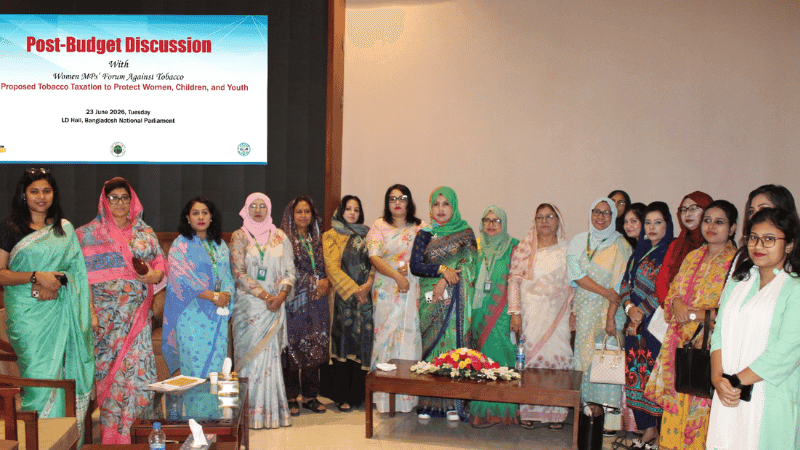

Members of the Women MPs’ Forum Against tobacco have called for a more effective review of the tax and pricing measures for low-tier cigarettes and smokeless tobacco products in the proposed national budget for FY 2026–27. They expressed this view during a post-budget discussion held at the Parliament LD Hall on Monday (June 23).
The speakers noted that “the government has demonstrated its commitment to public health by increasing allocations to the health sector, which is a highly commendable initiative. However, they emphasized that achieving public health objectives requires a more substantial increase in the prices and tax rates of tobacco products. Effective tobacco taxation is a globally recognized and proven strategy for reducing tobacco consumption and protecting public health.”
The meeting was informed that, public health and tobacco control experts had proposed simplifying the cigarette tax structure by reducing the existing four-tier cigarette market to three tiers and increasing prices accordingly. Since the prices of low-tier and medium-tier cigarettes are very close, consumers can easily switch to a slightly cheaper brand when prices rise in one tier. To address this issue, experts proposed merging the low and medium tiers and setting the retail price of a 10-stick pack at BDT 100. They also recommended retaining the existing 67% Supplementary Duty (SD) on all cigarette tiers while introducing a specific tax of BDT 4 per 10-stick pack.
However, the government’s budget proposal introduced only a marginal increase in cigarette prices. The retail price of a 10-stick pack of low-tier cigarettes was increased from BDT 60 to BDT 62. Approximately 75 percent of all cigarette sales in Bangladesh come from this low-tier segment. Therefore, the increase of only BDT 2 is considered insignificant. In practice, these cigarettes are already being sold individually at BDT 7 per stick across the country. This means that even if tobacco companies continue selling at the current market price, they will earn an additional profit of BDT 0.80 per stick, which would remain untaxed.
In FY 2023–24, a total of 68.89 billion low-tier cigarette sticks were sold in Bangladesh. At an additional profit margin of BDT 0.80 per stick, tobacco companies could earn approximately BDT 55.12 billion (BDT 5,512 crore) in untaxed profits. Consequently, the government stands to lose a significant amount of potential tax revenue.
Furthermore, the proposed budget did not incorporate the recommendation to impose a specific tax of BDT 4 per 10-stick cigarette pack. Maintaining the 67% Supplementary Duty without introducing a specific tax would allow tobacco companies to generate substantial additional profits.
Therefore, it appears that the proposed budget, rather than strengthening public health protection and maximizing government revenue, creates greater opportunities for tobacco companies to increase their profits. At the same time, it may increase health risks among young people and low-income consumers by keeping tobacco products affordable.
The meeting also noted that the proposed budget has introduced pricing measures and imposed Supplementary Duties on nicotine pouches and Heated Tobacco Products (HTPs). In addition, Supplementary Duties have been imposed on the import of nicotine granules and nicotine pouches. Taxing these products effectively grants them legal recognition, which may facilitate the expansion of their market. This could increase the risk of nicotine addiction, particularly among adolescents and young people.
The participants therefore urged the government to reconsider the tax and pricing measures for low-tier cigarettes and smokeless tobacco products in the proposed FY 2026–27 budget, taking into account the recommendations of public health and tobacco control experts.
According to public health and health economics experts, implementing the proposed reforms could generate an additional BDT 44 billion in government revenue. It could also encourage nearly 500,000 adult smokers to quit, prevent approximately 372,000 young people from initiating smoking, and avert nearly 400,000 premature deaths in the long term.
The discussion was chaired by Rasheda Begum Hira, Vice-President of the Women MPs’ Forum Against Tobacco. Members of Parliament present at the event included Newaz Halima Arly, Bilkis Islam, Farida Yeasmin, Sabira Sultana, Sunsila Jabrin, Ferdousi Ahmed, Jahrat Adib Chowdhury, Salina Sultana, Shcotara Akter, Rezeka Sultana, Nadia Pathan Papon, Momtaj Alo, Helen Jerin Khan and Suraia Zarin. Also present was Shahin Akter Dolly, Executive Director of Nari Maitree. All participants called for a reconsideration of the proposed tax and pricing measures for low-tier cigarettes and smokeless tobacco products in the national budget in order to protect public health and curb excessive profits by tobacco companies.
Leave A Comment