
Dwellers in both way crisis : Stoves fail to Ignite, yet electricity bill continues to climb
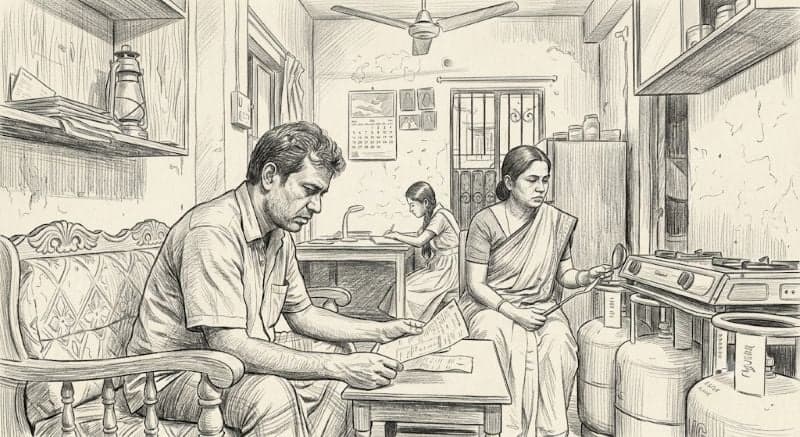

Last week, a lengthy line formed outside the Rural Electrification Board office in Hili, Dinajpur. Not all individuals were present to settle their electricity bills. Many simply held their bills, inquiring about the same issue: Why has my bill increased so significantly?
A comparable situation occurred in Betagi, Barguna. Consumers there reported receiving bills that were double or even triple their usual amounts. Some claimed that the bills were generated based on estimates rather than actual meter readings. This issue is no longer isolated.
Throughout Bangladesh, individuals are sharing images of their electricity bills on Facebook almost daily, expressing disbelief at the sudden hike. For users of prepaid meters, the distress is even more pronounced. They report that their recharge balance depletes much more quickly than before. Funds that once sufficed for an entire month of electricity now barely last a week.
When the balance runs out before the month concludes, they are compelled to utilize emergency credit, which is deducted from the next recharge. Consequently, they receive even fewer units the next time, perpetuating a cycle of ongoing shortages.
The government has provided an explanation. The Power Division asserts that the increased bills are not a result of faulty meters. Officials state that new electricity tariffs were implemented in June, reduced load shedding has led to higher electricity consumption, and increased usage has pushed many households into higher tariff brackets. The State Minister for Power and Energy has also mentioned that individual complaints were examined and that most arise from misunderstandings. That explanation is not entirely inaccurate.
Many consumers lack familiarity with the slab-based pricing system in Bangladesh. For instance, a household that previously consumed 200 units of electricity has now increased its usage to 250 units this month. This represents a mere 25 percent increase in consumption.
However, the additional 50 units are charged at a higher rate due to their placement in a different pricing slab, resulting in a disproportionately higher total bill.
Nevertheless, clarifying a situation does not equate to providing reassurance to individuals.
The term "misunderstanding" carries an unsettling connotation. It subtly implies that the onus is on consumers, suggesting that the issue arises from their lack of comprehension of the system. The more pertinent question, however, is the reverse: Who was responsible for elucidating the changes in the first place?
Prior to the implementation of the new tariff, how many consumers were aware of the potential increase in their bills? Does the electricity bill transparently indicate how many units fall within each pricing slab and the method of charge calculation?
Were prepaid customers adequately informed beforehand about the reduced number of units they would receive for the same expenditure? The predominant answer is no.
Consumers were notified of the tariff increases through official announcements, but they only grasped the implications of these increases upon receiving their bills. There was no explanation provided for the interim period.
Moreover, even the Power Division has not asserted that every complaint is simply a misunderstanding. It later conceded that some bills from June contained clerical mistakes. Thus, errors did occur, but the public remains unaware of their extent.
The Consumers Association of Bangladesh (CAB) has raised an even more pressing issue. It suspects that some inflated billing may have been employed to artificially lower the appearance of system losses at the end of the fiscal year. Consequently, the organization has called for an independent investigation.
The allegation has yet to be substantiated. However, it should not be disregarded without a thorough investigation. If such practices have indeed taken place, it would imply that consumers are inadvertently financing inefficiencies within the power distribution network.
The impact of escalating electricity bills has coincided with households grappling with another crisis. In recent weeks, Bangladesh has faced a severe shortage of natural gas. In numerous areas of Dhaka, gas is unavailable for the majority of the day. A resident from Mirpur informed local media that his neighborhood used to receive gas for approximately two hours starting at 4am; now, there is virtually none available during daylight hours.
Many families are forced to stay awake late into the night just to prepare meals.
In Chattogram, the daily demand for gas is around 400 million cubic feet, while the supply has dwindled to about 225 million cubic feet.
The causes of this situation largely lie outside the control of consumers. One of the two Floating Storage and Regasification Units (FSRUs) at Matarbari in Maheshkhali has encountered a mechanical issue, which is hindering the unloading of LNG cargoes until repairs are finalized. Concurrently, disruptions in the Strait of Hormuz have further limited supplies. Although Bangladesh has agreements with three LNG suppliers, only one is currently providing gas—and even that is below the agreed-upon volume. The remaining gas must be procured from the costly spot market.
Nevertheless, none of these explanations alleviate the challenges faced in the kitchen. People still require means to cook.
Individuals with the financial means are opting for induction cookers, electric stoves, or LPG cylinders.
Conversely, those without such means are reverting to wood-fired stoves. This phrase—"those who can afford it"—highlights the true divide. Purchasing an induction cooker is merely the first step. It necessitates compatible cookware, and electric cooking leads to a significant rise in monthly electricity usage.
For families already grappling with soaring electricity bills, managing both expenses is simply unfeasible. Consequently, the crisis impacts individuals in markedly different ways.
A financially stable family can acquire an alternative appliance and continue cooking with relative comfort. In contrast, a low-income household is left reliant on firewood, kerosene, or the arduous task of waiting until midnight in hopes that gas supplies will resume. In an urban setting, cooking with firewood is not just a matter of inconvenience.
Smoke permeates the living space, children suffer from chronic coughs, and neighbors express their discontent. In essence, the same crisis yields vastly different outcomes. For affluent households, the cost is quantified in monetary terms. For less fortunate families, it is measured in terms of health, dignity, and daily struggles. This leads us to the pivotal question.
Since June, retail electricity rates have surged by approximately 15 to 20 percent, wholesale rates by around 20 percent, and transmission fees by nearly 24 percent.
However, the Bangladesh Energy Regulatory Commission (BERC) has also made another significant acknowledgment that has not garnered much attention: despite these price hikes, the government will still need to allocate approximately Tk 41,000 crore in annual subsidies to address the financial shortfall of the Bangladesh Power Development Board. This figure warrants serious consideration.
If electricity prices have risen considerably and a Tk 41,000 crore deficit persists, what exactly is the source of this shortfall? Is it due to consumers paying insufficient amounts? Or is the framework of electricity procurement, fuel imports, long-term contracts, and system management inherently so costly that no level of tariff increases can bridge the gap? These inquiries are seldom addressed.
Instead, the same remedy is proposed repeatedly: increase prices. The expenses resulting from policy choices, contracts, planning shortcomings, or management inefficiencies are ultimately passed on to ordinary consumers—individuals who had no involvement in those decisions.
Moreover, these costs are not distributed equitably. For an individual earning Tk 100,000 a month, an additional Tk 2,000 electricity bill is aggravating.
For someone earning Tk 15,000, an extra Tk 500 can necessitate a complete overhaul of the household budget—foregoing fish this month, delaying medication until next week, or requesting a child's private tutor to defer payment. Electricity is not a luxury that households can simply forgo. While lights may be turned off, fans cannot be during Bangladesh's sweltering summer heat, particularly for children and the elderly.
Cooking cannot be indefinitely postponed either. Thus, when utility bills increase, what individuals sacrifice are essentials such as food, healthcare, and education.
These sacrifices seldom show up in official statistics, yet they happen daily in households throughout the nation. Another aspect warrants consideration.
Officials contend that as load shedding has decreased, electricity consumption has increased, leading to higher bills. This assertion holds true. However, it also indicates that the long-anticipated advantage of consistent electricity has turned into an extra financial strain.
Families who have faced years of power interruptions are now finally enjoying uninterrupted electricity—only to find that it is beyond their financial means.
If this is the result of progress, it may be time to rethink what development should truly signify.
The solutions are neither complex nor unattainable. The independent inquiry requested by the Consumers Association of Bangladesh ought to move forward. Authorities should publicly reveal the number of billing discrepancies that occurred in June, the sources of complaints, and how many have been rectified.
Transparency alone could alleviate much of the public's distrust. Electricity bills should also be simplified for better comprehension.
Consumers are entitled to clear information detailing how many units fall within each tariff category and precisely how each charge is computed. Prepaid customers should be informed, prior to recharging, of the number of units they will receive and what deductions are being applied.
Another significant issue is whether it is justifiable to impose full utility charges in regions where gas service is essentially unavailable.
Consumers are incurring costs for a service that they frequently do not receive.
Additionally, there must be an efficient and responsive complaint resolution system. A consumer who receives no response from a hotline should not be left without any means of seeking redress.
The individuals gathered outside the electricity office in Hili were not engaged in discussions about subsidy amounts. They were unfamiliar with the concept of an FSRU, nor were they deliberating on the geopolitical dynamics of the Strait of Hormuz.
They had one straightforward question: Why is this month's bill so elevated? It is a straightforward inquiry.
Until the state offers a clear, transparent, and comprehensible response—not just in numerical terms, but in accessible language—the trust between citizens and the institutions that serve them will remain unfulfilled.
Shimul Zabaly. Poet & Journalist
shimulzabaly@gmail.com
Leave A Comment