

The Guardian report
Election hopes turn into disappointment, fear for women in Bangladesh
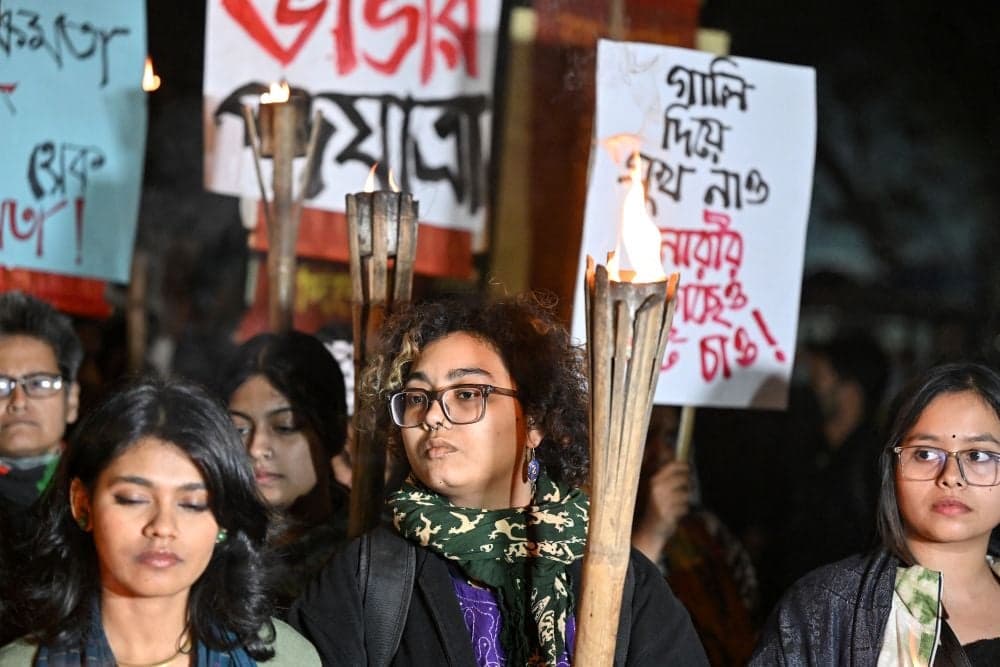

Hopes surrounding the election have turned into disappointment and fear for many women in Bangladesh, including those who were at the forefront of the July mass uprising, according to a report by the British national daily The Guardian.
The report warns that a resurgence of conservative Islamist politics and the low number of female candidates in the election could threaten women’s rights.
The Guardian notes that for many people in Bangladesh, the past few weeks had been a moment of celebration, as they were promised a free and fair election for the first time in 17 years. The election is scheduled to be held tomorrow, Thursday. In August 2024, the government led by Sheikh Hasina fell following a bloody, student-led uprising in which more than a thousand people were killed.
Opposition leaders who had long been persecuted and imprisoned are contesting the election this time. They are holding public rallies freely after many years. The former prime minister is currently living in exile in India and is facing the death penalty in Bangladesh in a case involving crimes against humanity. Her party, the Awami League, has been banned from participating in the election.
However, even before the election, women have taken to the streets demanding their rights, chanting slogans such as, “The people shed blood, now we want equality.”
The report identifies Jamaat-e-Islami as one of the political parties that faced the most repression under Sheikh Hasina’s rule, a period marked by election rigging and crackdowns on opposition groups. Jamaat-e-Islami is an Islamist party that believes in introducing Sharia law in Bangladesh. During Hasina’s rule, some of the party’s leaders were imprisoned, some were forcibly disappeared, and others faced the death penalty.
Since the fall of Sheikh Hasina, Jamaat-e-Islami has become active with unprecedented energy and is presenting itself as the main rival to the Bangladesh Nationalist Party, BNP. Earlier, it was widely assumed that the BNP would secure an easy victory in the election.
Limited opinion polls also suggest that the BNP is likely to win. However, Jamaat-e-Islami is expected to secure more votes than at any time in its history and to emerge as a significant political force after the election.
Thomas Kean, senior consultant on Bangladesh at the Crisis Group, said it appears that a powerful Islamist party will play a central role in Bangladesh’s future politics, whether as a major opposition force or as part of the governing structure.
Critics say conservative Islamist politics has already gained ground in society. In rural areas, religious leaders have been seen preventing girls from playing football, describing the sport as “obscene” for women.
Women have also complained of facing violence and harassment over not covering their hair and over their clothing choices.
Although Jamaat-e-Islami has promised reforms, protection for women from harassment, and clean politics, the party has not fielded a single female candidate in the election. Statements by party leader Shafiqur Rahman have also triggered backlash.
In an interview with Al Jazeera, Shafiqur Rahman said no woman could ever become the leader of the party, claiming it would be un-Islamic. Controversy has also resurfaced over a comment he made last year, in which he denied the existence of marital rape, instead describing extramarital sexual relations between an “immoral” man and woman as rape.
One of Jamaat-e-Islami’s proposed policies is to reduce women’s working hours from eight to five hours, with a promise that the government would subsidise the remaining three hours. According to the International Labour Organization, women make up 44 percent of Bangladesh’s workforce, the highest proportion in South Asia.
The National Citizen Party, NCP, formed by student leaders who helped oust Sheikh Hasina, announced in December that it would contest the election in alliance with Jamaat-e-Islami. This has deepened disappointment, as the party had previously presented itself as progressive and had positioned women at the forefront as a political alternative. Yet it has nominated only two women as candidates.
Several women have since left the NCP over its electoral alliance with Jamaat-e-Islami.
Although 91 percent of Bangladesh’s population is Muslim, the country has maintained a secular stance since independence in 1971. Religious-based politics was banned at the country’s founding but gained prominence during periods of military rule after 1975. Secularism was reinstated in the constitution in 2011.
Analysts say many of those now supporting Jamaat-e-Islami are disillusioned with the old political leadership. Since 1971, power has alternated between the Awami League and the BNP, both of which have been accused of dynastic politics and widespread corruption.
Jamaat-e-Islami is believed to have gained popularity particularly among young and first-time voters, who make up 42 percent of the electorate and are eager for change.
Analysts add that voters have been drawn towards Islamist politics as a reaction to the authoritarian nature of Sheikh Hasina’s rule.
Leave A Comment
You need login first to leave a comment