
Establish a special tribunal to combat child abuse
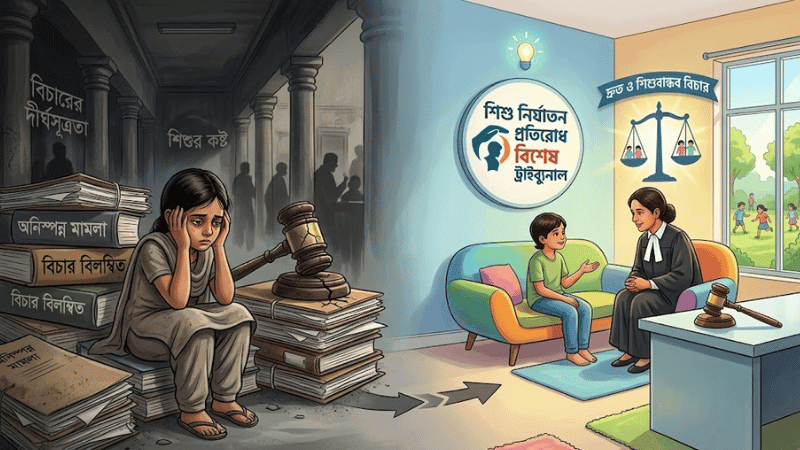
When a child becomes a victim of abuse, it is not only the child's body and mind that are scarred—the conscience of the state is wounded as well. Yet when that same child is forced to spend years climbing courthouse steps in search of justice, repeatedly recounting the traumatic incident or facing the accused in court, the justice system itself, however unintentionally, becomes part of the abuse. Delayed justice does not merely postpone the conclusion of a case; it delays a child's return to a normal life. Child abuse cases, therefore, cannot continue to move at the pace of ordinary litigation.
In Bangladesh, public outrage over child abuse is common. Calls for tougher laws, harsher punishments and even the death penalty frequently dominate public discourse.
However, one fundamental question often remains overlooked: What is the value of harsher laws if justice itself is not delivered promptly? The greatest source of confidence for an offender is not the weakness of the law, but the slowness of the justice system. As long as perpetrators believe that a case can drag on for years, the fear of punishment will remain significantly diminished.
Meanwhile, child victims and their families gradually lose faith in the judicial process. Many eventually abandon their pursuit of justice altogether, creating a vicious cycle of impunity that encourages future crimes.
Against this backdrop, the time has come for Bangladesh to seriously consider establishing a Special Tribunal for the Prevention of Child Abuse. Many countries have already embraced similar judicial mechanisms.
Whether called a Special Court, Special Tribunal, or Fast-Track Court, their objective remains the same: to ensure the swift adjudication of child abuse and sexual violence cases through child-sensitive procedures and timely verdicts. These countries recognise that justice for children is not merely about reaching the right verdict—it is equally about reaching that verdict without unnecessary delay.
India's Protection of Children from Sexual Offences (POCSO) Act, 2012 established Special POCSO Courts, where child victims can testify without confronting the accused directly, proceedings are held in camera, and trials are expected to conclude within a prescribed timeframe.
South Africa's Sexual Offences Courts rely on specially trained judges, prosecutors and victim support professionals to expedite cases involving sexual violence against women and children.
The Philippines has introduced specialised courts and child-friendly judicial procedures to handle child abuse, trafficking and child sexual exploitation cases.
In many states of the United States, although separate tribunals do not always exist, the Child Advocacy Center model brings together police officers, prosecutors, physicians, psychologists and social workers to minimise repeated interviews of child victims while ensuring a faster and more compassionate justice process.
These experiences demonstrate that countries successful in protecting children have not relied solely on stricter laws; they have transformed the justice system itself into one that is child-centred. A child does not understand courtroom formalities.
A child understands fear, shame and uncertainty. It is therefore the responsibility of a modern state to adapt its justice system to the needs and vulnerabilities of children.
Bangladesh already has Women and Children Repression Prevention Tribunals, where serious offences—including child rape—are prosecuted. It also has Juvenile Courts, but these primarily deal with children in conflict with the law rather than children who are victims of abuse. Consequently, child abuse cases are dispersed across different courts without a dedicated judicial structure capable of ensuring swift disposal.
In reality, judges often handle an overwhelming variety of cases simultaneously, inevitably affecting the pace of trials involving children.
What Bangladesh now needs is a specialised tribunal exclusively dedicated to crimes committed against children. Its jurisdiction could include child abuse, sexual violence, abuse resulting in death, online sexual exploitation, child trafficking and other serious offences against children.
Such a tribunal should operate under clearly defined timelines for investigation and trial, provide child-friendly testimony rooms, allow video testimony, ensure that a child's statement is recorded only once, and employ specially trained judges, prosecutors and investigators. Witness protection, psychosocial support, compensation and rehabilitation should be integral components of the system. Clear deadlines for appellate proceedings should also be established so that a child's quest for justice does not remain unresolved for years.
Creating such a tribunal is not merely about establishing another court. It is a declaration that the state is prepared to redefine its priorities. It sends a clear message that there is no room for delay, negligence or procedural indifference in cases involving violence against children. Swift justice strengthens accountability for offenders while restoring public confidence in the state's commitment to protecting its youngest citizens.
Children are the most vulnerable members of society. They therefore deserve the strongest protection that the justice system can provide. The measure of a civilised nation lies not only in the severity of the punishments it prescribes, but also in how swiftly, compassionately and effectively it delivers justice.
Establishing a Special Tribunal for the Prevention of Child Abuse in Bangladesh is no longer simply an administrative proposal; it is a moral imperative, a constitutional responsibility and a commitment to future generations. Childhood should never be buried beneath the weight of endless legal proceedings.
If Bangladesh truly places the best interests of the child at the heart of its national priorities, the clearest demonstration of that commitment will be a justice system that is swift, child-sensitive and unwavering in delivering justice for every abused child.
Leave A Comment