
Every letter of July Charter written in blood of martyrs: Ali Riaz
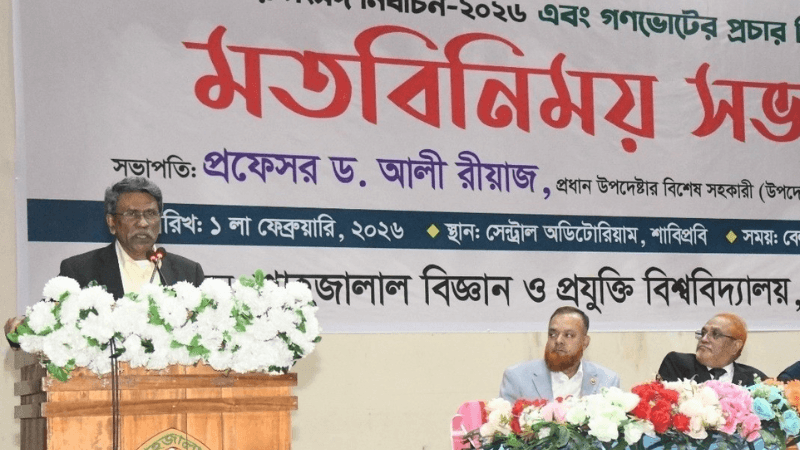

Professor Dr Ali Riaz, Special Assistant to the Chief Adviser, has said that every letter of the July National Charter was written not with black ink, but with the blood of martyrs. To honour this sacrifice, all political parties have reached a consensus on implementing the July National Charter and have formally committed themselves by signing it.
He made the remarks on Sunday, February 1, while delivering the chair’s address at an exchange meeting on publicity related to the upcoming parliamentary election and referendum, organised by Shahjalal University of Science and Technology (SUST) in Sylhet.
Speaking at the meeting held at the SUST Central Auditorium, Ali Riaz said,
“Those who were oppressed under the previous authoritarian system, who lost their lives while resisting injustice and repression, who endured imprisonment, enforced disappearances or extrajudicial killings, have left behind a responsibility for us. That responsibility is to transform Bangladesh into an accountable state system in the days ahead.”
He added that the current constitution allows excessive concentration of state power in the hands of a single individual. “The July Charter and the referendum have been arranged to eliminate this structural weakness. After long discussions with political parties under the initiative of the interim government, the charter has been drafted, incorporating specific proposals for constitutional amendments. Once implemented, these reforms will free the state from one-person dominance.”
Referring to the misuse of the presidential power of pardon, Ali Riaz said that under the existing constitution, the President can pardon anyone convicted by courts from lower levels up to the highest court—a provision that has been grossly abused in the past. “In reality, this authority has been exercised according to the wishes of the Prime Minister,” he said.
The July Charter proposes that no pardon can be granted without the consent of the victim’s family, and this provision will be ensured through the referendum.
Addressing electoral reforms, he noted that although the constitution assigns the President a role in appointing Election Commissioners, past practice shows commissions being formed solely at the will of the Prime Minister. To prevent such irregularities in the future, political parties have agreed to limit the tenure of any individual as Prime Minister to a maximum of ten years. These reforms, he said, can be implemented through a positive referendum outcome.
The meeting was attended as special guests by SUST Vice-Chancellor Professor Dr A M Sarwaruddin Chowdhury, Sylhet Agricultural University Vice-Chancellor Professor Dr Alimul Islam, Sunamganj Science and Technology University Vice-Chancellor Professor Dr Nizam Uddin, and Habiganj Agricultural University Vice-Chancellor Professor Dr Sayem Uddin Ahmed.
Teachers, students, representatives from various public and private universities in the Sylhet division, and media professionals were also present.
Leave A Comment
You need login first to leave a comment