

Everyone wants to share in success
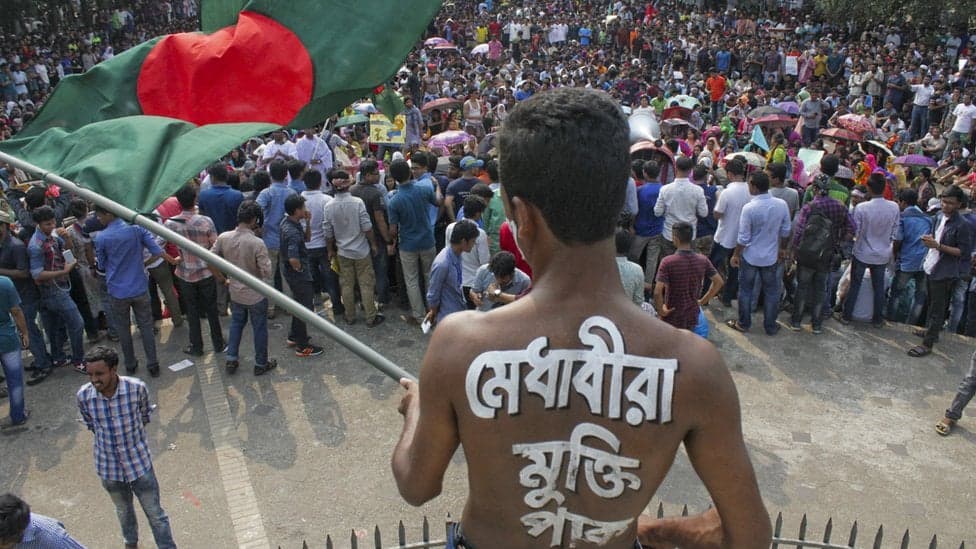
After the anti-quota movement took a violent turn, there was a significant change in the behavior and rhetoric of the Awami League’s workers and supporters. When slogans against Bangabandhu and the independence were heard, the Chhatra League was mobilized, inciting conflicts and driving the quota protestors out of the university. In the next moment, the leaders of the Awami League realized that deploying the Chhatra League had backfired, as the image of the Chhatra League had been severely damaged. With this awareness, the Chhatra League was promptly withdrawn from the field of conflict.
After the Prime Minister ordered the Chhatra League to be restrained, the field was taken over by the quota protestors, and the Chhatra League's dormitories were vandalized. Once school and college students became involved in the movement, the police were also compelled to act with restraint. However, before the police could become restrained, there were official reports of 150 deaths. Observing the videos of the shootings, it appears that in many cases the police fired in a manner that seemed intended to escalate the movement into violence. After the indiscriminate police shootings, the scenes of police killing and hanging the bodies of activists from overpasses or trees did not further stir the public. As the presence of the quota protestors became increasingly visible everywhere, it led to frustration among the grassroots leaders and activists of the Awami League. In their frustration, they began to say, "It was inappropriate to discuss the quota issue in talks about China."
They also had no presence on social media. At the press conference on the China visit, there were no insightful questions from journalists about the memorandum of understanding with China; instead, the focus was on the quota issue. Even though questions about the quota were not problematic in themselves, the journalists’ main aim seemed to be to provoke the Prime Minister against the quota movement rather than addressing the issues at hand. At almost all of the Prime Minister's press conferences, there are sycophantic praises and flattering remarks, which are distressing for the audience. Each time, there is strong criticism of this obsequious behavior from journalists, yet no change occurs. Such sycophantic questioning also tarnishes the Prime Minister's image.
Many years ago, the then Indian Prime Minister Morarji Desai had advised Bangladeshi journalists to avoid asking meaningless and foolish questions. When the destruction continued unchecked after the police's indiscriminate shootings, and the police were not receiving orders to fire, electronic media reporters began to take a stand in favor of the movement. This led to severe frustration among the Awami League's workers and supporters. It seemed to them that the fall of the government could no longer be prevented. As the government's refusal to meet the quota protestors' demands continued, the general public on social media and in the streets began to accuse the government.
My university classmate, Saima Jahan Papri of the Student Union, has repeatedly called to express concern about the country's situation. Papri was the Vice President of Rokeya Hall at Dhaka University twice in the 1970s. Recently, during the quota movement, female students expelled the Chhatra League's president and general secretary from Rokeya Hall, and the Prime Minister mentioned that some of them were tied to pillars and beaten. In response to the question of how this was possible, Papri said, "One cannot survive through tough times solely by wielding power if one is not decent, humble, and unpretentious. If the Awami League were to lose power, newspapers would be filled with hundreds of reports listing the countless faults of its top leaders. However, while in power, no one is speaking out because expressing criticism now would displease the Awami League leaders."
Awami League leaders are said to be unable to tolerate criticism. However, there is doubt whether most of them even read the newspapers properly. Having become leaders through political struggle and movements, they believe they know everything. A common complaint against them is that "Awami League leaders are arrogant." So, who were the quota protestors opposing? It certainly shouldn't have been against the government, as the government had abolished the quota system back in 2018. In 2021, a few freedom fighters filed a case against the government's abolition of the quota system. The High Court ruled in favor of retaining the freedom fighter quota, declaring the government's cancellation order illegal. The government has appealed the High Court's decision. Thus, neither the government nor the student community wants the quota system. Unfortunately, despite the government's stance being in favor of eliminating the quota or supporting the students, the movement turned against the government because it failed to clearly and straightforwardly communicate its position.
Both the students and the government had a common stance on the quota issue. Despite the government’s position being aligned with the anti-quota stance of the students, it remains unclear why the students decided to protest against the government. It is possible that the students, unable to speak out directly against the court or engage in legal protest, chose to demonstrate against the government as a way to indirectly exert pressure on the judiciary. They saw that a group that had organized a movement at Shahbagh intersection had previously succeeded. However, there was a significant difference between the two movements. The movement related to Kader Mollah's trial verdict was confined to the Shahbagh intersection, but the quota protest movement spread throughout the country. As the students' movement extended nationwide, it became uncontrollable and turned confrontational with the police. Since the matter was beyond the government's control, it would have been appropriate to confine the students' movement to Shahbagh intersection until the Supreme Court’s verdict.
As the matter of the quota was under the jurisdiction of the court, the quota protestors eventually realized that there was little the government could do. Understanding this, they proposed taking the issue to Parliament. However, Parliament also had no authority to resolve the matter. The Constitution has directed the government to create regulations regarding quotas, including determining the necessity and extent of quotas for different classes or groups of people, placing the responsibility on the executive branch of the government. The Constitution grants the executive branch of the government the power to establish and amend quota policies. Accordingly, the government formulated the quota policy in 1972 and subsequently abolished it in 2018. However, when the issue was brought before the court, the government temporarily lost the authority to exercise its executive powers. With the High Court's ruling ordering the reinstatement of the freedom fighter quota, protests erupted. The government appealed to the Supreme Court. At the request of the government's chief lawyer, the Attorney General, the Supreme Court agreed to advance the hearing date. Despite the loss of 150 lives, the government had to wait for the Supreme Court's verdict.
University students involved in the quota protest were knowingly taking action against the government. However, the general public and students from schools and colleges did not have a clear understanding of the quota issue. They were unaware that the government did not have the authority to make decisions on matters that were pending in court. The government also failed to effectively communicate this to school and college students. Once an issue is brought before the court, everyone, including the government, must wait for the final verdict. The legal aspect of the issue was not simplified and repeatedly communicated. What was said was largely theoretical discussions among experts. The general public barely heard any of this. Because the people did not understand, even after the Supreme Court's verdict, they believed that the government intentionally delayed addressing the reasonable demands of the quota protestors. They thought that if the government had accepted their demands at the beginning of the movement, the situation would not have become so complicated. Ultimately, the matter was resolved through the Supreme Court's ruling.
We need to remember that in the country, the number of families not related to freedom fighters is greater than those related to freedom fighters. In fact, there are currently more people speaking against the Liberation War. The primary reason for the higher number of anti-independence individuals is that no one other than the Awami League is being allowed to be considered a part of the Liberation War. This exclusion leads to a sense of frustration, and the 'spirit' of the Liberation War is often mocked relentlessly on social media. Families where no one is currently attending university and there is no prospect of anyone doing so in the near future are also opposed to the freedom fighter quota. This is due to widespread propaganda about fake freedom fighters. There has even been propaganda suggesting that individuals born after the Liberation War are included in the list of freedom fighters. The Ministry of Liberation War has not provided any response to such propaganda. The Ministry of Liberation War needs dynamic leadership, with an emphasis on knowledge rather than just experience. The ministry's passive and indifferent attitude has led the public to believe that, with its complicity, there is widespread misuse of state benefits by fake freedom fighters.
Even freedom fighters no longer desire the freedom fighter quota. Due to the government's lack of a suitable explanation regarding the quota, opposition parties have repeatedly claimed that the demands of the quota protestors are reasonable and that the government should accept them. If the government's inability to take action on matters pending in court were properly communicated, then rickshaw pullers, pushcart vendors, or even my educated nephew Shimul, my son Arnab, and my grandson Swapnil would not blame the government for the quota's abolition. I had to go through great lengths to explain the matter to my wife, and even then, she either didn't understand or didn't want to understand. In response to the unusual situation, the government stated at the last moment that they had, in principle, accepted the demands of the quota protestors. This position of the government is both foolish and meaningless because the government was already against the quota before the movement began. The government had abolished the quota system in 2018 and appealed the High Court's ruling against the abolition. In this context, there is nothing left to accept in principle again. However, the government should have told the students in a meeting, "The government is also against the quota, so let's join forces and fight the legal battle together. We will definitely win the legal battle." Admittedly, this suggestion of mine is opportunistic because if the country's situation had not been so dire, I might not have come up with this idea, and the Supreme Court might not have changed the hearing date either.
The Awami League and the current government are weak in terms of propaganda and providing reasonable explanations. Most leaders are accustomed to speaking in a provocative manner, which people do not appreciate. The General Secretary of the Awami League often provokes the opposition to protest by making pointed remarks. He frequently mentions that the BNP has failed to build a significant movement despite their efforts. The public does not understand what benefit the Awami League gains from such statements. If he had said that the public was not responding to the BNP's call, it could have been considered a significant statement. The Awami League's leaders and activists are all engrossed in the allure of power. If success slips away, everyone will blame the top leaders, as no one takes responsibility for failure; everyone wants to share in success.
Ziauddin Ahmed: Former Executive Director of Bangladesh Bank and former Managing Director of Mint.
Leave A Comment
You need login first to leave a comment