
Experts call for transparent spectrum valuation model amid AI surge
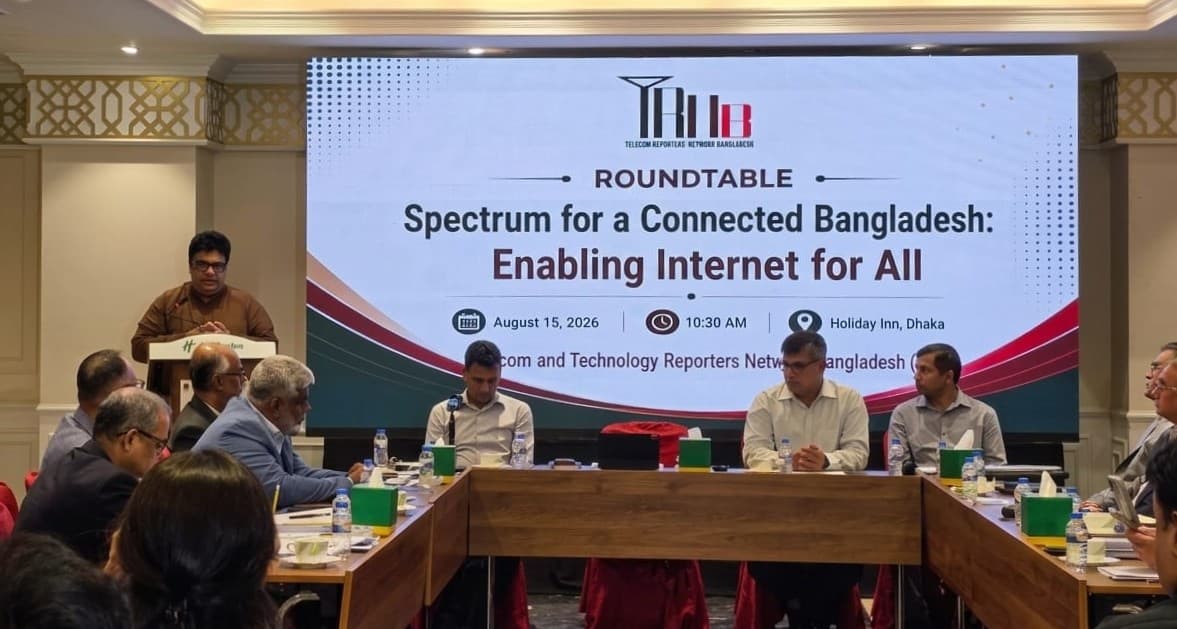

Telecom sector experts and stakeholders have called for a transparent, analytics-driven and publishable valuation model for spectrum management. They stressed that spectrum should not be viewed merely as a source of immediate government revenue but as a driver of the national digital infrastructure and the future economy powered by artificial intelligence (AI), cloud and IoT.
The demand was raised at a roundtable titled 'Spectrum for a Connected Bangladesh: Enabling Internet for All', organised by the Telecom and Technology Reporters Network Bangladesh (TRNB) at Holiday Inn in Tejgaon on Saturday.
Prime Minister's Adviser for Posts and Telecommunications Rehan Asif Asad said the government has set a target to bring 7 crore feature phone users under seamless mobile data networks. To this end, steps are being taken to ensure affordable smartphones.
BTRC Chairman Major General (retd.) Md Emdad Ul Bari said Bangladesh currently has only 2.3 MHz of spectrum allocated per million subscribers, far below the global benchmark.
In the keynote presentation, telecom expert Munir Hasan proposed a combined valuation framework using three methods: ODB, Discounted Cash Flow (DCF) and benchmarking. He argued that the economic value of spectrum should not be determined by a single method alone.
He noted that in the 2018 auction, only 33 percent of offered spectrum was sold; in 2021, a 5 MHz block in the 2100 MHz band sold for over 70 percent above reserve price due to competition; while in the 2026 auction for the 700 MHz 'golden spectrum', only one operator participated, selling at reserve price.
He questioned why the 2100 MHz band was priced at $2 million per MHz in 2013, while the superior 700 MHz band was priced similarly eight years later — approximately Tk 237 crore, close to the 2018 price for the 900 MHz band — despite clear differences in propagation and coverage characteristics. He noted that no publicly available analytical document explains these pricing decisions.
Speakers argued that reducing spectrum costs and ensuring adequate allocation would increase network investment, benefiting e-commerce, fintech, cloud, AI and IoT. Citing GSMA research, they pointed out that Bangladesh's spectrum fees account for about 16 percent of operator revenue, compared to 10 percent in Asia-Pacific and 8 percent globally. Bringing unit prices closer to the regional average could help cover 99 percent of the country with 5G by 2035, potentially adding $34 billion to the economy — up to $45 billion if aligned with the global average. Bangladesh currently ranks 93rd globally in mobile network performance.
On the renewal of the 900, 1800 and 2100 MHz bands later this year, operator representatives noted that several countries, including Pakistan, India and Vietnam, have recently reduced fees for these bands, while some European countries have extended licences at no extra cost. Despite the average revenue per user being less than $1.5, the combined pressure of spectrum fees, annual charges and VAT is raising operator costs.
Rehan Asif Asad said, alongside high-quality networks, ensuring affordable smart devices is crucial. About 7 crore people still use feature phones. While a Tk 3,000 smartphone proved unviable, manufacturers have shown that Tk 5,500-6,000 ($50-55) is achievable. Following India's Reliance model of a two-thirds touchscreen, one-third keypad phone, duties and VAT on raw materials have been waived.
BTRC Chairman Md Emdad Ul Bari said Bangladesh has only 2.3 MHz of spectrum per million subscribers, much lower than the global standard. With future 5G and AI model demand, operators will need an additional 1,500 MHz of spectrum, which he described as a major challenge.
The roundtable was chaired by TRNB President S M Masuduzzaman Robin and moderated by General Secretary Faruk Hossain. Speakers included AMTOB President and Robi CEO Ziad Shatara, Grameenphone CEO Yasir Azman, Banglalink CEO Euhan Buse, Foreign Chamber of Commerce CEO T I M Nurul Kabir, AMTOB Secretary General Lt Col Mohammad Zulfikar and BTRC Spectrum Consultant Dr Khaled Mahmud.
Leave A Comment