
Farmers fail to recover production costs, losing capital
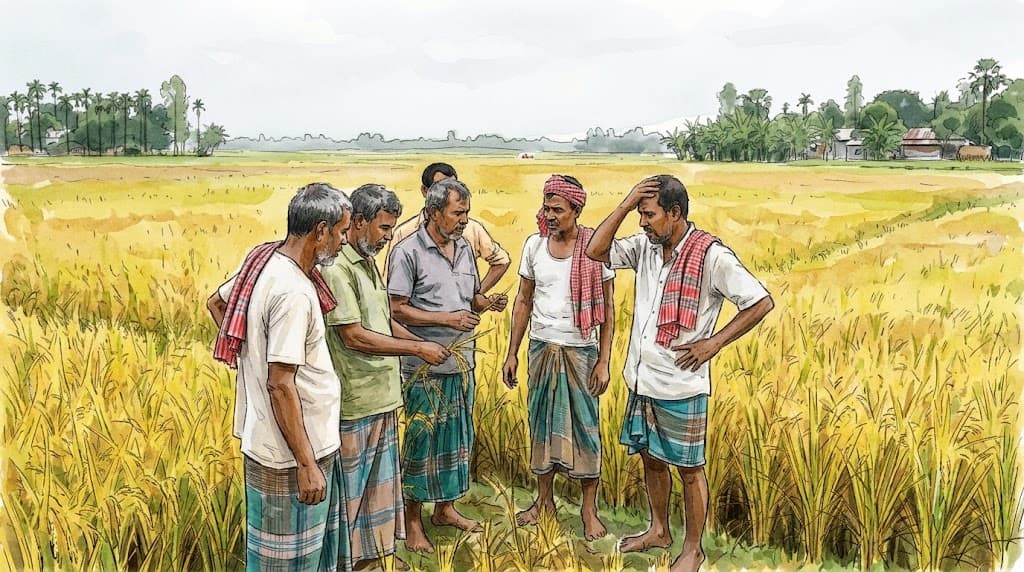

Farmers are struggling to recover even their production costs from the crops they grow, leaving many of them losing their invested capital despite harvesting and selling their produce. In some cases, they make a small profit after deducting direct expenses. But once the value of their own labour and the cost of renting land are taken into account, even that margin disappears. As a result, farmers are steadily losing the money they invest in agriculture.
Farmers said Aman paddy is currently growing in the fields. A bigha of land produces around 18 maunds of paddy, although the yield varies depending on the variety. The total cost of production, including expenses up to marketing, is approximately Tk 16,000 per bigha. Paddy generally sells for around Tk 1,000 per maund, although prices fluctuate from one market to another.
At that rate, the production cost comes to about Tk 890 per maund, leaving farmers with a nominal profit of Tk 110 per maund. However, this calculation does not include the value of a farmer’s labour over the four-month cultivation period. Nor does it account for land rent, which many farmers must pay because they cultivate leased or sharecropped land.
As a result, selling paddy may appear profitable on paper, but farmers are often facing losses in practice. They can recover some of the shortfall by selling the straw or using it as fodder for livestock at home.
Abu Hasan and Faruk Hossain, farmers from Kajipara village in Bogura’s Shajahanpur upazila, said the current situation had made it increasingly difficult to earn a profit from paddy cultivation. Instead, they said, their savings were gradually being depleted.
They said the Aman harvest was expected to begin in another 14 to 15 days, but they were uncertain about what the outcome would be.
Paddy is not the only crop bringing losses. Farmers are also struggling to make a profit from vegetable cultivation.
At least 10 farmers, including Mojibor Rahman of Bogura Sadar upazila, Mizanur Hossain of Shibganj upazila and Abdul Khaleque of Shajahanpur upazila, said they were losing between Tk 50 and Tk 150 on every maund of radish by the time it reached the market from their fields.
According to their calculations, transporting one maund of radish from the field to the market costs between Tk 350 and Tk 450, depending on transport expenses. Yet the vegetable is selling in wholesale markets for only Tk 250 to Tk 300 per maund.
The cost of growing radishes includes fertiliser, pesticides, irrigation, labour, transportation and market fees. Taken together, these expenses are leaving farmers with losses this season.
While farmers struggle to recover their production costs, intermediaries and retailers are making profits.
Conversations with farmers and vegetable traders suggest that wholesale prices have fallen because of an increase in the supply of early-season vegetables. Farmers say they could secure better prices if adequate storage facilities were available for their produce. But with insufficient vegetable storage infrastructure in Bogura, they are often forced to sell their harvest at low prices.
Cauliflower cultivation also offers little real profit. Although farmers may make a small margin per maund after deducting production and transportation costs, that margin disappears once the value of their own labour and land rent is included.
According to farmers’ calculations, a bigha of land yields around 80 maunds of cauliflower over two months, at a production cost of approximately Tk 30,000. This puts the production cost at Tk 375 per maund. Transporting the crop to market adds another Tk 150 per maund, bringing the total cost to Tk 525.
Cauliflower is currently selling at wholesale markets for around Tk 600 per maund, leaving a nominal profit of Tk 75 per maund.
At this rate, selling 80 maunds from a bigha would generate a total profit of Tk 6,000. On paper, that is the return on two months of labour and investment. But once the work done by farmers and their family members, along with the cost of renting the land, is included, even this profit disappears.
Farmers said they spend two months tending their cauliflower fields, irrigating the crops, applying fertiliser and harvesting the produce. Family members also contribute their labour, but none of this is assigned a monetary value in the usual calculations. Land rent is similarly excluded. Once all expenses are taken into account, cauliflower cultivation, too, leaves them facing losses.
Asked about the low prices of vegetables in wholesale markets, Bogura Senior Agricultural Marketing Officer Md Morshed Al Mahmud said early vegetable cultivation had increased this year. As a result, a large volume of vegetables had arrived in the markets at the same time, pushing down wholesale prices.
Leave A Comment