

Speakers at CGS roundtable
'Fears grip minorities as elections near'
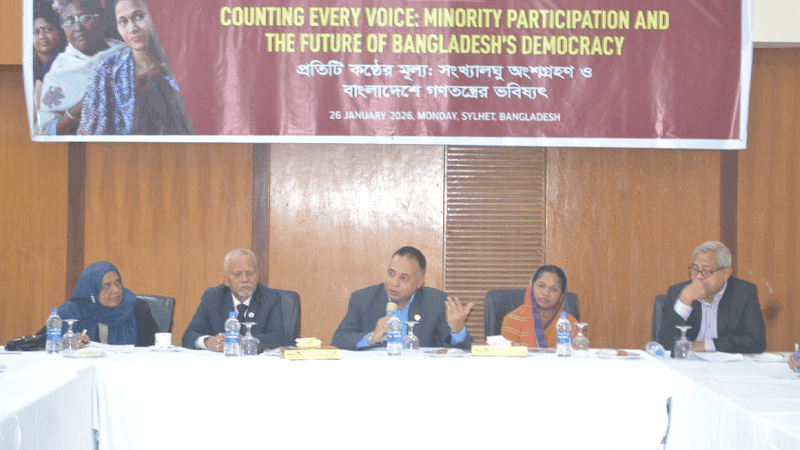

Voting rights cannot be exercised in an environment of fear and intimidation, and without ensuring voting rights, inclusive democracy will remain only a slogan, speakers from minority communities, civil society and professional groups in Sylhet said.
They said minority communities are treated as vote banks whenever elections approach, but there are no visible initiatives by the state or political parties to ensure their security, dignity and rights.
The remarks were made on Monday, January 26, at a roundtable titled Every voice matters: Minority participation and the future of democracy in Bangladesh, organised by the Centre for Governance Studies, CGS, in Sylhet.
The discussion was held at a hotel hall in the city’s Ramerdighirpar area, with participation from civil society representatives, lawyers, teachers, journalists, members of minority communities and leaders of various marginalised groups.
Speakers particularly emphasised the need to ensure effective, safe and fearless participation of minority communities in the run-up to the 2026 parliamentary elections. They also stressed transparency and accountability in state institutions and the importance of bringing marginalised voices into the mainstream.
At the outset, CGS president Zillur Rahman said minority participation must be viewed as a core benchmark of democracy as Bangladesh moves towards parliamentary elections, not a side issue.
He said although minorities make up about 9.6 percent of the population, their rights, security and dignity receive little attention in political parties’ election pledges. While many parties view them as vote banks during elections, visible accountability is absent afterwards.
A democratic election, he said, is not just about casting votes, but about ensuring political participation without fear, pressure or threats. Otherwise, inclusive democracy will remain rhetorical.
Referring to indigenous communities, he said long-standing neglect persists regarding cultural recognition, land disputes and the realisation of fair rights. Recognition alone is insufficient; implementation gives rights meaning.
Advocate Mrityunjay Dhar, president of the Hindu Buddhist Christian Unity Council, Sylhet, said eight demands were placed in 2014, but none have been implemented. Fear and panic grip minorities whenever elections approach, he said.
He alleged that homes of Hindu and Buddhist communities have been burned over allegations of religious disrespect, and people have even been burned alive. A mob can never deliver justice, yet mobs are now doing so, he added.
Advocate Syeda Shirin Haque, president of the Conscious Citizens Committee, Sylhet, said despite promises to form a women’s commission, there has been no effective presence. Brutal incidents such as people being burned alive continue, exposing clear failures in maintaining law and order.
She said representation of women and minorities in parliament remains extremely limited, posing a major challenge to both the constitution and democracy.
Senior journalist Iqbal Siddiqui said Bangladesh gained independence in 1971 and again saw hope for change in 2024, but disappointment has only grown.
He highlighted attacks on the media, mob culture and social moral decline, saying no reform would be sustainable without restoring law and order.
Bijoy Krishna Biswas, president of the Hindu Buddhist Christian Unity Council, Sylhet metropolitan unit, asked whether being Hindu disqualifies him from becoming president of the country, and why minorities lag behind in accessing rights.
Tea worker leader Hari Sabar said they are still deprived of fair wages, land and education.
Deacon Nijhum Sangma, chairman of the Presbyterian Church, Sylhet, said minorities fall into crisis whenever they speak out, remaining silent out of fear of what may happen before and after elections.
Representatives of the Hijra Jubo Kalyan Sangstha said despite political recognition, real security and dignity remain elusive.
Lakshikanta Singh, CEO of EDCO, said neither the BNP’s 31-point agenda nor Jamaat’s manifesto clearly commits to minority rights, leaving many to view elections as meaningless.
Leave A Comment
You need login first to leave a comment