
Foreign lord holds the helm as Hayatullah breathed his last in desert
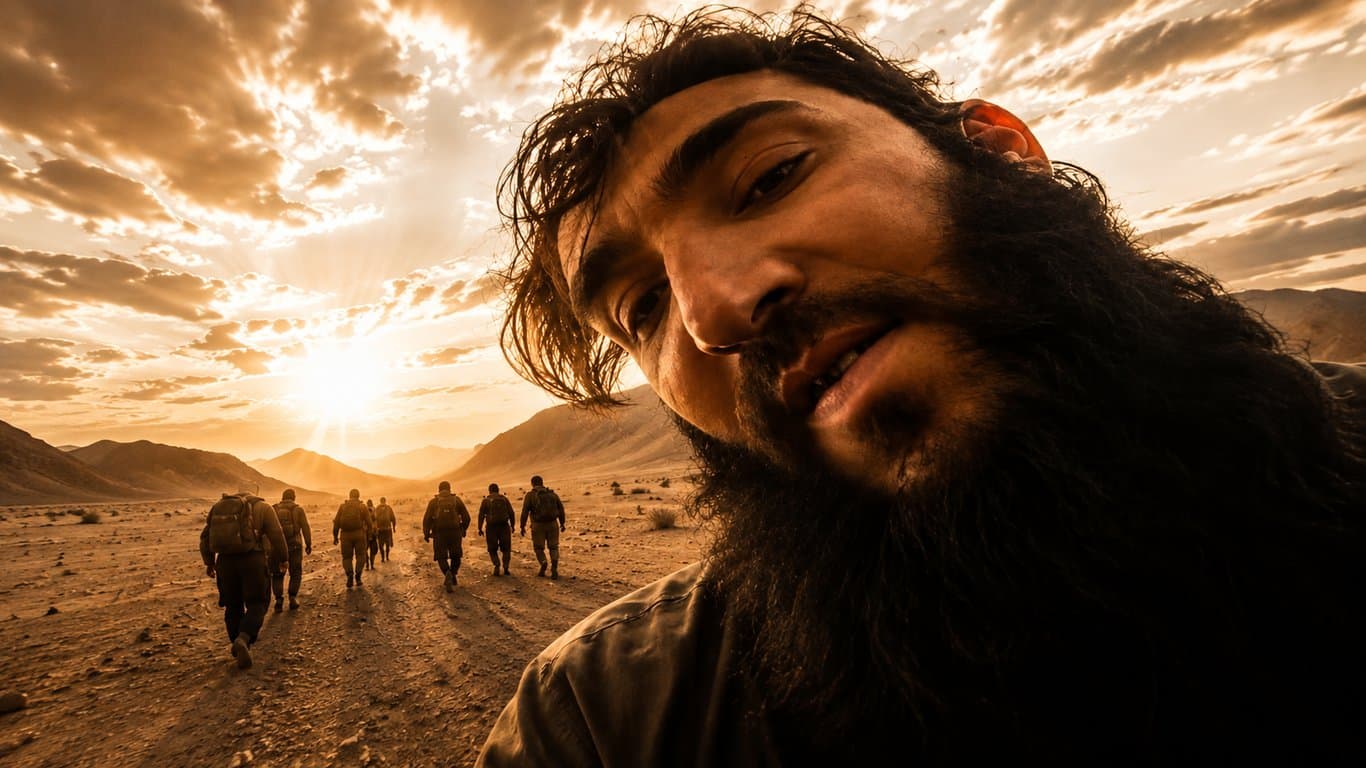

The desert burned beneath a blazing mid-summer sun. It hung overhead like an enormous ball of fire, as though it could scorch everything in sight into ashes. In every direction stretched endless grey sand, shimmering under the relentless heat. There were no trees, no shade, no homes—nothing to suggest that life had ever existed there. Far ahead, a glimmer on the horizon promised water. But the closer one walked, the clearer it became that it was nothing more than another trick of the desert, another ribbon of sand masquerading as hope.
When the wind rose, the sand lashed against the face like thousands of burning needles. And when it stopped, an eerie silence settled over the landscape—as though every living soul had long since abandoned the earth.
It was in that silence, somewhere in Afghanistan's Nimroz Desert, near the Iranian border, that a young Afghan man sat down one afternoon in the middle of July.
His body had begun to surrender.
His tongue had gone dry. His voice came out in broken whispers. His legs no longer obeyed him. Yet somewhere deep inside, a fragile hope still lingered. Perhaps if he could walk just a little farther, he would find a road. Perhaps a passing vehicle. Perhaps someone carrying water.
But the desert offered no answers.
It is called Dasht-e Margo—literally, the Desert of Death. Bordering Iran, Dasht-e Margo is one of the harshest and most inaccessible regions in the area.
There are no security checkpoints, no settlements, and almost no signs of human life. That isolation has long made it a preferred route for undocumented migrants and the smugglers who guide them across the border.
By then, the young man understood there was only one road left before him—and it led swiftly toward death.
He picked up his phone. Perhaps his hands were trembling. Perhaps his vision had already begun to fade.
Perhaps he could no longer even recognize his own reflection on the screen.
Yet he pressed the record button.
Standing at the edge of death, what does a human being ask of the world one last time? Water? Justice? Revenge?
He asked for none of it. Instead, he apologized to his mother. He apologized to his family. He asked his wife to look after their children. If she could, he said, she should try to repay the debts he would leave behind. Another voice, belonging to a fellow traveller, was also captured in the recording. He too had only one request: that someone tell his mother he was sorry and ask for her forgiveness.
Two men. Both waiting for death.
And the last words of both were not anger...
...but apology. No one knows how long after recording that message the phone slipped from the young man's hand.
No one knows whether, in his final moments, he saw his mother's face in the shimmering mirages of the desert.
After that, his voice was heard no more. The young man in the video was Hayatullah, a 36-year-old from Afghanistan's Badghis Province. He was an ordinary man with an ordinary family. He had children. He had responsibilities. And like countless Afghans, he carried the crushing weight of debt.
What he did not have was a job that could keep hunger away from his home. Hunger is perhaps the most merciless force on earth. It was hunger that ultimately drove Hayatullah onto the road called Dasht-e Margo—the Desert of Death.
And because this barren wilderness lies beyond the reach of both Afghan and Iranian authorities, there are no security posts on either side of the border. For years, this desolate stretch of Nimroz Province has served as one of the most dangerous routes used by undocumented migrants attempting to reach Iran in search of work.
It was along this very path that Hayatullah and eighteen other Afghan men set out, hoping to build a better life across the border. None of them survived. They all died of thirst. Because no one leaves home simply for the adventure of leaving.
Even the roots of a tree long to remain in the soil where they first took hold. Uproot it and plant it elsewhere, and for a while it stands silent, almost as if it has died. Human beings are no different.
No one willingly leaves behind the familiar courtyard, a mother's face, or the tiny hands of their children to walk into an unforgiving desert—unless the life they once called home has itself become a desert.
Afghanistan today is gripped by profound hardship. Crushed under the weight of debt, countless Afghans are struggling to survive. For some, desperation has become so severe that families have reportedly sold their children simply to escape starvation.
Hunger carries no flag. It belongs to no religion. It has no politics. It does not recognize constitutions, borders, or geopolitics.
Hunger speaks only one language. It whispers from an empty stomach:
"Do something. Go somewhere. Survive—any way you can."
According to the Afghanistan-based Amu TV, Hayatullah and eighteen others set out for Iran in the middle of July in search of work. Their vehicle broke down in the vast expanse of Dasht-e Margo in Afghanistan's Nimroz Province. Forced to continue on foot, they soon lost their way in the endless desert.
There was sand in every direction.
The sun blazed overhead like an open furnace. There was no village ahead. No road. No sign of life.
Eventually, the little water they had carried with them ran out. When Hayatullah realized there would be no road back for him, he took out his mobile phone and recorded what would become his final statement.
What does a person say when standing at death's door? Do they curse the state? Do they demand justice from those in power? Do they accuse the world of abandoning them? Hayatullah did none of those things. He apologized to his mother. He apologized to his family. He asked his wife to take care of their children. If the family could manage it, he said, they should repay the debts he was leaving behind.
Another man, Mir Adam, whose voice can be heard in the recording, made a similar request. If he did not survive, he asked that someone tell his mother he loved her, deliver the news of his death, and ask for her forgiveness. What a remarkably humble man Hayatullah was.
The state had given him no work. It had given him no food. In his final hours, it could not even give him a single glass of water. Yet he was the one asking everyone else for forgiveness. As though hunger were his crime. As though searching for work were something shameful.
As though wanting to stay alive were an act of defiance against the state.
Hayatullah's video is not merely the final message of a dying man.
It is the death certificate of a nation.
According to an investigation by TOLOnews, the nineteen men in the group were between 22 and 36 years old.
Local residents discovered their dehydrated bodies in the Nimroz desert 15 days after they had gone missing. Five bodies were recovered first, followed later by the remaining fourteen. Hayatullah's mobile phone was found alongside the bodies. It was from that phone that the video spread across the world.
Just a few minutes of footage. Just a handful of quiet words. Yet within those moments lies the story of Afghanistan's long and painful history. A nation does not collapse in a single day.
A nation does not fall apart overnight. It begins quietly. First, under the influence of foreign patrons, books are taken from people's hands and replaced with fear. Asking questions becomes a sin. Dissent is branded as betrayal.
The gentle light of religion is gradually extinguished, only to be replaced by flames of anger lit in its name. People are divided—by religion, tribe, language, ethnicity, and ideology.
Neighbors are taught to fear one another. The person living next door is no longer seen as a friend, but as an enemy. The judiciary grows weak.
Public institutions gradually become servants of political factions or groups backed by foreign interests.
The voice of the media shrinks until it is reduced to little more than a whisper. Loyalty begins to matter more than competence.
Obedience becomes the highest qualification for public office. Then the state itself becomes addicted to dependence. Its weapons come from abroad. Its budget survives on foreign assistance. Its security strategy is drafted in the offices of foreign advisers. Who governs the country, who is removed from power, who signs a peace agreement, who is labelled a terrorist and who is called a strategic partner—those decisions are sometimes outlined not in the nation's own parliament, but behind closed doors in distant foreign capitals.
Outwardly, the country still appears sovereign. It still has a flag. A national anthem. An army. Ministers.
Even a presidential palace. Only one thing is missing. The backbone to make its own decisions. Its rulers gradually begin to fear the silence of foreign embassies more than the verdict of their own people.
They learn to read the raised eyebrow of a foreign ambassador more quickly than the tears of a hungry farmer. Whether their own citizens have enough to eat becomes a secondary concern.
The real question becomes whether the foreign patrons remain satisfied.
Then, eventually, those foreign powers step out from behind the curtain. Some arrive carrying the language of democracy. Others come under the banner of peace. Still others claim to be fighting terrorism.
They provide weapons first. Then they organize peace conferences. They help create leaders. And when those leaders have outlived their usefulness, they are discarded—denounced as corrupt, incompetent, or failures. The country is transformed into a chessboard. Yet even chess pieces enjoy one privilege.
When the game ends, they are carefully placed back inside the box.
Ordinary people are denied even that mercy.
When the game is over, airplanes arrive—but only for the powerful. The doors open for presidents, ministers, advisers, contractors, and their families. No special aircraft comes for ordinary citizens.
They are left with hostile borders. Barbed wire. The vehicles of human smugglers. And deserts like Dasht-e Margo. The players leave. Their allies receive rewards. The generals collect medals.
New rulers raise new flags. And ordinary people? Before they die, they whisper to their mothers: "Please forgive me."
What was Hayatullah's crime? He wanted to live. He wanted to buy bread for his children. He wanted to repay his debts. He wanted to return home—to his mother.
In no court of law are these considered crimes. Yet in the deserts of a failed state, the simple desire to survive can become the gravest offence of all. Today, this is Afghanistan's story.
But from east to west, many more Afghanistans are slowly taking shape. In some places, it happens in the name of religion. Elsewhere, in the name of nationalism. Some invoke security.
Others are driven by a partnership between foreign interests and domestic elites hungry for power.
We often imagine that nations are destroyed by the thunder of bombs.
In reality, the sound of a nation's collapse is not always so loud.
Sometimes it is heard in the fading voice of a man stranded in a desert. Sometimes it echoes in the desperate cries of children searching for food.
Sometimes it lingers in the silence of a mother waiting for a son who will never return. And sometimes, it rises again in the chants of a new generation refusing to accept the same fate.
Hayatullah's final video is not merely the story of one man dying of thirst.
It is a reminder that the collapse of a state is rarely sudden. Long before buildings crumble or governments fall, institutions weaken, truth becomes negotiable, public trust erodes, and ordinary people are left to bear the heaviest burden. History shows that no nation is immune to decline.
When power becomes detached from accountability, when fear replaces freedom, and when survival itself becomes a privilege rather than a right, the first victims are almost always ordinary citizens.
In the end, governments write policies. Powerful nations shape strategies. Politicians debate. Generals draw maps. But it is people like Hayatullah who pay the final price.
Not with speeches. Not with headlines. But with their last breath. In the middle of a desert. Holding a phone. Asking only one thing of the world: "Mother... please forgive me."
Leave A Comment