
Golam Sarwar: An editor who walked in path of light
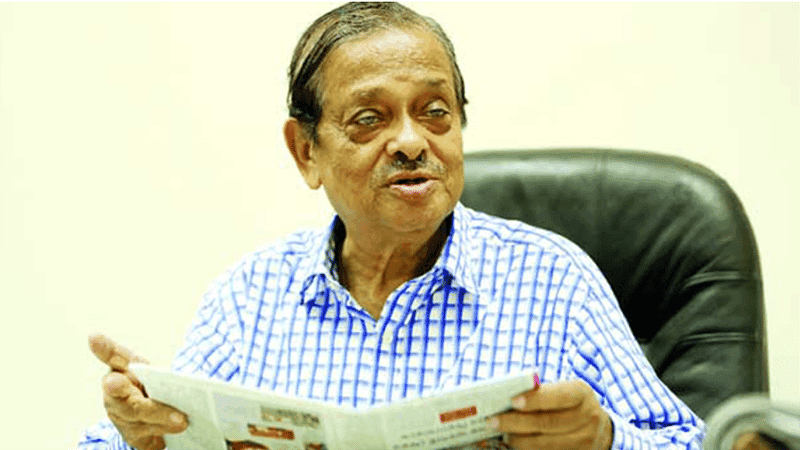

As the Fourth Estate, the press and news media carry an immense responsibility. The media not only presents events before readers objectively, but can also play a major role in shaping public opinion during movements, struggles and critical moments by taking a principled moral position. At times, the media itself becomes the voice of the people.
During Bangladesh's Liberation War in 1971, the English-language daily The People played a particularly significant role in reporting the country's struggle for independence.
The day after Bangabandhu Sheikh Mujibur Rahman's historic 7 March speech, Dainik Ittefaq ran the headline: “We may consider going to the Assembly, if…” The People, meanwhile, carried the headline: “Withdraw this barbarous alien army.”
Until the crackdown on 25 March, the newspaper's headlines and cartoons reflected the aspirations of the Bengali people. That is why The People's role during that period is still remembered with deep respect.
At the heart of The People at the time was its news editor, Anwar Zahid. The newspaper was published under his planning and supervision. For this reason, Anwar Zahid's contribution continues to be remembered with respect in Bangladesh's journalistic circles.
The rise of the Gonojagoron Mancha was another significant episode in Bangladesh's political history. The non-partisan movement generated a powerful response across the country, and its influence can still be felt in Bangladesh's politics.
On 5 February 2013, Jamaat-e-Islami leader and convicted war criminal Abdul Quader Molla was sentenced to life imprisonment by a tribunal for crimes against humanity. He had been found guilty on five of six charges, including allegations related to mass killings in the Mirpur area. But the sentence was life imprisonment.
The people of Bangladesh could not accept the verdict. The anger intensified after newspapers published photographs of Quader Molla apparently making a victory sign the following day. Young online activists began blocking roads at Shahbagh in Dhaka in protest. Within moments, the movement spread across the country like wildfire.
The country's mass media played a particularly important role in the spontaneous participation of ordinary people in the movement. At the forefront was the then editor of Dainik Samakal, the widely respected Golam Sarwar, who demonstrated remarkable courage in expressing his views without hesitation.
“We Do Not Accept This Verdict”
One of the fundamental principles of journalism is maintaining faith in the judiciary and respecting court verdicts. News organisations therefore have to exercise particular caution when reporting on judicial decisions. In the language of the media, courts are even addressed respectfully as “you”.
The basic point is that, under the constitutional structure of the state, the judiciary occupies a position above political considerations. Respecting the court and its verdict is therefore a fundamental responsibility.
Yet after the first verdict against Quader Molla was announced, intense public anger quickly erupted. Fierce protests began on social media. People were distressed and outraged.
It was at this moment that Samakal, one of the country's leading newspapers, published one of its boldest headlines: “We Do Not Accept This Verdict.” It was a direct rejection.
The headlines of other leading newspapers were considerably more restrained. Prothom Alo ran: “Disappointment and anger over failure to award the death penalty.”
The Daily Star reported the verdict under the headlines “Qader Mollah Gets Life Term” and “Disappointment.”
Other newspapers also reported the story cautiously. But on that day, everyone's attention was drawn to Samakal's banner headline surrounding the Quader Molla verdict. It immediately captured readers' attention.
I heard the story behind that timeless headline from Ajay Dasgupta, a senior journalist and deputy editor of Samakal.
Recounting the events of that day, he said Golam Sarwar would normally remain in the office for a long time, overseeing everything until the newspaper went to press.
The proposed headline that day had initially been fairly conventional. But as the hours passed, the political situation changed rapidly. Editor Golam Sarwar finalised the headline late at night, almost at the last possible moment.
Before doing so, he sought information about public sentiment over the Quader Molla verdict and closely followed the changing political dynamics. Finally, in light of the rapidly changing circumstances, he settled on the timeless headline:
“We Do Not Accept This Verdict.”
Golam Sarwar's particular strength in Bangladeshi journalism was his ability to write striking, appropriate headlines. Throughout his career, he produced many remarkable headlines—effective, memorable and capable of capturing readers' attention.
His work around the Gonojagoron Mancha offers numerous examples of what a powerful newspaper headline can be. Sometimes Golam Sarwar wrote the headlines himself. At other times, he refined headlines written by his colleagues in the newsroom.
Headlines on the Gonojagoron Mancha in Dainik Samakal
6 February 2013 “We Do Not Accept This Verdict”
7 February 2013 “Shahbagh Is Like Tahrir Square”
8 February 2013 “Shahbagh in Turmoil, the Country in Turmoil”
9 February 2013 “A Stern Warning”
10 February 2013 “A People Awakened at Shahbagh”
11 February 2013 “Shahbagh: The Heart of Bangladesh”
12 February 2013 “Stay Awake, Friends”
13 February 2013 “A Thunderous Oath in Silence”
14 February 2013 “The Fire of Protest in Falgun”
15 February 2013 “A Traveller on the Path of Light”
A Traveller on the Path of Light
The contribution of Shaheed Janani Jahanara Imam to the movement demanding justice for war crimes is undeniable. Under her leadership, the movement eventually led to the formation of the People's Court on 26 March 1992. That tribunal found senior Jamaat-e-Islami leader Ghulam Azam guilty and handed down a death sentence.
Among the many programmes organised by the Gonojagoron Mancha, a huge portrait of Shaheed Janani Jahanara Imam was installed at Shahbagh on 13 February 2013.
The following day, the Gonojagoron Mancha organised a candle-lighting programme.
Dainik Samakal presented the candle-lighting ceremony in a strikingly different way. Its entire front page was devoted to a single photograph: a burning lamp, with the illuminated image of Shaheed Janani Jahanara Imam at its centre.
It was an extraordinary piece of page design, created under Golam Sarwar's direction. The visual treatment of the Gonojagoron Mancha undoubtedly generated a strong response.
Samakal gave it the title: “A Traveller on the Path of Light.”
Mustafiz Shafi, who served as acting editor of Dainik Samakal, spoke about the story behind that iconic front page at a memorial event for Golam Sarwar organised by the Bangladesh Press Institute.
According to Mustafiz Shafi, the idea of dedicating an entire front page to a single image came from a cover of the London-based Guardian.
During the London Olympics, The Guardian had created a striking cover using only a composition of lights. There was nothing else—just light and the play of light.
Golam Sarwar adapted that idea for Samakal. The result was “A Traveller on the Path of Light.”
A veteran editor, Golam Sarwar had deeply identified himself with the Gonojagoron Mancha movement. Alongside publishing appropriate reports and photographs to shape public opinion, he also took up his own pen.
On 8 February 2013, Samakal published his special column “Salute, Friends”, in which he thanked the younger generation for this unprecedented mass movement and expressed his wholehearted support for the new generation of activists.
As a good editor and a sensitive journalist, the way Golam Sarwar covered and assessed the unfolding events of the Gonojagoron Mancha was, quite simply, extraordinary.
Timeless. Humble tribute to Golam Sarwar.
The author is a lecturer in the Department of Mass Communication and Journalism at Jagannath University.
Leave A Comment