
Haor Development Body place a 20-point demand with Tk 50,000cr special budget allocation
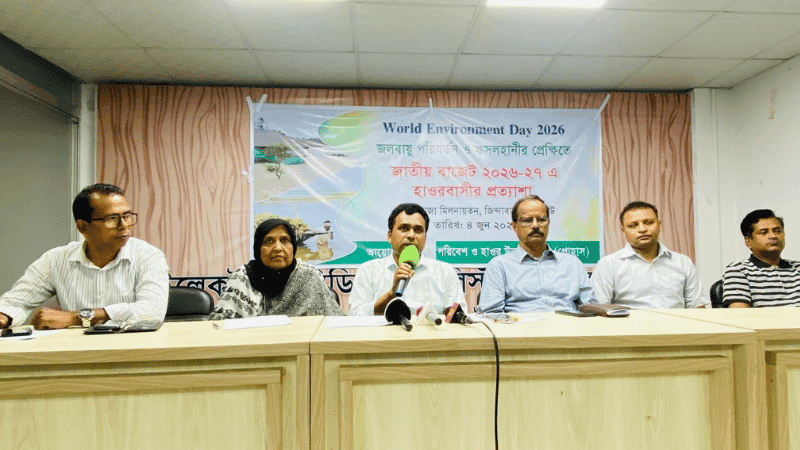

An environmental advocacy group has called for a special allocation of Tk 50,000 crore for Bangladesh’s haor region in the proposed national budget for fiscal year 2026–27, placing a 20-point set of demands aimed at addressing climate vulnerability, agricultural losses and long-term development challenges in the country's wetland basin.
The demands were presented at a discussion titled “National Budget 2026–27: Expectations of Haor Residents” held at the conference hall of the Electronic Media Journalists Association (EMJA) in Sylhet on Thursday (June 4).
Leaders of the Environment and Haor Development Organisation said recurring flash floods, excessive rainfall, climate change impacts and crop losses have pushed millions of haor residents into growing uncertainty, making targeted budgetary support essential for safeguarding livelihoods and national food security.
The discussion was chaired by the organisation’s President Kasmir Reza and moderated by General Secretary Piyush Purkayastha Titu. Professor Dr. Masud Alam of the Department of Economics at Shahjalal University of Science and Technology attended as the keynote speaker.
Presenting the organization’s recommendations, Kasmir Reza said widespread crop losses this year had left farmers in the haor region in severe distress, warranting a dedicated Tk 50,000 crore allocation in the upcoming budget.
Among the key proposals are allocating at least three percent of GDP to climate-related initiatives, introducing agricultural insurance in haor areas, providing special incentives for affected farmers, increasing funding for river and wetland dredging, establishing modern grain-drying and community threshing facilities, implementing lightning protection programmes, setting up fisheries research laboratories and sanctuaries, expanding support for farmers and fishermen, and establishing a full-fledged meteorological office in the region.
Professor Dr. Masud Alam warned that repeated crop losses in the haor belt could have long-term implications for the national economy and GDP growth. He stressed that embankment construction alone cannot solve the region’s challenges and called for an integrated water management strategy involving canal excavation, water reservoir development and sustainable planning.
He also urged authorities to create a comprehensive database of genuine farmers and fishermen and expand research on the haor ecosystem to support evidence-based policymaking.
Speaking at the event, Sujan Sylhet President Advocate Shirin Chowdhury emphasised the need for adequate budgetary support considering the unique challenges faced by the vast population living in haor areas. She also called for special allocations for women’s health and protection and highlighted the importance of accurate early weather warning systems to reduce agricultural losses.
Former Sylhet Press Club President Ikramul Kabir pointed to recurring allegations of corruption and irregularities in embankment construction projects, saying meaningful development in the haor region would remain elusive unless such issues are addressed.
BIDD Research Director Dr. Sharif Ahmed Chowdhury recommended expanding the cultivation of early-maturing rice varieties, increasing government procurement of farmers’ produce and introducing crop insurance to protect growers from climate-induced losses.
Other speakers, including former President of Midhnagar Development Council Sylhet Aminul Islam and educator Lion Md. Mostafizur Rahman, underscored the critical role of the haor region in ensuring the country’s food security, fisheries production and ecological balance.
Leave A Comment