
HRW questions fair trial standards at Bangladesh's War Crimes Tribunal
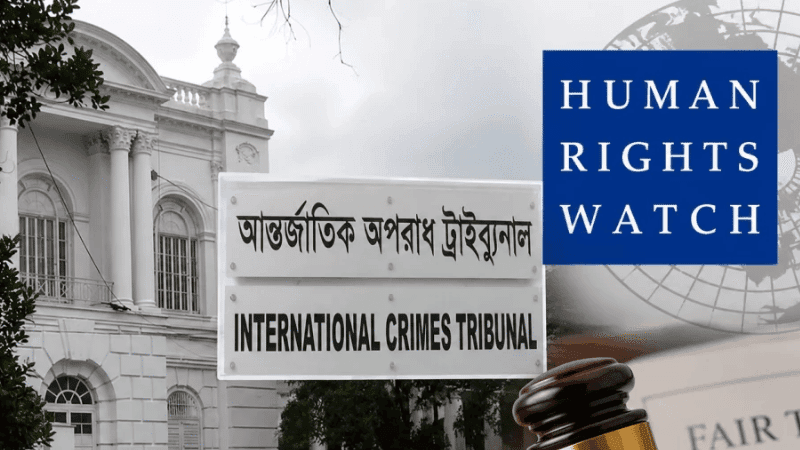

Human Rights Watch has raised concerns over the conduct of trials at Bangladesh's International Crimes Tribunal (ICT), warning that failures to uphold international legal standards risk denying justice to victims, undermining the rule of law, and enabling politically motivated prosecutions.
In a statement issued from London, the rights group said those responsible for serious violations committed under ousted Prime Minister Sheikh Hasina's government must be held accountable, but stressed that many of the ongoing prosecutions are falling short of international fair trial norms.
Meenakshi Ganguly, deputy Asia director at Human Rights Watch, said Bangladesh's criminal justice system needs urgent reform, adding that the new government must ensure there is no room for political vendettas driven by weak investigations and arbitrary allegations.
The tribunal is currently hearing cases tied to the security force crackdown on the July-August 2024 protest movement, which left more than 800 people dead and thousands injured, as well as alleged extrajudicial killings and enforced disappearances carried out during Hasina's rule.
Human Rights Watch said its monitoring of more than a dozen cases before the tribunal uncovered serious due-process concerns, including multiple instances in which witness statements appeared to contain identical, cut-and-pasted incriminating passages.
According to the organisation, the tribunal has completed six trials since Hasina's fall, convicting 62 people of crimes against humanity. Of them, 42 — including Hasina herself — were tried in absentia, and 16 were sentenced to death. On July 27, prosecutors filed charges against 41 people on counts of crimes against humanity and genocide, among them politicians, security force members and two journalists.
HRW noted that while the interim government amended the tribunal law after the 2024 political transition to bring the definition of offences closer to international standards, the changes failed to guarantee legal protections equivalent to comparable international courts.
The BNP government led by Prime Minister Tarique Rahman, elected in February this year, has introduced no further amendments.
Under the existing law, the statement said, prosecutors can order arrests without meeting any evidentiary threshold, detainees can be held for months without written justification, and there is no right to interlocutory appeal before trial begins. Trials can start just three weeks after evidence disclosure — insufficient time for defence preparation, HRW said — while proceedings in absentia lack safeguards such as the right to choose one's own counsel, and defence lawyers face restrictions during cross-examination.
The statement cited the May 14 arrest orders against two journalists — Ekattor TV managing director Mozammel Babu and presenter Farzana Rupa — over their reporting on a 2013 rally by Hefazat-e-Islam. Prosecutors allege the pair spread "false information" to help the then-government cover up deaths during the rally. Their lawyers told HRW they were never given written grounds for the arrests, which the group said violated Article 14 of the International Covenant on Civil and Political Rights as well as Bangladesh's International Crimes (Tribunals) Act.
HRW also questioned the addition of genocide charges against the two journalists in the July 27 charge sheet, noting that under international law, genocide requires proof of specific intent to destroy, in whole or in part, a national, ethnic, racial or religious group.
As an example of duplicated testimony, the group pointed to a Chittagong case involving 22 Awami League politicians and activists charged over killings in the city on July 16, July 18 and August 4, 2024. A review of 55 published witness statements found a six-line passage repeated almost verbatim in 14 separate statements, accusing seven politicians of orchestrating killings through "planning, financing, provocation and instructions." A second, longer passage appeared nearly identically in nine further statements.
In the same case, lawyers for senior Awami League politician A.B.M. Fazle Karim Chowdhury, who is in custody, supplied journalists with recordings purportedly capturing a tribunal prosecutor offering to secure his bail in exchange for 10 million taka. The prosecutor resigned after the recordings surfaced, but the chief prosecutor's office has yet to conclude its investigation even as judges proceeded to frame charges. The trial is scheduled to begin on August 6.
Ganguly said Bangladeshi authorities must recognise that the political witch-hunts of the Awami League era cannot be repeated, adding that charges built on duplicated witness statements point to the absence of a credible justice process that will once again fail victims, their families and the country at large.
Leave A Comment