
Hundreds sing Rabindra Sangeet protesting defacement of Tagore portrait
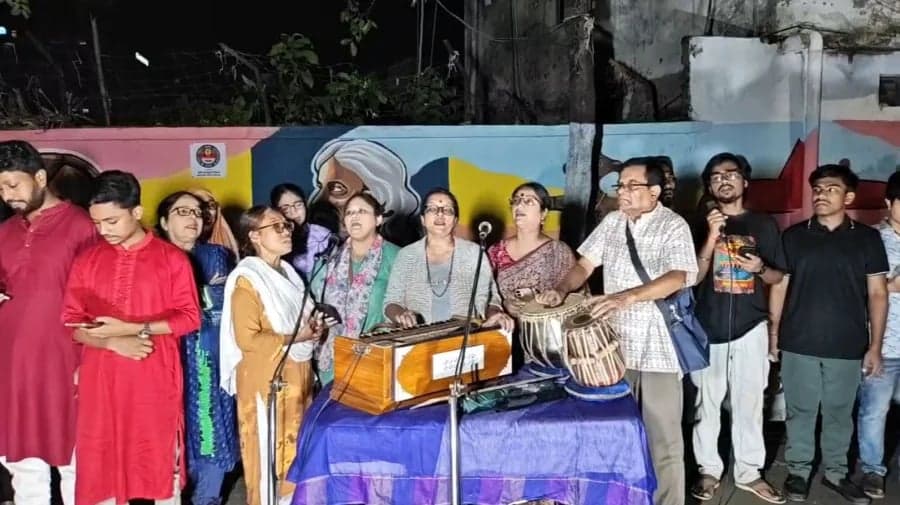

Cultural activists from several organisations gathered to sing Rabindra Sangeet in unison in protest against an attempt to deface a graffiti portrait of Rabindranath Tagore on a wall outside the Bangladesh Shilpakala Academy in Segunbagicha, Dhaka.
The programme, held on Saturday, October 10, called for the protection of Bangladesh’s cultural heritage and secular values.
Organised under the title “An Impromptu Protest: Rabindra Sangeet in a Hundred Voices”, the event drew participants from several cultural organisations, including Udichi Shilpigoshthi.
They performed a selection of Tagore’s songs, including O Amar Desher Mati, Aji Bangladesher Hridoy Hote and Sankoch-er Bihwalata. The programme concluded with a collective rendition of Bangladesh’s national anthem, Amar Sonar Bangla, written by Tagore.
The gathering was chaired by Jamsed Anwar Tapan, general secretary of Bangladesh Udichi Shilpigoshthi and coordinator of the Democratic Cultural Alliance. Tamzid Haider Chanchal, president of Bangladesh Chhatra Union, moderated the event.
Speakers included Amirun Nujhat Manisha, organising secretary of Bibartan Cultural Centre; Tahmina Sultana Sathi, former general secretary of the Central Khelaghar Asar; and Iqbalul Haque Khan, assistant general secretary of Udichi’s central committee, among others.
Speakers alleged that attempts were being made to reduce Tagore to his religious identity and deny his literary and cultural contributions. They argued that the vision of a secular Bangladesh was deeply connected to the aspirations of the Liberation War, the mass uprising of 1990 and the 2024 mass uprising.
Any attempt to steer the country away from these ideals, they said, must be resisted.
Amirun Nujhat Manisha, organising secretary of Bibartan Cultural Centre, said campaigns were being conducted against Tagore by labelling him a “Hindu poet”.
She argued that such statements were being made without an adequate understanding of his life, literary works and historical significance. She also alleged that attempts were being made to exploit the July uprising for vested interests.
Manisha said the cultural struggle and the political struggle would have to continue in tandem.
Tahmina Sultana Sathi, former general secretary of the Central Khelaghar Asar, said the goal of independence had been to establish an egalitarian and secular Bangladesh.
The vision, she said, was of a country where every child would have equal opportunities and everyone’s rights to work, food and housing would be protected.
She called for collective resistance whenever efforts to realise these goals were obstructed.
Iqbalul Haque Khan, assistant general secretary of Udichi’s central committee, also condemned the attempt to whitewash Tagore’s graffiti. He stressed that the struggle to build a secular Bangladesh must continue.
In his closing remarks, Jamsed Anwar Tapan said smearing paint over Tagore’s portrait could not erase the poet from the Bengali consciousness or cultural identity.
Attempts had also been made during the Pakistani era to suppress Rabindra Sangeet and the practice of Tagore’s works, he said.
However, the Bengali cultural movement had played a significant role in paving the way for the Liberation War. Tapan called for resistance against any future attempts to obstruct cultural activities.
Rumi Probha, general secretary of Udichi’s Dhaka metropolitan unit, led the musical performances. Speaking to Bangla Tribune, she said efforts were under way to erase from history prominent figures whose lives and work were deeply rooted in the language, culture and heritage of the Bengali people. Such attempts would ultimately fail, she said, adding that the programme had been organised to register a protest against them.
Meanwhile, police detained four people, including A N M Ayas, member-secretary of the State Dialogue Forum, on Saturday afternoon in connection with an attempt to deface Tagore’s graffiti on the wall outside the Shilpakala Academy.
They were taken to the Detective Branch (DB) office of Dhaka Metropolitan Police for questioning.
One of those detained was a woman.Sheikh Zahidul Islam, deputy commissioner of the Dhaka Metropolitan Police’s Ramna division, said Ayas had been detained as a preventive measure amid concerns that the incident could lead to disorder.
Shafiqul Islam, additional commissioner (Detective Branch) of the DMP, said the detainees were being questioned and that further legal action would be taken based on the information obtained.
Dhaka South City Corporation had commissioned portraits of 10 writers, literary figures and cultural personalities on a wall beside the Shilpakala Academy. The figures include Bangladeshis Kazi Nazrul Islam, Fakir Lalon Shah, Zainul Abedin, SM Sultan, Zahir Raihan, Shah Abdul Karim and Humayun Faridi. The portraits also feature three prominent figures from West Bengal: Rabindranath Tagore, Ishwar Chandra Vidyasagar and Satyajit Ray.
The inclusion of personalities from West Bengal, as well as the absence of any women among those portrayed, has sparked debate on social media, with opinions divided over the selection.
Leave A Comment