

'If deep tube wells run, we get meal'
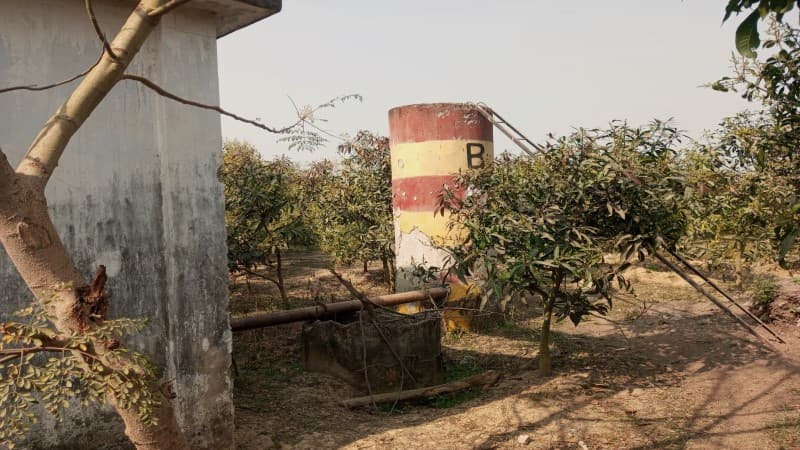

"If deep tube wells run, we get rice," said Md Ataul Islam, a resident of Deopara union in Godagari upazila.
He said, "Before 1985, our area produced only one crop a year, dependent on rainwater. Yield was 15 to 20 maunds per acre. In years when rains were untimely, farmers got no harvest. Now, yield is 80 to 90 maunds per acre. Some land produces more than three crops. Water from deep tube wells installed by the Barind Multipurpose Development Authority (BMDA) is used to cultivate all kinds of crops including wheat, rice, vegetables and mango orchards. If there are no tube wells or if water supply stops, the northern region will turn into a desert like before. There will be a food crisis."
Md Moktar Hossain from Laldanga village in Sapahar upazila, Naogaon, said, "Before 1985, the Barind region was a rugged expanse of red laterite soil, high and low hillocks, a shade-less wasteland. As far as the eye could see were sun-scorched barren fields. There was not a drop of water anywhere. In the scorching heat of Chaitra, emaciated farmers struggled for life, their plough bulls even more emaciated. In the distance, palm trees stood on one leg, with occasional acacia and cactus fences. This was the Barind land."
Muhammad Matiur Rahman, Project Director (Current Charge) and Executive Engineer of the BMDA's Irrigation Infrastructure Rehabilitation (RIIP) project, told Views Bangladesh, "Several deep tube wells operated by BMDA are about 35 to 40 years old. Generally, the operational life of deep tube wells is 20 to 25 years. Currently, various components of these deep tube wells, such as filters, housing, pipes, and motors, are getting damaged, causing sand and stones to come out with the water. As a result, these deep tube wells are becoming inoperative or useless at any time, disrupting irrigation. In this situation, there is an urgent need to re-excavate those deep tube wells and bring them into irrigation use."
He further said, "Through the Irrigation Infrastructure Rehabilitation (RIIP) project, water supply is being arranged by excavating the deep tube wells that are becoming inoperative and disrupting irrigation. BMDA cannot implement this project with its own funding. Not only this, necessary ongoing projects need to remain operational."
History shows that the picture of the Barind land was different in ancient times. From around 300 BC to the period of spread of Buddhism and culture, this region was known as a prosperous agricultural and industrial area. The natural environment of the region was also quite excellent at that time.
According to historian Nelson (1923), the Barind region was full of forests. According to William Hunter's (1876) description, almost all types of trees found in Bengal were available in this region. Mango, blackberry, tamarind, palm, date, banyan, paikar, silk cotton, acacia, plum, bamboo, cane, and numerous creepers and shrubs abounded in this Barind land.
However, during the British rule, with the increase in population, the expansion of agricultural land, establishment of homesteads, supply of raw materials for industries, extensive use of wood for furniture and house construction materials, fuel, and construction of infrastructure like roads, dams, etc., the forests of this area were gradually destroyed. Essentially, from that time, the process of desertification began in this region.
Due to the natural order of the environment, the amount of rainfall in this region decreased. Where the country's average annual rainfall is 2500 mm, in this region it is not more than 1400 mm. Being a downstream country, due to the construction of dams/barriers on almost all rivers coming from upstream countries, most rivers (Mahananda, Atrai, Punarbhaba, Shiba, Pagla, Korotoa, Teesta) often dry up in the dry season. Additionally, due to lack or reduction of water flow in rivers or canals, silt accumulates, and most streams, canals, and wetlands fill up, losing their adequate water holding capacity. As a result, surface water sources in this region also become very insufficient.
For various reasons, the lands of this region were rain-dependent and single-cropped. If rains were untimely, even a single crop production was hampered. After the rain-dependent broadcast aman crop, the lands remained fallow for the rest of the year, used as grazing land. Extracting groundwater from deep aquifers through thick layers of clay was also not easy. So, irrigation was out of the question; local people used pond, canal, and wetland water for drinking water and various household chores. Due to lack of proper crop production, the people of this area were extremely poor. They could not eat three full meals a day. Even many landowners were needy. Therefore, local people regularly migrated elsewhere in search of work.
Due to soil composition and low groundwater levels, irrigation with conventional deep tube wells was not possible in this region. In that context, in 1985, engineers of the then BADC in this region invented a special type of deep tube well, creating the opportunity for irrigation with groundwater. The journey of development in this region began through the Barind Integrated Area Development Project under the Bangladesh Agricultural Development Corporation (BADC). The institution established by the late Chairman and Executive Director of BMDA, Dr M Asaduzzaman, is currently facing a manpower shortage.
Initially, through this project, activities were conducted in 15 upazilas of Rajshahi, Naogaon and Chapainawabganj districts. Creating irrigation facilities by installing deep tube wells and excavating ponds and canals, preventing desertification through afforestation, and constructing feeder roads for marketing produced crops and communication were among the main goals and objectives of this project.
Due to time constraints, funding adversities, and various administrative complexities, the project's activities were hindered, but even the few activities created a great ray of hope in the minds of the people of this area. Immense potential for golden crops emerged in the barren lands of the Barind area. To realise that potential, a separate institution named BMDA was formed under the Ministry of Agriculture on January 15, 1992, incorporating all (25) upazilas of Rajshahi, Naogaon and Chapainawabganj districts for the development of the entire Barind area.
Dr Md Ejadul Islam, Executive Engineer of BMDA's Kurigram Region, told Views Bangladesh, "BMDA started working for the development of agriculture and environment in the Barind area, including irrigation infrastructure development, expansion of irrigated area and cultivable land, production and supply of quality seeds, and planting fruit and other trees for weather and environmental improvement, and is successfully progressing in the agriculture sector. BMDA started working to transform the Barind area into the country's granary, prevent desertification through afforestation and re-excavation of canals and ponds for supplementary irrigation, and improve the quality of life through product marketing by developing rural communication systems."
He said, "BMDA's activities were initiated for the development and proper use of surface and groundwater resources in irrigation, agricultural mechanisation, seed production and supply, crop diversification, tree planting and preservation to maintain environmental balance, construction and maintenance of link roads on a limited scale, installation of irrigation equipment, supply of safe drinking water in localities, and providing research and training. However, implementation activities have been somewhat disrupted due to regular manpower shortages."
BMDA has installed 15,793 deep tube wells in 16 districts. It has constructed 13,501 km of water distribution systems for irrigation, installed 532 LLP, 119 solar-powered LLP, re-excavated 2024 km of canals, constructed 749 cross-dams, installed pontoons in 11 rivers, re-excavated 3140 ponds, removed waterlogging from 10,850 hectares including Raktadah Bill, Tepa Bill, Mansur Bill in Naogaon and Chhatragachha Bill, Debor Bill in Rajshahi, constructed 572 solar dug wells, and built 1144 km of link roads.
The organisation has constructed overhead tanks to supply drinking water to 1579 families, planted 2.58 crore trees for afforestation, produces 600 metric tonnes of seeds annually, and trained 1,48,218 farmers.
Until January 2026, BMDA is supplying water to 22,000 hectares for aus, 362,000 hectares for aman, and 260,000 hectares for rabi crops. Until June 2025, it is supplying water to 80,600 hectares for aus, 357,000 hectares for aman, and 629,000 hectares for rabi crops.
According to BMDA sources, the authority has been conducting its activities in this area for a long time to continue the agricultural and economic development of Rajshahi and Rangpur divisions. Currently, there is a significant manpower shortage here. To continue agricultural and economic development, initiatives need to be taken to increase the manpower of this organisation. The organisation is running with 726 personnel. Recruitment has been stopped since 2008. The organisation needs another 1911 personnel. Due to the manpower shortage, activities are progressing slowly. A new organogram has been prepared and sent to the ministry to make it more effective. If the organogram is approved, the long-standing frustration of the working personnel, along with the agricultural and economic development of the two divisions, will be alleviated.
Dr Md Abul Kasem, Additional Chief Engineer (Current Charge) of BMDA (Surface Water Development and Construction-Design Subdivision), told Views Bangladesh, "There is a manpower shortage. The ministry has been informed about this."
Leave A Comment
You need login first to leave a comment