
Industry seeks rationalisation of spectrum costs to support digital future
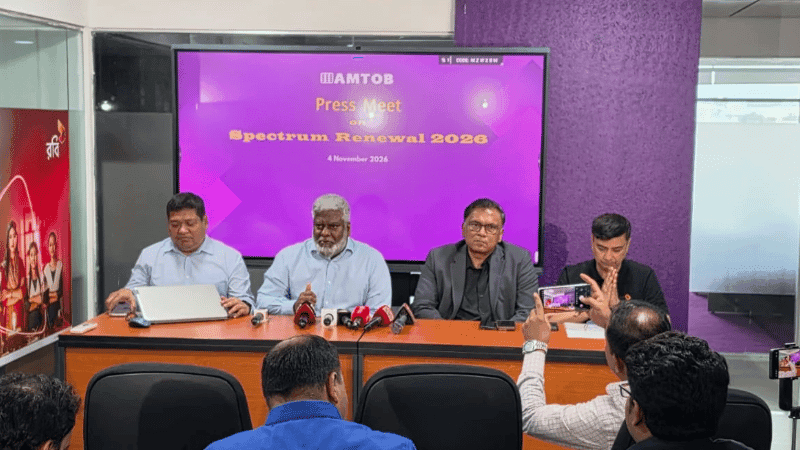

Bangladesh's mobile industry respectfully urges the Government to further rationalise spectrum renewal costs and associated terms to ensure sustained investment in digital infrastructure, service quality, and nationwide connectivity, said mobile telecom industry leaders at a press meet today.
The speakers said, the industry appreciates the regulator's engagement with stakeholders and recognises the efforts made during the spectrum renewal process. However, while discussions often focus on reductions from previously circulated figures, it is important to recognise that the current proposed spectrum valuation does not represent the prevailing benchmark for renewal and remains significantly higher than international and Asia-Pacific market norms when assessed against sector revenues and market realities.
The press meet took place at Association of Mobile Telecom Operators of Bangladesh (AMTOB) office in Banani where Taimur Rahman, Chief Corporate and Regulatory Affairs officer of Banglalink, Tanveer Mohammad, Chief Corporate Affairs Officer of Grameenphone, Shahed Alam, Chief Corporate and Regulatory Officer of Robi Axiata PLC discussed about the upcoming spectrum renewal. Lt Col Mohammad Zulfikar (retd) moderated the event.
The speakers said, spectrum policy should support broader national objectives, including digital inclusion, network expansion, innovation, and affordable connectivity for citizens. Striking the right balance between government revenue and long-term sector sustainability is therefore essential.
Spectrum Costs Remain High Relative to Industry Economics
Independent international studies indicate that spectrum-related costs in Bangladesh account for a significantly larger share of operators' revenues than both Asia-Pacific and global averages. This places substantial pressure on a sector already facing stagnant revenues, low ARPU growth, rising operating costs, and continuous network investment requirements.
Mobile operators have recently invested heavily in spectrum acquisition and network expansion and will be required to make further investments to meet rapidly growing data consumption and future technology requirements. Excessive spectrum costs inevitably reduce the industry's ability to invest in wider coverage, better service quality, greater network resilience, and enhanced customer experience.
Future spectrum requirements will increasingly be driven by data traffic growth and network capacity demand rather than by the number of megahertz assigned. Spectrum valuation frameworks should therefore evolve to reflect capacity needs, network efficiency, digital demand, and socio-economic benefits.
The proposed extension of spectrum licence tenure is a positive step that provides greater certainty for long-term investment planning. However, the full benefits of such an approach can only be realised if the overall commercial framework remains investment-friendly and aligned with international best practices.
The mobile telecommunications sector is a major contributor to government revenue and an important enabler of economic growth, employment, financial inclusion, education, healthcare, and digital public services. Continued investment by operators is critical to achieving Bangladesh's ambition of becoming a smart, digitally empowered nation.
A more balanced and forward-looking spectrum framework would strengthen operators' ability to invest in infrastructure, improve customer experience, expand connectivity to underserved communities, and accelerate the country's digital transformation journey.
The mobile industry respectfully requests further rationalisation of spectrum renewal costs and related charges, taking into account industry revenues, ARPU trends, future investment requirements, and international benchmarks. Such an approach would create a sustainable and mutually beneficial outcome for the people of Bangladesh, the Government, and the industry, ensuring affordable services, stronger networks, and continued progress towards national digital development goals.
Taimur Rahman of Banglalink said, “Spectrum is essential for ensuring quality of service, network capacity and nationwide coverage. As Bangladesh moves from voice to data, spectrum demand is growing exponentially, while operators’ revenues are not increasing proportionately. Spectrum pricing must therefore reflect today’s realities, with significantly lower unit prices to enable continued investment in spectrum aquisition, network expansion and service quality. The government should take a holistic view of spectrum pricing, looking beyond immediate revenue and recognising its critical role in accelerating digital transformation, economic growth and long-term national development.”
Tanveer Mohammad of Grameenphone, said, "We thank BTRC for taking a structured approach in the spectrum renewal process and fostering series of constructive dialogues with telecom operators. However, the proposed 20-year spectrum fees appear to have been derived by broadly scaling up the value of a standard renewal period. A 20-year spectrum license should not simply be priced by proportionately scaling the value of a 15-year license. The economic value of additional years declines due to technological evolution, changing market and demand conditions, and investment risks. Accordingly, we therefore respectfully request a more rational renewal price based on an appropriate valuation
methodology, together with flexible payment terms. Spectrum renewal is not merely a revenue consideration; it is an investment in Bangladesh's digital future. A balanced and investment-friendly framework will preserve operators' capacity to invest in network expansion, service quality and affordable connectivity, while creating greater long-term economic and digital value for the country."
Shahed Alam of Robi Axiata PLC said, "We appreciate the regulator's efforts in advancing the spectrum renewal process. However, spectrum affordability should be assessed in the context of industry revenues, investment capacity, and the need for continued network expansion. As Bangladesh's digital economy grows, a balanced and investment-friendly spectrum framework will enable operators to enhance service quality, expand connectivity, and accelerate digital inclusion. We respectfully encourage a pragmatic approach that supports both long-term sector sustainability and the country's digital ambitions."
We firmly believe that a pragmatic, forward-looking approach to spectrum pricing and licence tenure will deliver a Win-Win-Win outcome for the people of Bangladesh, the Government and the industry by accelerating connectivity, fostering innovation and supporting the nation's digital economy goals.
Leave A Comment