

Key areas of constitutional reform gain political parties support

Political parties have reached broad consensus on several key areas of constitutional reform, including the revival of the caretaker government system, the expansion of citizen rights, and the restructuring of Parliament. However, the inclusion of the word 'pluralism' among the fundamental principles of the state remains a point of contention.
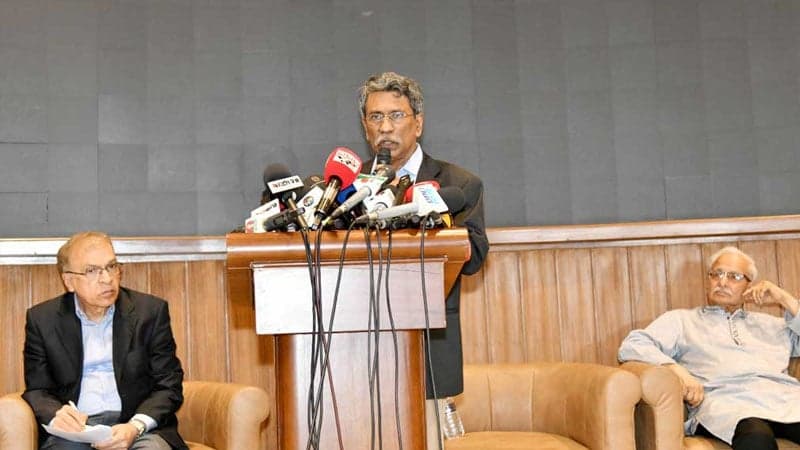
At a press briefing held at the LD Hall of the Jatiya Sangsad on Monday (May 26), National Consensus Commission Vice-Chairman Professor Ali Riaz presented updates on the Commission’s work. He stated that most political parties support incorporating equality, human dignity, social justice, and democracy as fundamental principles of the state, but differ over the proposed inclusion of 'pluralism' in that list.
The reintroduction of the caretaker government has seen unanimous support from all major parties, marking one of the most significant areas of agreement in the ongoing dialogue. There is also general support for forming a bicameral legislature, though a few parties continue to advocate for a unicameral system. While there is agreement on reserving 100 seats for women in the lower house, the method of reservation remains under discussion.
Most parties also support assigning the position of Deputy Speaker to the opposition, regardless of the structure of Parliament. There is a strong consensus on giving the opposition leadership of key standing committees such as the Public Accounts Committee, the Estimates Committee, the Public Undertakings Committee, and the Privileges Committee.
The proposal to form an upper house with 100 members has received considerable support, but parties are yet to agree on how its members should be elected. There is general consensus on amending Article 70 of the Constitution, which prohibits lawmakers from voting against their party. Most parties support enforcing party discipline on money bills, confidence votes, and constitutional amendments. Some have proposed including national security bills in that list, though this remains a matter of debate.
Amending Article 48(a) of the Constitution has also received wide backing. However, parties remain divided over how to recalibrate the balance of power between the Prime Minister and the President.
Despite these areas of agreement, several key structural issues remain unresolved. These include the decentralisation of the judiciary, the appointment process and tenure of the caretaker government’s chief adviser, the composition of the National Constitutional Council, the possibility of MPs holding multiple offices, and the procedure for electing the President and amending the Constitution. Professor Riaz noted, however, that most parties have expressed a willingness to continue dialogue on these contentious matters.
The Commission had sent a spreadsheet containing 166 recommendations—drawn from the reports of five previous commissions—to 38 political parties and alliances. These recommendations spanned constitutional reform, electoral reform, the judiciary, public administration, and anti-corruption measures. Parties were asked to indicate whether they agreed, disagreed, or partially agreed with each recommendation, and were given the opportunity to submit comments.
Of the 38 parties and alliances approached, 35 responded with feedback. Many submitted detailed comments and analyses alongside their responses. Between March 20 and May 19, the Commission held 45 consultation sessions with 33 parties and alliances. Some meetings extended over multiple days, reflecting the depth of engagement.
Leave A Comment
You need login first to leave a comment