
Let the scorching sun help keep Bangladesh cool
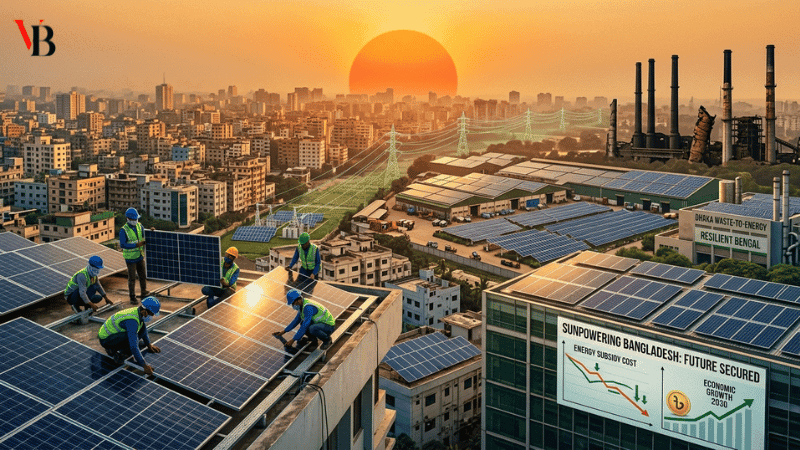

Bangladesh’s power policy is caught in a costly contradiction. The state continues to spend enormous sums subsidising electricity, with Tk 37,000 crore allocated for power subsidy in FY2025-26 after the revised figure for FY2024-25 rose to Tk 62,000 crore. Yet even as the country struggles under a subsidy-heavy, import-dependent power model, it continues to make renewable adoption more difficult than sound judgment would suggest.
This is no longer merely an energy-sector concern. It is a macroeconomic one. Bangladesh remains heavily reliant on imported fuel and imported electricity. As a result, every external shock, every bout of exchange-rate pressure, and every spike in global energy prices eventually feed into the budget, the balance of payments, and the consumer’s burden. A country already preoccupied with reserve management cannot indefinitely subsidise a system that repeatedly draws upon foreign exchange simply to remain operational.
That is why renewable energy must now be understood not merely as climate policy, but as economic strategy. Solar panels, inverters, batteries, and wind equipment are often imported, but unlike imported fuel, they are largely capital expenditure. They are purchased, installed, and then generate value over many years. Imported fuel, by contrast, is consumed rapidly and must be bought again and again. One builds productive capacity. The other entrenches recurring external dependence.
The timing for action is favourable. Global solar prices have fallen sharply over the past two years. The real danger now is not that solar remains prohibitively expensive, but that policy may remain too hesitant to seize the opportunity before us.
In the short term, Bangladesh should reduce, and where appropriate eliminate, import costs on key renewable components so that uptake may accelerate. Pakistan offers a telling example. Solar’s share of Pakistan’s electricity rose from 4% in 2021 to 14% in 2024, and by the first four months of 2025, solar supplied 25.3% of utility electricity, becoming the country’s largest single source during that period. Imports of solar modules from China rose from 3.5 GW in 2022 to 16.6 GW in 2024, with more than 10 GW imported in early 2025 alone.
Pakistan’s experience does not suggest that tax relief alone explains such growth. Higher grid tariffs, falling global panel prices, and market demand all played an important part. Yet it does demonstrate a larger truth: when the state ceases to make solar unnecessarily expensive, uptake can accelerate quickly.
In the mid term, Bangladesh may consider an India-style push for local manufacturing of renewable equipment. Such an approach may eventually prove relevant, but only if pursued with caution and credibility. Even then, imported machinery, components, equipment, and raw materials required for domestic renewable manufacturing should continue to enjoy tax exemptions or very low tax treatment. The objective should be to cultivate industry, not suffocate transition under premature protectionism.
In the long term, Bangladesh should invest more seriously in research, exploration, and pilot projects for wind, tidal, wave, waste-based power generation, and other alternative energy solutions. Solar should remain the immediate priority because it is commercially more viable and more readily deployable today. But a country confronting heat stress, climate vulnerability, urban waste-management pressure, and long-term energy uncertainty should not confine its ambition to one technology alone. In cities already struggling with mounting waste and limited disposal capacity, waste-to-energy deserves attention not only as a power option but also as a practical urban management tool.
There is also room for a sensible fiscal incentive on the demand side. The government should consider offering tax benefits to businesses that meet more than 50% of their power needs from solar or other approved renewable sources. Such a measure would encourage factories, commercial buildings, warehouses, logistics operators, and service-sector firms to invest in self-generation, easing pressure on the grid and deepening the market for renewable solutions. Selling and procuring electricity from a renewable power generator should also be kept out of taxation for a period to encourage entrepreneurial investment.
The benefits would not end there. Once private entities begin producing a meaningful share of their own electricity, the scope for theft from the grid is naturally reduced. So too is the space for ghostly bills devised to manage system gaps, for spillage, and for the waste of public resources. In that sense, greater private renewable generation is not merely an energy solution. It is also a governance reform, an efficiency reform, and a fiscal relief mechanism.
Bangladesh does not need to subsidise the old system while taxing the new one. It should lower barriers to renewable adoption now, consider manufacturing support with care, and broaden the horizon towards wind, waste-based, and other alternative energy over time. If it gets that balance right, the country can ease subsidy pressure, conserve foreign exchange, and build a more resilient energy economy.
And in a land increasingly scorched by heat, there is a quiet wisdom in using the very source of that scorching sun to help keep it cool.
Abu Nazam M Tanveer Hossain
Principal, Stratagem
Leave A Comment