Views Bangladesh Logo
author image

Abu Nazam M Tanveer Hossain

  • Bangladesh

Public Policy Advocate
Let the scorching sun help keep Bangladesh cool

Let the scorching sun help keep Bangladesh cool

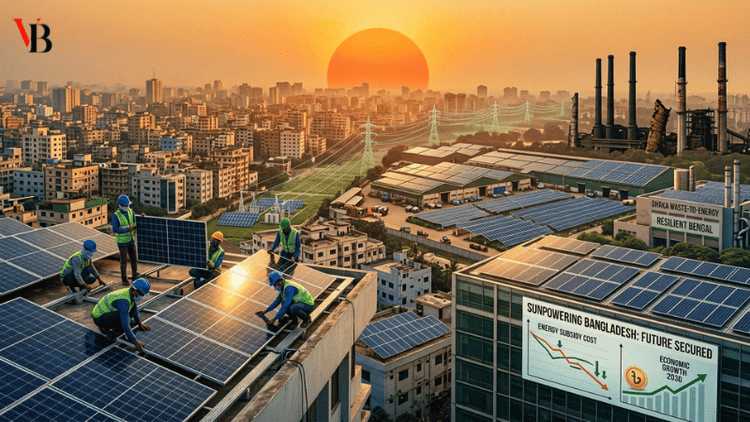
Bangladesh’s power policy is caught in a costly contradiction. The state continues to spend enormous sums subsidising electricity, with Tk 37,000 crore allocated for power subsidy in FY2025-26 after the revised figure for FY2024-25 rose to Tk 62,000 crore. Yet even as the country struggles under a subsidy-heavy, import-dependent power model, it continues to make renewable adoption more difficult than sound judgment would suggest.
Regulate digital platforms with strategy, not reflex

Regulate digital platforms with strategy, not reflex

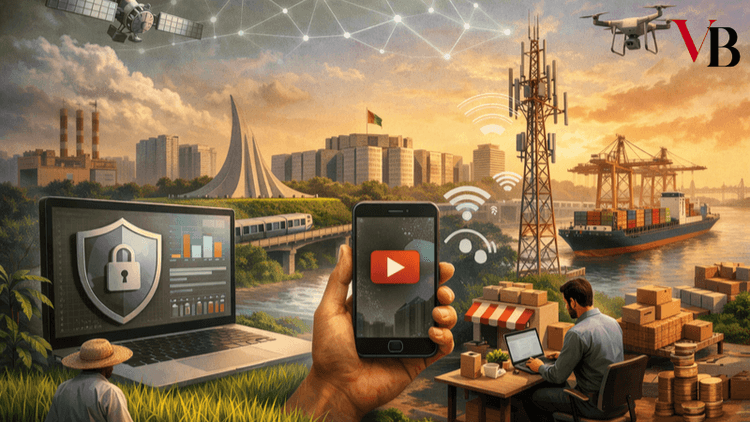
Bangladesh needs stronger data governance and OTT regulation, but not through disruption or disproportionate compliance burdens. A sequenced, market-aware approach combining digital literacy, smarter enforcement, and competitive local infrastructure can protect citizens while preserving exports, entrepreneurship and economic resilience.

Data protection towards digital isolation?

Data protection towards digital isolation?

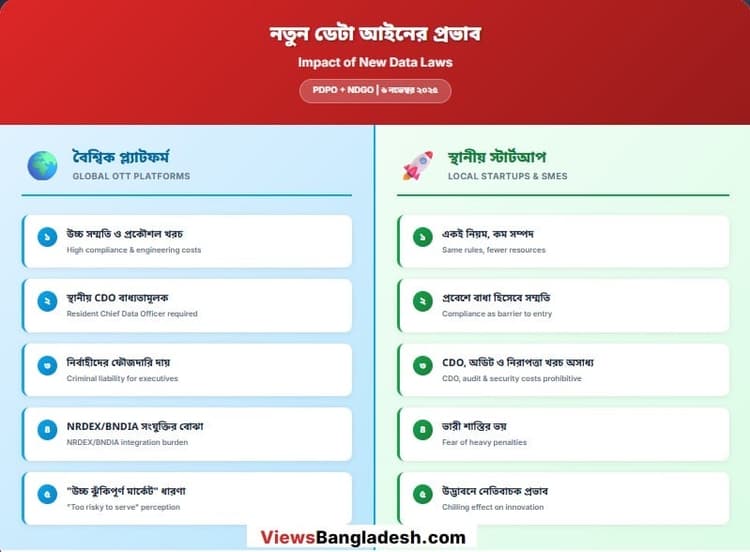
Two new Ordinances got gazetted on the 6th November creating a single, very heavy data regime together: ● the Personal Data Protection Ordinance (PDPO) governs privacy, rights and security of personal data; ● the National Data Governance Ordinance (NDGO) governs how all data – personal and non-personal – must sit inside a state-managed interoperability and DPI stack (BNDIA, NRDEX, etc.). Let us try to analyse the impact of these two laws on (a) global OTTs and (b) small/local data-handling businesses.

Rethinking the Draft Telecom Ordinance 2025

Rethinking the Draft Telecom Ordinance 2025

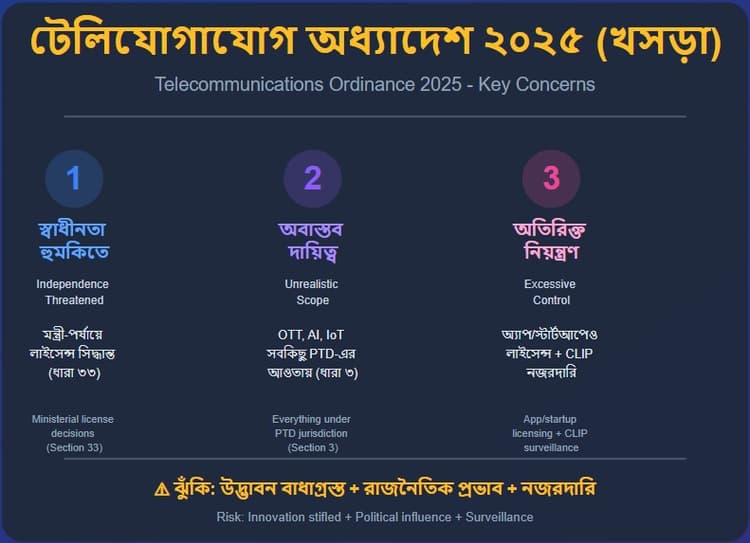
The draft Bangladesh Telecommunications Ordinance 2025 has been released for public comment with a bold promise: a “modern” telecom regime that recognises the realities of the digital age – from spectrum and submarine cables to OTT, AI and IoT. But when you dive in, three big questions stand out: how independent will the regulator really be, how much can the Ministry realistically supervise, and where exactly does licensing stop and surveillance begin?

A Policy Fallacy Rooted in Over-Licensing and Weak Oversight
 A Policy Fallacy Rooted in Over-Licensing

A Policy Fallacy Rooted in Over-Licensing and Weak Oversight

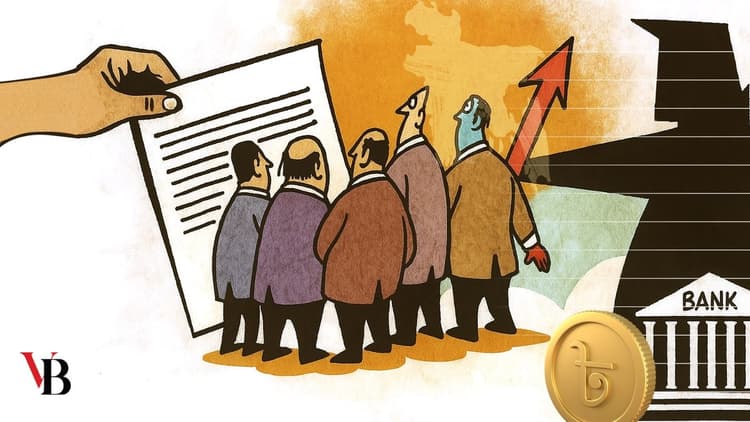
Bangladesh, with a GDP of around USD 460 billion in 2025, has one of the most over-licensed financial sectors in South Asia. It currently hosts 61 scheduled banks, 38 non-bank financial institutions (NBFIs), over 750 licensed microfinance institutions (MFIs), alongside 13 mobile financial service (MFS) providers, 9 payment service providers (PSPs), and 12 payment system operators (PSOs). These institutions are regulated by four bodies: Bangladesh Bank (BB), the Insurance Development and Regulatory Authority (IDRA), the Microcredit Regulatory Authority (MRA), and the Bangladesh Securities and Exchange Commission (BSEC). Yet financial inclusion remains suboptimal. A substantial segment of the population, including many in urban areas, remains excluded from formal financial services.

Promising but demands tuning
Revision Attempt of Connectivity Policy

Promising but demands tuning

The BTRC’s draft reform of the ILDTS policy is a vital step toward a modern, future-ready telecom framework. After two decades of outdated licensing, this overhaul promises a more efficient, competitive, and innovation-driven sector. By phasing out ineffective licenses and addressing key inefficiencies, it sets the stage for meaningful, sustainable growth in Bangladesh’s telecom industry.