
Mamata Banerjee: which path after the fall?
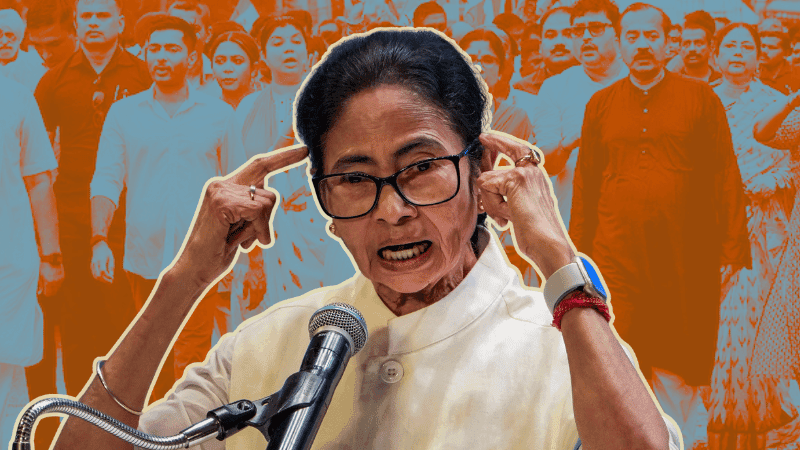

A significant chapter in the political history of West Bengal came to a close on May 4, 2026. The BJP won 207 out of 294 seats, forming the government in the state for the first time. The Trinamool Congress was reduced to just 80 seats.
However, a story even larger than the numbers emerged: Mamata Banerjee was defeated in her own constituency, Bhabanipur, by Suvendu Adhikari by a margin of 15,114 votes. In the very seat where she had secured over 70% of the votes in 2021, this defeat is not just political—it is symbolically profound.
After serving as Chief Minister of West Bengal for 15 years and ending the 34-year rule of the Left Front in 2011, Mamata Banerjee’s political future now appears deeply uncertain. Yet those who are quick to declare her “finished” may also be mistaken. Over a political career spanning five decades, Mamata has repeatedly bounced back from situations where her career seemed all but over. The question now is — can she do it once again?
The day after the results were announced, Mamata Banerjee declared at a fiery press conference at her Kalighat residence, “There is no question of resigning. We have not been defeated by the people’s mandate, but by conspiracy.” She directly accused the Election Commission and central security forces of bias, alleging widespread electoral manipulation. In a party meeting, she reportedly said, “Let them impose President’s Rule if they want. Let them dismiss me if they can.” The defiant tone reflected her long-familiar fighting spirit, but this time it also triggered a constitutional crisis.
Under Article 164 of the Constitution of India, a chief minister holds office at the pleasure of the governor, which is fundamentally tied to majority support in the legislative assembly. The All India Trinamool Congress had clearly lost that majority. As a result, Mamata’s continuation in office was becoming increasingly untenable constitutionally. Finally, on May 7, Governor R. N. Ravi dissolved the assembly by invoking Article 174(2)(b) of the Constitution. The governor’s one-line order stated that, in exercise of the powers conferred under Article 174(2)(b) of the Indian Constitution, the West Bengal Legislative Assembly stood dissolved with effect from May 7, 2026. In this way, Mamata’s refusal to resign ultimately became meaningless on its own.
This entire sequence of events is unprecedented in the political history of India. Mamata Banerjee has become the first chief minister in independent India to lose an election, refuse to resign, and ultimately lose office automatically upon the dissolution of the legislative assembly. Sagarika Ghose, a Rajya Sabha member from the All India Trinamool Congress, wrote in a column for ThePrint that Mamata was not resisting authoritarianism — she herself was moving in that direction. The remark carried particular significance because it came from within her own party.
Poetry and the politics of morale
Following the defeat, Mamata Banerjee published an English poem titled Brave. Written in simple language, the poem speaks of courage, self-respect, and refusing to bow before adversity. “Be brave and strong” — the opening line functions both as a personal reflection and as a message to demoralized Trinamool workers. Mamata’s habit of writing poetry is not new, but this time its political symbolism carries far greater weight.
Had the poem been merely an emotional outpouring, it might not have drawn so much attention. But it appeared at a moment when many leaders and activists of the All India Trinamool Congress were visibly demoralized, with some already leaning toward the victorious camp. In that context, analysts see Mamata Banerjee’s use of poetry to preserve party morale as a calculated political move.
Party rebuilding and digital strategy
Immediately after the defeat, Mamata Banerjee and Abhishek Banerjee held a meeting with the party’s online campaign team. It was the Trinamool’s first meeting with its “digital warriors” after the election. One message was repeated throughout the meeting — morale must not collapse, and the fight must continue. Mamata urged everyone to prepare for a broader political movement ahead.
The party’s information technology wing has also been reorganized. A central committee has replaced the long-standing leadership structure previously overseen by Debangshu Bhattacharya. In the newly formed committee, Upasana Chowdhury has been placed first, followed by Debangshu in the second position.
Alongside these efforts, Mamata Banerjee has also convened separate meetings with top district leaders. Meetings with MPs and defeated candidates have been scheduled at her Kalighat residence on May 14 and 15. Written messages have already been sent to party presidents across different districts. Clearly, Mamata is trying as quickly as possible to prevent a split within the party and prepare the organization for a renewed political battle. These swift moves reflect both her political instincts and her long experience in crisis management.
Opposition unity and the strategy of the INDIA alliance
On the very day Suvendu Adhikari took oath, Mamata, speaking from her residence on Harish Chatterjee Street, appealed to the Left, the far-left, and all opposition forces for unity. In her words, “She is now prepared to consider the enemy of her enemy as a friend.” In the same breath, she even announced the hours during which she would be available at home for discussions.
This was not merely a tactical move — it also marked the closing of an epic political circle. Fifteen years after rising to power by ending the 34-year rule of the Left Front, Mamata is now seeking those very leftist forces as political allies.
The leftist parties, however, have rejected the proposal. But the picture looks different at the national level. Rahul Gandhi reportedly called Mamata Banerjee to express support for her allegations of “vote theft.” In internal party meetings, Mamata and Abhishek Banerjee made it clear that strengthening the INDIA Alliance ahead of the 2029 Lok Sabha elections is now their primary objective.
With 42 MPs in Parliament — from both the Lok Sabha and Rajya Sabha — and nearly 41 percent of the vote share still behind them, the All India Trinamool Congress remains a significant force in national politics. By leveraging this strength, Mamata is likely to retain a favorable bargaining position with the Indian National Congress and other regional parties.
At the same time, the Trinamool’s battle is continuing in the Supreme Court of India. During the special intensive revision of the voter list, nearly nine million voters were reportedly removed from the rolls. On this issue, the Supreme Court has asked Trinamool leaders to file fresh petitions in constituencies where the margin of victory was smaller than the number of deleted votes. If this legal challenge succeeds, it could raise serious questions about the legitimacy of the election and add a new dimension to Mamata’s political narrative.
Can Mamata rise again?
Mamata Banerjee’s political life is a long story of repeated rises and setbacks. In 1984, at just 29 years old, she became one of India’s youngest MPs after defeating veteran CPI(M) leader Somnath Chatterjee in Jadavpur. She lost in 1989, only to return in 1991. In 1998, she broke away from the Indian National Congress and founded the All India Trinamool Congress. After the party’s disastrous performance in the 2001 assembly elections, it appeared close to collapse — yet she did not stop. Drawing fresh political energy from the movements in Singur and Nandigram, she went on to make history in 2011.
Political analyst Shikha Mukherjee told BBC, “There have been many obstacles in Mamata’s political career. In 2001, her party was almost on the verge of destruction, but she rose again and rebuilt the organization. That reflects her capacity to fight.”
Sabir Ahmed of Pratichi Trust said that the foundation of Mamata’s success lay in her extraordinary connection with ordinary people. “Her ability to sit in the courtyards of rural households and speak in the language of common people is what made her so popular,” he noted.
However, this time the situation is far more difficult than before. Mamata Banerjee is now over seventy, and after years in power, both her physical stamina and political energy appear somewhat diminished. According to an analysis by BBC, the political history of West Bengal suggests that once the people remove a party from power, they rarely bring it back again. The Left Front stands as the strongest example of that pattern. Mamata will now have to break that precedent — something that remains historically unprecedented.
Three challenges will define the future
First challenge: keeping the party intact
After such a crushing defeat, the All India Trinamool Congress could begin to fracture from within. A wave of defections toward the victorious camp has already begun. During its years in power, the Trinamool developed a political culture of attracting leaders from rival parties. Now, the party itself may become a victim of that same culture.
In Indian politics, there is a harsh reality: many who carry a party’s flag while it is in power often drift away once that power disappears. Preventing such a collapse is currently Mamata’s most urgent task.
Second challenge: Abhishek
The role of Abhishek Banerjee within the All India Trinamool Congress and his style of leadership are now becoming subjects of open dissent inside the party. According to a BBC analysis, criticism surrounding Abhishek’s corporate-style management of the party, the growing authority of consultancy firms, and widespread allegations of corruption and arrogance have now entered mainstream political discussion.
The situation could worsen further if central investigative agencies intensify corruption-related cases involving him. As Mamata Banerjee’s unofficial political heir, Abhishek sought to establish himself as a dominant force within the party. But the electoral disaster has also damaged his own image significantly. In this situation, maintaining a balance between “Pishi” (aunt) and “Bhaipo” (nephew) politics may become increasingly difficult for Mamata Banerjee herself.
Third challenge: rediscovering the old ‘opposition Mamata’
Mamata’s political identity can broadly be divided into two phases — the opposition leader before 2011, and the chief minister after that. Her record as an opposition leader was extraordinary. But as late leftist leader Shyamal Chakraborty once remarked, “Wild animals belong in the forest, and Mamata Banerjee belongs in the opposition.” That comment has now acquired a renewed political meaning.
The key question is whether, after 15 years in power, she can once again transform herself into the old “street-fighting Mamata.” Can she capitalize on the failures of the new Bharatiya Janata Party government and build a mass movement around a major public issue? The answer to that question may ultimately determine whether her political comeback is possible.
Has Mamata’s personal popularity begun to fade?
For a long time, a large section of people in West Bengal believed that no matter how deeply party leaders and workers were accused of corruption, Mamata Banerjee herself remained untouched by that stain. Her blue-and-white slippers, simple lifestyle, and ordinary Bengali sarees symbolized an image of personal honesty that set her apart from many other politicians.
But the results of the 2026 election suggest that the burden of corruption allegations against the All India Trinamool Congress has increasingly begun to affect Mamata personally as well.
The school teacher recruitment scandal, the ration distribution scam, and the controversy surrounding R. G. Kar Medical College and Hospital ultimately fueled strong public anger against the Trinamool government. Alongside these issues, complaints over the lack of industrial investment, unemployment, and political violence accumulated over a decade and a half before finally being reflected in the ballot box.
Mamata’s personal popularity was no longer strong enough to shield the party from the consequences of its failures.
Pravine journalist Rantideb Sengupta has rightly argued that it would be wrong to declare Mamata Banerjee irrelevant overnight. With 80 MLAs, 42 MPs, and around 41 percent of the vote share, she still remains one of the most influential opposition leaders in India. Citing examples such as Pranab Mukherjee and Atal Bihari Vajpayee, he reminds us that politics is a long-distance race, not a sprint.
But the reality ahead is undeniably difficult — extremely difficult. On one side is the strong dominance of the new Bharatiya Janata Party government in the state, on another is internal fragmentation within her own party and the growing “Abhishek problem,” and in addition there are age and physical constraints.
Yet Mamata Banerjee cannot easily be written off, because she has repeatedly surprised political observers throughout her career.
In the political history of West Bengal, one question now stands above all others: will she become the rare exception to the state’s unwritten rule — where once a party is voted out after decades, it never returns — or is the 2026 defeat the final major chapter of her political journey?
The answer remains uncertain. But Mamata Banerjee herself has not yet stopped fighting.
Leave A Comment