
Ministry to use AI for import-export trade analysis, trade agreements
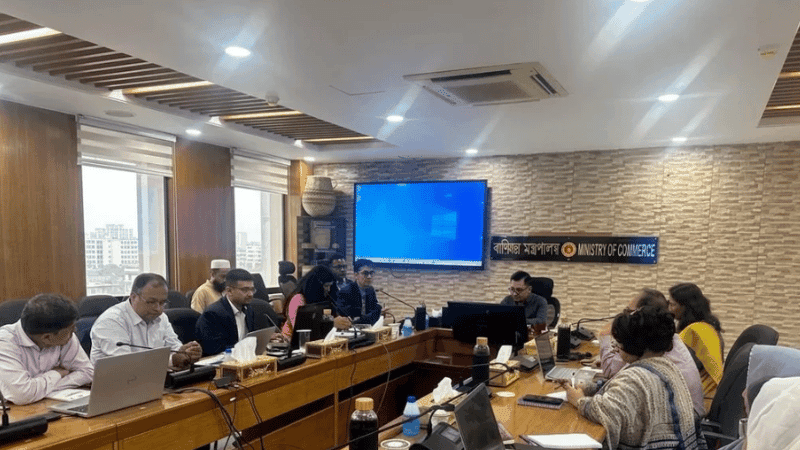

The Ministry of Commerce is building capacity to use Artificial Intelligence (AI) for analysing import-export data, monitoring market prices, and reviewing World Trade Organisation (WTO) agreements and Free Trade Agreements (FTAs). A five-day special training programme has also begun for officials to utilise AI in government policy formulation and decision-making.
Commerce Minister Khondkar Abdul Muktadir inaugurated the training programme at the ministry's conference room on Sunday afternoon. Ministry Public Relations Officer Kamal Hossain said 30 officials of the ministry are participating in the first batch of the training, which will run from August 9 to 13. The programme is jointly organised by UK International, the United Nations Development Programme (UNDP) and the Ministry of Commerce.
The training will cover strategies for using AI in trade management and policy formulation, as well as in preparing and analysing government documents, reviewing import-export data and analysing international trade agreements.
Speaking at the inaugural event, the Commerce Minister said the use of AI in government work can make administrative activities faster, more efficient and more data-driven. AI can play an important role, particularly in analysing import-export data, monitoring market conditions, demand and prices of goods, and assessing the potential impact of trade policies.
He believes this will enable faster decision-making as well as more effective services for businesses and the general public. However, the Commerce Minister emphasised the importance of ensuring data security, privacy, transparency and human oversight in the use of AI.
He said a modern and smart trade system must be built by ensuring maximum use of technology.
The training sessions will cover the basic concepts of generative AI and its use in trade, summarisation and analysis of government documents, and prompt engineering. Additionally, training will be provided on using AI to prepare letters, memorandums, speeches and press releases, analyse import-export and market data, and review supply chains.
Officials will also be taught strategies for applying AI in analysing WTO agreements, as well as Free Trade Agreements (FTAs) and Preferential Trade Agreements (PTAs). Discussions will also cover global trade policy, policy formulation and strategic use of AI in e-governance. The training will conclude on the final day with capstone projects and direct presentations.
UNDP Senior Economic Adviser Waise Pary said AI can make policy formulation and implementation easier and more efficient by quickly analysing vast amounts of information, documents and data. This will not only reduce the workload of officials but also help in analysing past data and experiences for future trade and industrial policy formulation.
However, he stressed ensuring human judgement, analysis and oversight rather than relying entirely on AI. He also mentioned future training sessions on trade-focused AI models.
Transformative Economic Policy Programme-2 Project Manager Maruf Azam also spoke at the event. Through this programme, funded by UNDP, initiatives have been taken to enhance AI-based skills of Ministry of Commerce officials and ensure effective use of technology in government decision-making and policy formulation.
Leave A Comment