
New garment workers’ pay scale to take effect in December: Wage board

A new wage structure for readymade garment workers will be finalised by December, with representatives of both workers and employers agreeing to the timeline. Under the new structure, workers are expected to receive increased wages from January.
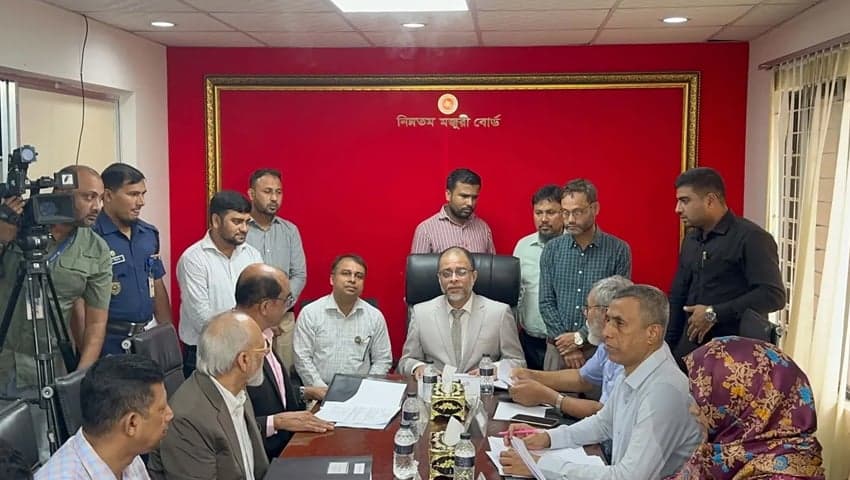
The chairman of the Minimum Wage Board, Syed Azad Subhani, and representatives of workers and employers disclosed the decision to journalists after the board’s first meeting at its office in Segunbagicha, Dhaka, on Wednesday, November 4.
The meeting began at 11am, with all six members, including the chairman, in attendance. Discussions focused on the ongoing protests by garment workers, their demand for higher wages and the need to finalise a new pay structure promptly.
After the meeting, Subhani said the board’s second meeting would be held next week. At that meeting, representatives of workers and employers will submit their respective demands and proposals in writing. The board will review those submissions and work to finalise its recommendations for a new wage structure as soon as possible.
He said the wage-setting process would not be allowed to drag on as it had in the past. The board would seek to reach a decision quickly, taking into account workers’ rightful entitlements and the overall condition of the industry.
Babul Akhtar, the workers’ representative on the board, said both sides had agreed to finalise the new wage structure by December. Accordingly, workers would receive salaries under the revised structure from January. He urged workers to return to their jobs rather than continue protests, as the government had taken the initiative to determine new wages. He also said maintaining production and ensuring a normal working environment in the industry were responsibilities shared by all.
ABM Shamsuddin, the employers’ representative, also confirmed that the new wage structure would be finalised by December. He said workers would receive wages at the revised rates from January.
Meanwhile, garment workers have been staging protests for several days in Mirpur, Gazipur and other industrial areas, demanding a minimum monthly wage of Tk 30,000. Demonstrations and road blockades have continued in various areas even after the formation of the wage board. Clashes and chases between workers and law enforcement agencies have also been reported in some places, disrupting production at several factories.
Although the first meeting reached an agreement on the timeline for finalising the new wage structure, the amount of the revised minimum wage has yet to be determined. Discussions on the figure are expected to advance after the board receives written proposals from both sides at its next meeting.
The government formed the six-member Minimum Wage Board on November 1 to revise wages for workers in the readymade garment industry. District and Sessions Judge Syed Azad Subhani is the chairman.
The other members are ABM Shamsuddin, director of the Bangladesh Garment Manufacturers and Exporters Association (BGMEA), and Asif Ayub, joint secretary-general of the Bangladesh Employers’ Federation, representing employers; Anwar Hossain, president of the Bangladesh Jatiyatabadi Sramik Dal, and Babul Akhtar, general secretary of the Bangladesh Garments and Industrial Workers Federation, representing workers. Dhaka University professor Mosleh Uddin Ahmed is the independent member.
Leave A Comment