
One child reported missing every 20 minutes; None knows how many return
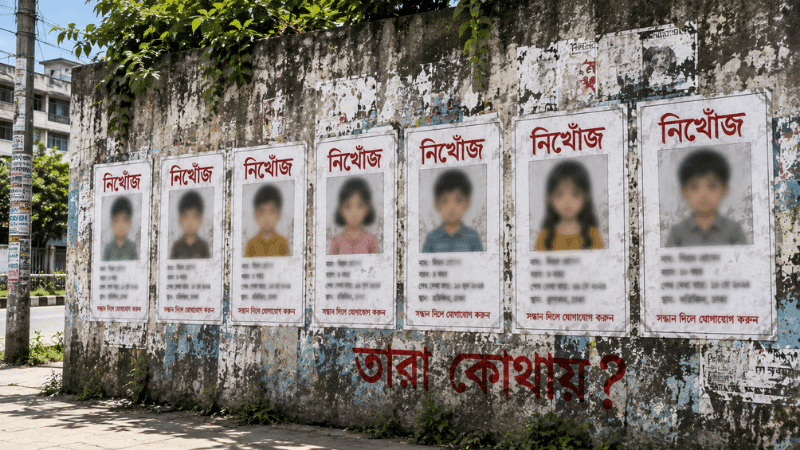

Various sources indicate that the rate of children going missing in Bangladesh is rising at an alarming pace. According to data held by the Police Headquarters, 15,917 cases were filed as general diaries (GDs) at police stations across the country over the seven months from January to July this year, following reports of children going missing. That amounts to an average of 2,274 GDs a month and more than 75 a day. In other words, a report of a missing child was filed at a police station every 20 to 21 minutes.
But among these thousands of cases, how many children were rescued, how many returned home on their own, how many GDs were closed, how many cases led to abduction charges, how many produced evidence of trafficking, and how many children remain missing? There is no regularly published, consolidated national statistic bringing together this information. As a result, it is impossible to establish the meaningful outcome of these cases. The question, therefore, is: what ultimately happened to these 15,917 cases, and where is the complete national record of their outcomes? The figures have also exposed a major weakness in Bangladesh's system for recording and tracking missing children.
Experts caution that the 15,917 GDs cannot be interpreted as meaning that 15,917 children are still missing. A child may go missing while playing, lose their way, leave home out of anger or go somewhere without their family's knowledge. In many cases, children are eventually found. The problem is that families often do not return to the police station to report that the child has come back, while police also do not have dedicated personnel to keep such records updated. Therefore, the fact that a missing-child GD remains on police records does not necessarily mean that the child is still missing.
Experts say an effective national information system should record at least seven distinct outcomes: rescued, returned home independently, found elsewhere, case registered for abduction, identified as a trafficking victim, deceased, and still missing. They argue that treating the figure of 15,917 as a direct measure of crime, abduction or trafficking would be misleading. At the same time, failing to track the outcome of these GDs represents a serious administrative gap.
A major reason for this gap is the lack of coordination among information held by different institutions. Unless police-station GDs, police investigations, inquiries by the Criminal Investigation Department (CID) or Police Bureau of Investigation (PBI), hospital and morgue records, and data held by private missing-child platforms are linked to the same case, the statistics remain little more than a count of GDs rather than a record of what actually happened to each child.
Taslim Huda Swapna, programme manager at the non-government organisation Nari Maitree, has expressed concern over this lack of coordination. Speaking to Views Bangladesh, she said immediate, practical measures were needed to prevent children from going missing. She suggested that specific projects could be developed around the emergency service 109, which addresses violence against women and children, or the dedicated child helpline 1098, so that anyone can seek assistance quickly. She also called for greater social awareness, expanded government campaigns and, where necessary, door-to-door awareness programmes to prevent the trend.
Taslim Huda Swapna believes people could also be kept alert to the issue of missing children through awareness content on social media and, if necessary, short daily bulletins. She said particular attention should be paid to children aged between 12 and 14, as field-level experience suggests that children in this age group face greater risks.
When contacted about the issue, Police Headquarters did not provide any specific data. Police, however, said that a system called MUN Alert was launched on January 13, 2026, to help identify and rescue missing and abducted children quickly. The system allows people to report cases around the clock and facilitates the rapid dissemination of information, including a child's photograph and last known location.
Additional Inspector General Md Sibgat Ullah said international research had shown that the first few hours after a child goes missing are the most critical, and that prompt action increases the chances of recovery.
He said the main objective of MUN Alert is to quickly disseminate information about missing or abducted children and to immediately verify the information received, assess the level of risk and issue an emergency alert when necessary. However, because the initiative has not yet been integrated with information held by individual police stations, the number of MUN Alert cases cannot be directly compared with the 15,917 GDs recorded by police.
Sibgat Ullah said there are plans to eventually integrate other police hotlines into the system to create a comprehensive and coordinated mechanism. The CID has also said that if there is a risk that a child has crossed an international border or has been trafficked, arrangements can be made to issue a Yellow Notice through Interpol.
Questions have also been raised about the practical implementation of MUN Alert. There have been allegations that, while information on a child's last known location, time and contact details is quickly published in some cases, subsequent updates do not always indicate whether the child has been found. In the case of six-year-old Yousuf Rafi of Narayanganj, for example, information stating that he had gone missing was published on June 29, but the relevant page still contains no information indicating that he has been found.
Child rights activists say publishing information about a missing child is not enough; the time and manner in which each case is resolved must also be recorded in the same system. They also believe that linking the system with relevant institutions, including the Department of Social Services, hospitals, morgues and law-enforcement agencies operating in border areas, would make it much easier to determine the whereabouts or latest status of a child after they go missing. Shamima Shawkat Lovely, founder of Naba Ananda, an organisation working with children, has also expressed concern over the lack of coordination.
Speaking to Views Bangladesh, Shamima Shawkat Lovely said a major factor behind the trend of children going missing was the deterioration of the law-and-order situation. “The level of security in different neighbourhoods is not what it should be. As a result, the risk that a child could face danger while outside the home or on the way back from school or a madrasa is now real,” she said.
She added that many mothers had personally approached her to express concern about their children. “They say they are afraid even to let their children out of sight. This anxiety is no longer confined to a particular family; a sense of unease and fear has developed throughout society,” she said. She believes the figures on missing children reflect that growing sense of insecurity.
Following the publication of the figures, many people on social media have alleged that the missing children are being abducted and sent abroad. Police, however, said there is no evidence so far of a direct link between these missing-child GDs and child trafficking. At the same time, police acknowledge that the possibility of trafficking cannot simply be ruled out in cases involving missing children.
A 2025 study by the United Nations Children's Fund (UNICEF) says Bangladesh serves simultaneously as a source, transit and destination country for trafficking in women and children. Poverty, climate-induced displacement, child marriage and unsafe migration, among other social and economic factors, increase children's vulnerability. The study also says that the number of children identified as trafficking victims and receiving assistance may be significantly lower than the actual scale of the problem.
A rapid assessment by the International Labour Organization (ILO) on the relationship between missing children and trafficking also provides important evidence. A review of 61 cases involving missing children identified in Patgram, Shibganj and Teknaf found that 61 per cent were boys and 39 per cent were girls. Sixty-seven per cent of the children had gone missing from their homes, while those aged between 13 and 18 accounted for 54 per cent. Nearly half of the children were found, while 10 children rescued in Teknaf were subsequently identified as victims of trafficking. Child rights activists, however, point out that this is not a national statistic and cannot be directly applied to the 15,917 GDs recorded by police. In their view, treating “missing” and “trafficking” as the same phenomenon would be wrong, just as failing to assess the possibility of trafficking in every missing-child case would be risky.
Information on unidentified bodies is another important element in determining the fate of missing children. If a missing child's body is later recovered but the identity cannot be established, and there is no automated system for matching the missing-child database with the database of unidentified bodies, the child's missing-person case could remain unresolved for years.
Experts therefore say that, alongside information such as a missing child's age, gender, photograph, physical characteristics, last known location and family contact details, information on unidentified bodies recovered from hospitals and morgues should also be maintained in a compatible format. They are calling for a national-level matching system, arguing that once a child goes missing, every subsequent outcome should be linked to the same case record—whether the child returns home, is rescued, is found elsewhere, is abducted, becomes a victim of trafficking or dies.
Only by documenting the outcome of every case will it be possible to determine how many children are actually going missing in Bangladesh, how many are returning home and how many disappear under circumstances that may point to more serious crimes.
Leave A Comment